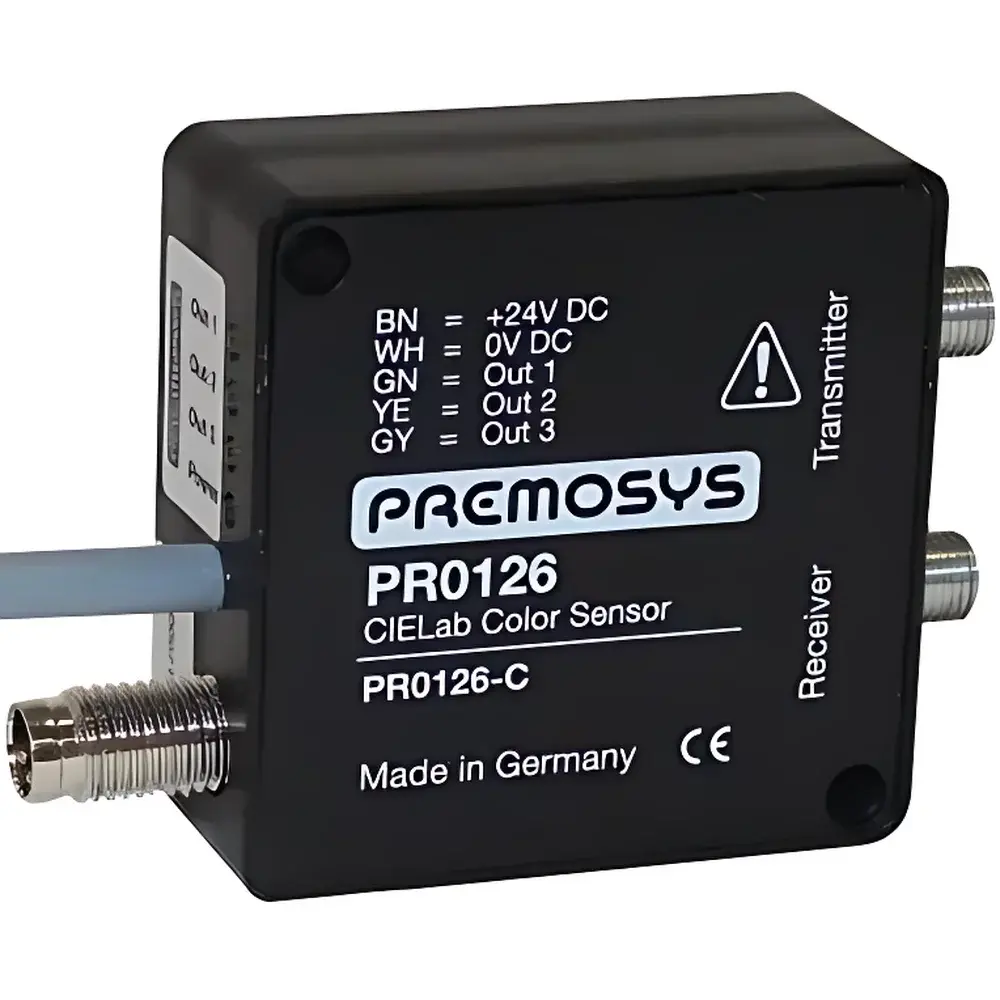
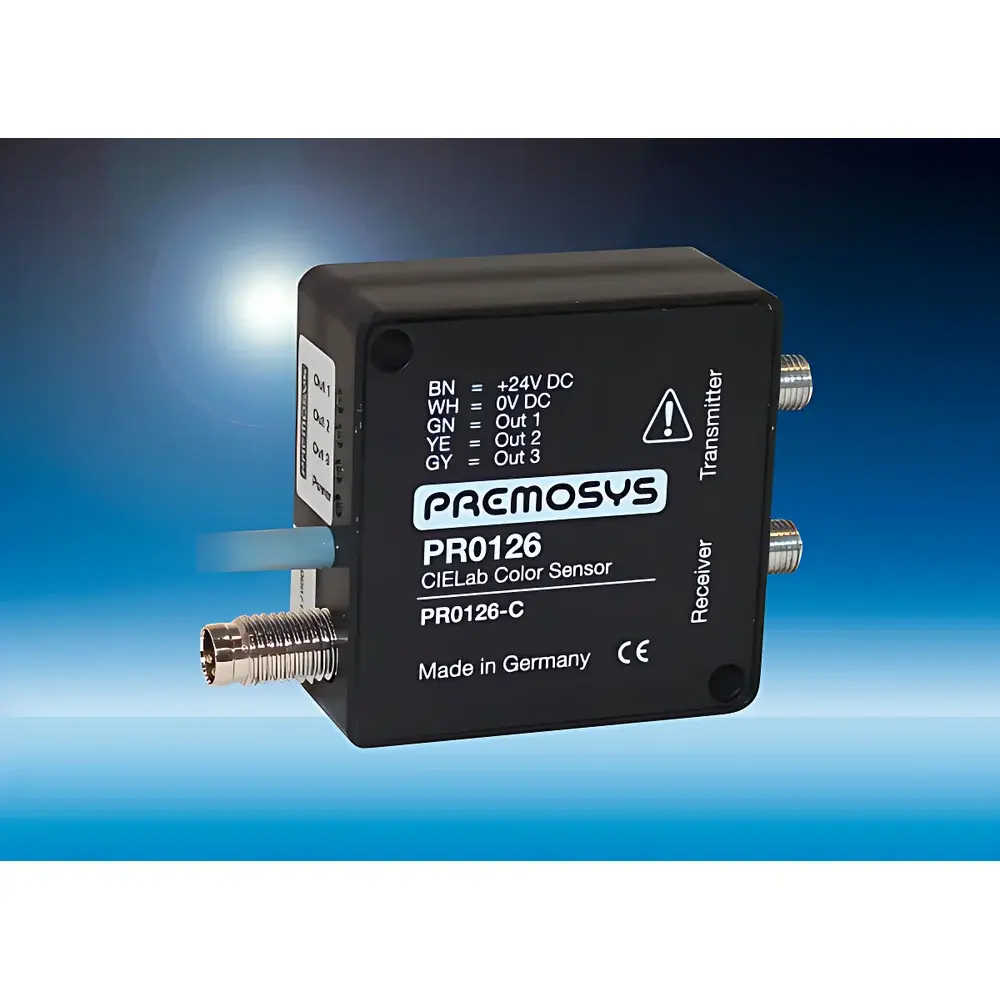
PREMOSYS PR126-C CIELAB Color Sensor
| Brand | PREMOSYS |
|---|---|
| Origin | Germany |
| Model | PR126-C |
| Light Source | White LED (5600 K) |
| Spectral Range | 400–700 nm |
| Output Interface | Serial and Parallel (simultaneous) |
| Power Supply | 24 V DC |
| Housing | Anodized Aluminum |
| Color Space | CIELAB (L*, a*, b*) |
| Chromatic Resolution | < 0.1 ΔE |
| Repeatability | < 0.5 ΔE |
| Inter-instrument Agreement | < 1% ΔE |
| Operating Temperature Range | 18–55 °C |
| Temperature Compensation | Automatic |
| Measurement Frequency | 500 Hz |
| Gain Calibration | Auto and User-Adjustable |
| Onboard Storage | Up to 7 product definitions (PR126-C7) or 4 (PR126-C4) with background operation |
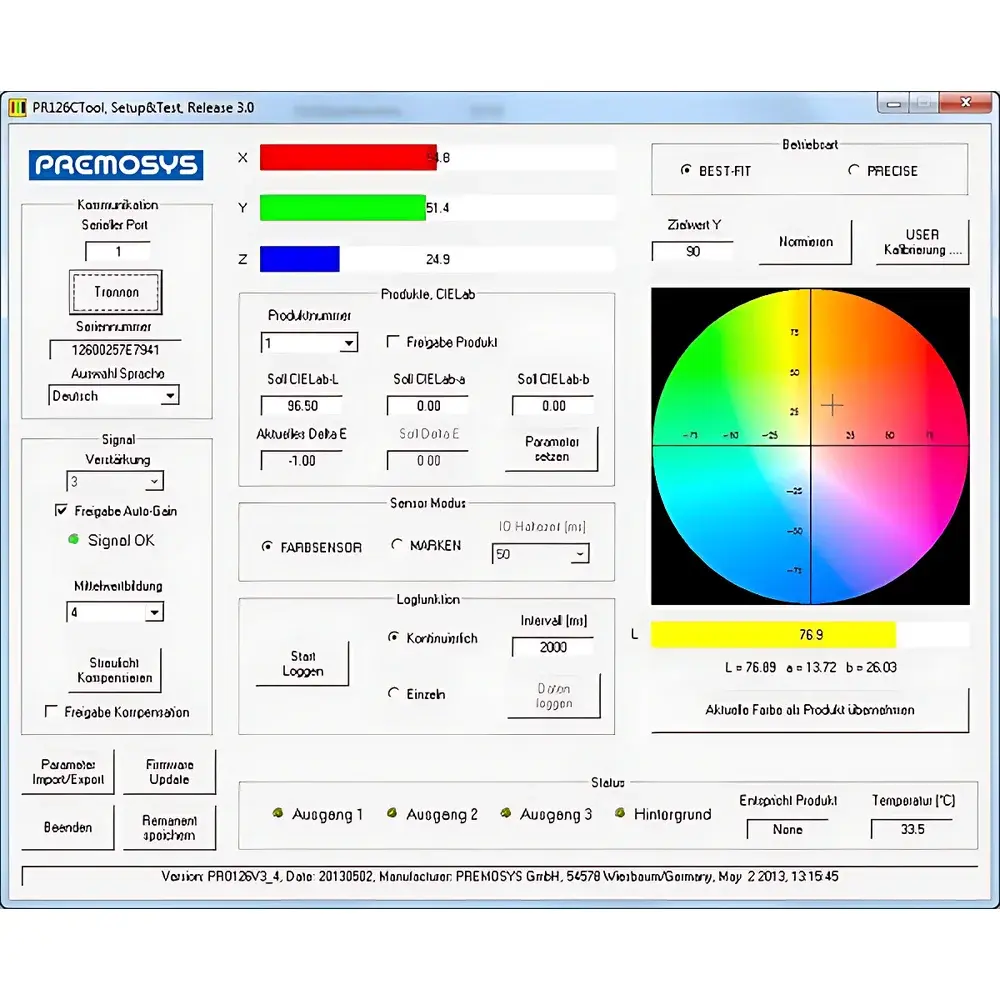
| Software | Multilingual configuration and ΔE calculation suite |
| Compliance | Designed for industrial QA/QC in regulated environments (supports GLP/GMP-aligned documentation workflows) |
Overview
The PREMOSYS PR126-C is a high-precision, industrial-grade CIELAB color sensor engineered for objective, repeatable color assessment under demanding production and laboratory conditions. Based on tristimulus colorimetry principles, it captures spectral reflectance data across the visible spectrum (400–700 nm) using a calibrated white LED illuminant (5600 K), then computes full CIELAB coordinates (L*, a*, b*) in real time. Unlike sequential RGB or filter-wheel-based systems, the PR126-C employs parallel analog signal acquisition across all three chromatic channels—enabling simultaneous sampling that minimizes temporal drift and suppresses interference from ambient light fluctuations, conveyor vibration, or thermal transients. Its optical architecture is optimized for robustness in continuous operation, with integrated temperature compensation ensuring stable ΔE calculations across an operational range of 18–55 °C. The sensor delivers metrological-grade color fidelity without requiring external spectrophotometers or PC-dependent processing, making it suitable for embedded integration into automated inspection stations, inline sorting systems, and closed-loop process control loops.
Key Features
- Real-time CIELAB output (L*, a*, b*) with automatic ΔE00 and ΔEab computation
- Parallel triple-channel photodiode array with synchronous ADC sampling at 500 Hz
- Onboard non-volatile memory supporting up to seven user-defined product color tolerances (PR126-C7 variant) or four (PR126-C4), enabling multi-product verification without host intervention
- Auto-gain calibration with manual override for sensitivity adjustment across material gloss, texture, and substrate variability
- Integrated thermal compensation algorithm maintaining inter-instrument agreement < 1% ΔE across units—critical for fleet-wide deployment in multinational manufacturing facilities
- Industrial-grade anodized aluminum housing rated for IP65-equivalent ingress protection (when properly mounted)
- Dual interface support: RS-485/RS-232 serial communication plus TTL-level parallel I/O for direct PLC or vision system handshake
Sample Compatibility & Compliance
The PR126-C is validated for use with opaque, translucent, and semi-gloss surfaces—including painted automotive body panels, injection-molded polymer components, pharmaceutical tablets, food packaging films, and bioreactor culture media. It does not require sample contact or standardized geometry (e.g., 45°/0° or d/8°), instead relying on consistent working distance (recommended 15–30 mm) and uniform illumination field (Ø8 mm spot size). While not a certified reference instrument per ISO 11664 or CIE S 014, its traceability path aligns with NIST-traceable color standards via factory calibration against ceramic tile references. The device supports audit-ready operation in regulated industries: onboard timestamped measurement logs, configurable pass/fail flags, and deterministic response timing meet foundational requirements for FDA 21 CFR Part 11–aligned electronic records when paired with compliant host software.
Software & Data Management
PREMOSYS provides a multilingual Windows-based configuration utility supporting English, German, Japanese, and Chinese. The software enables full setup of tolerance ellipsoids in CIELAB space, dynamic gain profiling, firmware updates, and export of CSV-formatted measurement histories with metadata (timestamp, product ID, L*a*b* values, ΔE, pass/fail status). All computations—including chromatic adaptation (D65 illuminant), CIEDE2000 weighting, and temperature-compensated tristimulus integration—are performed internally; the host system receives only final colorimetric results. No proprietary drivers are required—the serial interface complies with standard Modbus RTU protocol for seamless SCADA and MES integration.
Applications
- Automotive: Paint batch verification, interior trim matching, headlight lens tint consistency
- Pharmaceuticals: Tablet coating uniformity monitoring, blister pack foil color validation per USP
- F&B: Beverage fill-level indicator color stability, label print registration accuracy, dairy product whiteness trending
- Electronics: PCB solder mask hue verification, OLED display panel binning support
- Biotechnology: Cell culture media colorimetric pH estimation (phenol red-based), bioreactor turbidity correlation
FAQ
Does the PR126-C require annual recalibration?
No scheduled recalibration is mandated; however, users performing GxP-compliant operations should verify performance quarterly using certified color tiles (e.g., BCRA Series II) per internal SOP.
Can the sensor distinguish between metamerism?
It cannot resolve spectral metamers—its tristimulus output reflects observer-matched CIE 1931 2° standard observer response only. For metameric analysis, a full-spectrum spectrophotometer is required.
Is the 24 V DC supply isolated?
Yes—the power input features reinforced galvanic isolation rated to 1.5 kVAC, meeting IEC 61000-4-5 surge immunity requirements for factory-floor deployment.
What is the maximum cable length for serial communication?
Up to 1,200 meters using shielded twisted-pair RS-485 cabling with proper termination and grounding.
How is ΔE calculated by default?
The sensor computes both ΔEab (CIE 1976) and ΔE00 (CIEDE2000); the active formula is selectable via software configuration—ΔE00 is recommended for perceptual uniformity in quality-critical applications.