
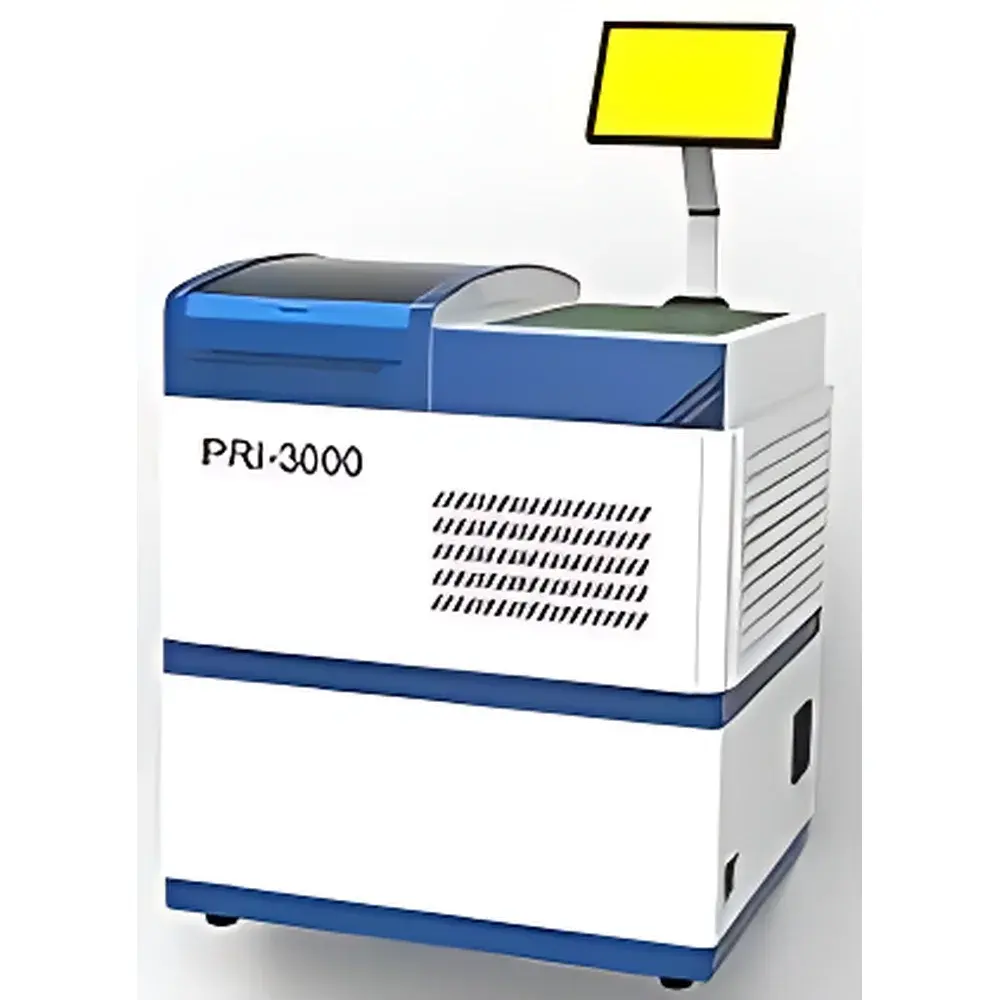
Pri-eco PRI-3000 Automated Vacuum Extraction System for Stable Isotope Analysis of Water
| Brand | Pri-eco |
|---|---|
| Origin | Beijing, China |
| Manufacturer | Yes |
| Country of Origin | China |
| Model | PRI-3000 |
| Price Range | USD 42,000–70,000 |
| Vacuum Channels | 15 |
| Ultimate Vacuum Pressure | 2 Pa |
| Pressure Measurement Range | 1–1000 Pa (Resolution: 0.1 Pa) |
| Heating Temperature Range | Ambient to 150 °C |
| Cryogenic Cooling | Integrated Compressor-Based System, Down to −100 °C |
| Sample Tube Volume | 5–15 mL |
| System Leak Rate | ≤1 Pa/min |
| Vacuum Pump Flow Rate | 5 L/s |
| Extraction Throughput | Up to 120 Samples/Day |
| Extraction Efficiency | >98% |
| Water Recovery Rate | 98–100% |
| Dimensions (W×D×H) | 100 × 60 × 95 cm |
| Sample Tube Interface | Flanged Borosilicate Glass Assembly |
Overview
The Pri-eco PRI-3000 Automated Vacuum Extraction System is an engineered solution for high-fidelity, reproducible extraction of liquid and vapor-phase water from solid biological and environmental matrices—including plant tissues, soils, sediments, and animal tissues—prior to stable hydrogen and oxygen isotope ratio analysis (δ²H, δ¹⁸O). It operates on the principle of cryogenic vacuum distillation under controlled thermal and pressure gradients: samples are heated under high vacuum while water vapor is continuously trapped and condensed in a sub-zero cold trap (−100 °C), minimizing isotopic fractionation and ensuring quantitative recovery. Unlike conventional methods such as low-temperature online distillation (requiring liquid nitrogen handling and fragile glassware) or azeotropic distillation (relying on toxic solvents like toluene or xylene), the PRI-3000 eliminates operator-dependent variables through full automation, sealed borosilicate glass pathways, and real-time vacuum monitoring. Its design directly addresses throughput bottlenecks in modern isotope hydrology labs where high-precision IRMS or laser-based isotope analyzers demand consistent, contamination-free water standards and extracts.
Key Features
- 15-channel parallel vacuum extraction module with individually actuated vacuum gate valves—enabling independent control, staggered start times, and failure isolation per sample position.
- Integrated compressor-driven cryocooler delivering stable −100 °C cold trap temperature without consumables or external coolant supply.
- High-stability resistive heating block (ambient to 150 °C) with ±0.5 °C temperature uniformity across all 15 positions; optimized thermal ramp profiles prevent thermal shock and isotopic exchange.
- Digital vacuum management system featuring a calibrated capacitance manometer (1–1000 Pa range, 0.1 Pa resolution) and active leak-rate monitoring (≤1 Pa/min compliance verified).
- Touch-enabled LCD interface with pre-programmed extraction protocols (e.g., “Leaf Tissue”, “Mineral Soil”, “Organic Peat”) and customizable ramp/hold sequences.
- Borosilicate glass vacuum manifold with flanged connections—chemically inert, optically transparent for visual process verification, and compatible with standard 5–15 mL sample tubes and 150 × 10 mm collection vials.
- Robust cabinet-style chassis (100 × 60 × 95 cm) with internal cable routing, vibration-damped mounting, and front-access service panels for routine maintenance.
Sample Compatibility & Compliance
The PRI-3000 accommodates heterogeneous sample types without preprocessing: intact leaves, root segments, homogenized soil cores (air-dried or field-moist), moss, lichen, wood xylem sections, and freeze-dried tissue powders. All wetted surfaces are inert borosilicate glass or electropolished stainless steel—eliminating memory effects and adsorption artifacts. The system meets core requirements for GLP-compliant isotope laboratories: full audit trail logging (time-stamped vacuum curves, temperature profiles, valve actuation events), password-protected method editing, and electronic signature support for protocol validation. While not certified to ISO/IEC 17025 out-of-the-box, its operational parameters align with ASTM D4129 (water content in soils) and USP (loss on drying), and its extraction fidelity supports data traceability under FDA 21 CFR Part 11 when paired with validated LIMS integration.
Software & Data Management
The embedded controller records all critical process parameters at 1 Hz resolution: absolute pressure, cold trap temperature, heating block setpoint and actual, valve status, and elapsed time. Exportable CSV logs include metadata headers (operator ID, sample ID, batch number, method name) and are timestamped to UTC. Optional Ethernet or USB-C connectivity enables remote monitoring via secure HTTP API and direct ingestion into laboratory informatics platforms (e.g., LabWare LIMS, Thermo Fisher SampleManager). No proprietary software license is required for basic operation; advanced analytics (e.g., kinetic modeling of extraction curves, outlier detection based on pressure decay slope) are available as optional firmware modules compliant with IEC 62304 Class B safety standards.
Applications
- Partitioning of evapotranspiration fluxes (soil evaporation vs. plant transpiration) using dual-isotope (δ²H–δ¹⁸O) mass balance models.
- Quantifying plant water uptake depth and source partitioning in ecohydrological studies (e.g., groundwater vs. rainfall infiltration signals).
- Validating soil water movement models by extracting matrix-bound water from unsaturated zone cores with minimal disturbance.
- Calibrating laser spectrometers via preparation of isotopically characterized water standards from natural materials.
- Studying xylem embolism dynamics through comparative extraction of water from embolized vs. functional conduits.
- Supporting paleoclimate reconstructions by isolating hydration water from speleothems or fossil cellulose prior to pyrolysis-IRMS.
FAQ
What sample types are validated for use with the PRI-3000?
Plant leaves, stems, roots, soil (mineral and organic), sediments, moss, lichen, and freeze-dried animal tissues have been experimentally validated. High-lipid or high-volatile-content samples (e.g., fresh fruits, resins) require method optimization and are not covered under standard warranty.
Does the system meet regulatory requirements for clinical or pharmaceutical isotope testing?
It complies with foundational instrumentation controls in 21 CFR Part 11 when deployed with documented SOPs and access-controlled user accounts; however, final assay validation remains the responsibility of the end-user laboratory.
Can the cold trap temperature be adjusted above −100 °C?
Yes—the cooling setpoint is programmable between −100 °C and +20 °C in 1 °C increments to accommodate different condensation targets (e.g., retaining volatile organics during co-extraction studies).
Is third-party calibration of the vacuum sensor included?
A NIST-traceable calibration certificate for the capacitance manometer is supplied with each unit; annual recalibration is recommended and supported via Pri-eco’s global service network.
What maintenance intervals are specified for the vacuum pump?
The dry scroll pump requires oil-free operation and scheduled inspection every 2,000 hours; filter replacement and performance verification are guided by onboard diagnostics and logged vacuum recovery times.



