
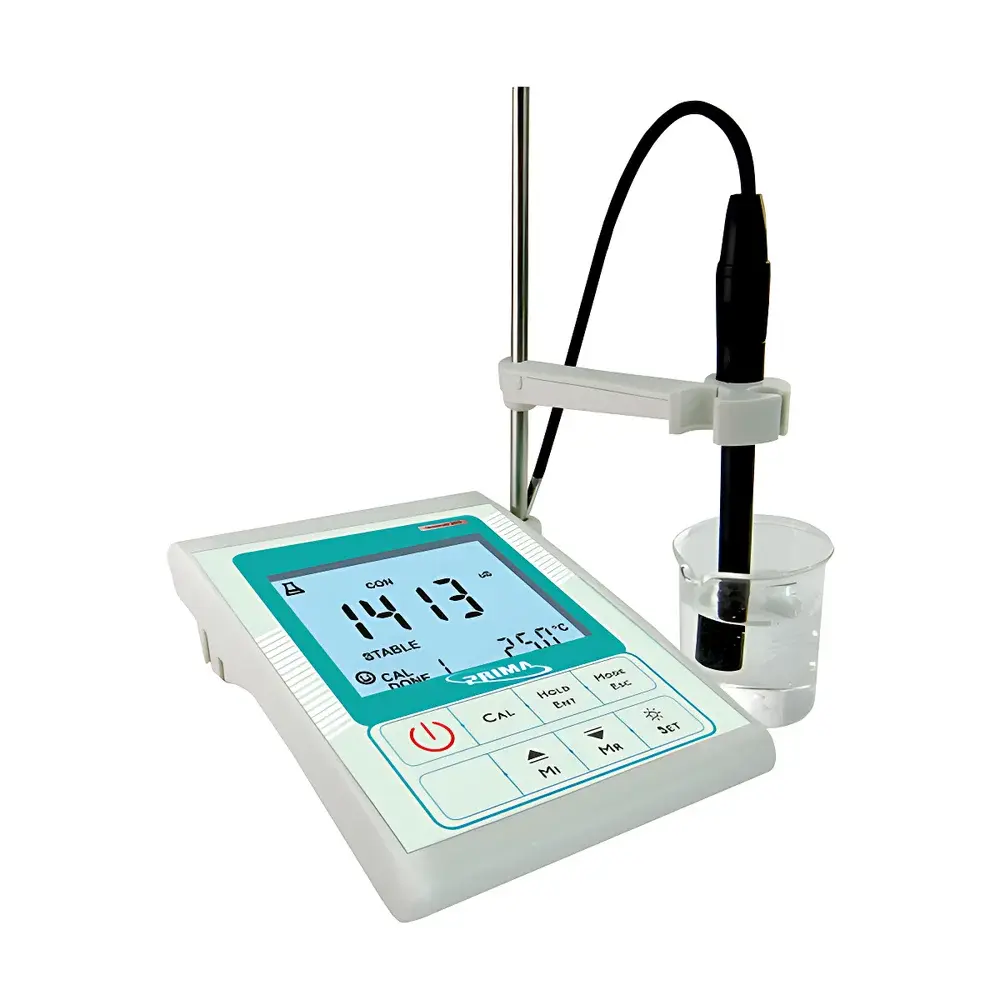
PRIMA innoLab 20C Benchtop Conductivity / TDS / Salinity Meter
| Brand | PRIMA |
|---|---|
| Origin | Taiwan |
| Model | innoLab 20C |
| Instrument Type | Benchtop Water Quality Analyzer |
| Measured Parameters | Conductivity, TDS, Salinity |
| Conductivity Range | 0–5.000 µS/cm, 0–50.00 µS/cm, 0–500.0 µS/cm, 0–5000 µS/cm, 0–50.00 mS/cm, 0–500.0 mS/cm |
| TDS Range | 0–500 ppt |
| Salinity Range | 0–325 ppt |
| Conductivity Resolution | 0.001–1 µS/cm and 0.01–0.1 mS/cm |
| Conductivity Accuracy | ±1% F.S. |
| Resistivity Range | 0–18.30 MΩ·cm |
| Resistivity Resolution | 0.01 MΩ·cm |
| Temperature Range | −5.0–120.0 °C |
| Temperature Accuracy | ±0.3 °C |
| Auto Temperature Compensation (ATC) | Yes |
| Reference Temp | 15.0–30.0 °C (default 25.0 °C) |
| Temp. Coefficient | 0.00–9.99% (default 2.00%) |
| TDS Factor | 0.40–1.00 (default 0.50) |
| Salinity Factor | 0.65 |
| Cell Constant Options | 0.01, 0.1, 1.0, 10.0 cm⁻¹ |
| Interface | USB |
| Power Supply | 100–240 VAC |
| IP Rating | IP54 |
| Dimensions | 150 × 194 × 56 mm |
| Weight | 1.0 kg |
| Data Storage | 100 measurement records |
Overview
The PRIMA innoLab 20C is a precision-engineered benchtop conductivity, total dissolved solids (TDS), and salinity meter designed for routine and regulatory-compliant water quality assessment in laboratory, industrial process, and environmental monitoring settings. It operates on the principle of two-electrode conductometric measurement—applying an alternating current across a graphite electrode pair to determine solution conductivity based on Ohm’s law and cell geometry. The instrument automatically converts conductivity readings into TDS (using user-selectable linear conversion factors) and practical salinity (based on the PSS-78 standard approximation). Its dual-range architecture supports high-resolution measurements from ultrapure water (down to 0.001 µS/cm) through highly conductive brines (up to 500.0 mS/cm), making it suitable for applications ranging from deionized water validation to wastewater effluent characterization.
Key Features
- Benchtop design with integrated rechargeable lithium-ion battery—enabling uninterrupted operation during temporary power loss or mobile deployment within lab environments.
- High-contrast backlit LCD display with 120° wide viewing angle for ergonomic readability under varied lighting conditions.
- Real-time electrode performance indicator and on-screen calibration point verification to ensure measurement traceability and sensor health awareness.
- Configurable temperature compensation (ATC) with adjustable reference temperature (15.0–30.0 °C) and linear temperature coefficient (0.00–9.99%), supporting compliance with ASTM D1125 and ISO 7888 methodologies.
- Multi-level resolution switching: automatic or manual selection of 0.001 µS/cm (for low-conductivity ultrapure water) up to 0.1 mS/cm (for high-salinity samples), preserving significant figures without manual range shifting.
- USB interface compliant with CDC/ACM class protocols—enabling direct data export to Windows/Linux systems without proprietary drivers; compatible with spreadsheet and LIMS ingestion workflows.
- IP54-rated enclosure ensures protection against dust ingress and water splashes during daily lab use.
Sample Compatibility & Compliance
The innoLab 20C accommodates aqueous samples across diverse matrices—including potable water, cooling tower fluids, boiler feedwater, aquaculture ponds, municipal wastewater, and industrial process streams. It supports interchangeable electrodes with standardized cell constants (0.01, 0.1, 1.0, and 10.0 cm⁻¹), enabling optimal sensitivity matching for specific sample conductivities per ISO 7888 Annex B recommendations. The device meets general requirements for GLP-compliant data acquisition: timestamped storage of 100 measurement records, visible calibration history, and auditable parameter configuration (e.g., TDS factor, salinity coefficient, reference temperature). While not FDA 21 CFR Part 11–certified out-of-the-box, its deterministic calibration logging and non-editable memory structure support audit readiness in regulated QC/QA environments.
Software & Data Management
Data transfer occurs via native USB virtual COM port—requiring no additional software installation. Exported records include date/time stamp, measured parameter value, unit, temperature, electrode constant, and active compensation settings. Users may import CSV-formatted outputs directly into Excel, LabArchives, or validated LIMS platforms. The instrument retains all stored entries during power cycling, and battery status is continuously monitored with low-power warning indication. Firmware updates (if released) are delivered as signed binary files via PRIMA’s technical support portal—ensuring version control and integrity verification.
Applications
- Validation of reverse osmosis and deionization system performance through resistivity monitoring (0–18.30 MΩ·cm).
- Routine surveillance of industrial cooling circuits for scaling potential and corrosion risk assessment.
- Environmental field labs performing rapid screening of surface water conductivity trends aligned with EPA Method 120.1.
- Food & beverage production lines verifying rinse water purity prior to equipment sanitization.
- Educational laboratories teaching fundamental electrochemical principles of ionic conduction and temperature dependence.
- Aquaculture facilities maintaining species-specific salinity setpoints using calibrated PSS-78–derived calculations.
FAQ
Does the innoLab 20C support automatic electrode recognition?
No—it requires manual entry of the cell constant corresponding to the connected electrode.
Can the device measure resistivity directly without calculation?
Yes—resistivity is displayed in real time as a derived parameter (0–18.30 MΩ·cm) alongside conductivity.
Is the USB interface compatible with macOS?
Yes—when used with standard CDC/ACM serial emulation drivers available natively in macOS 12+.
What is the battery life under continuous operation?
Approximately 12 hours at room temperature with backlight enabled; battery recharges fully in ≤4 hours via included AC adapter.
How often should calibration be performed?
Daily for critical applications; otherwise, before each analytical session or when drift exceeds ±0.5% of full scale—per ISO/IEC 17025 clause 7.7.1 guidance.







