
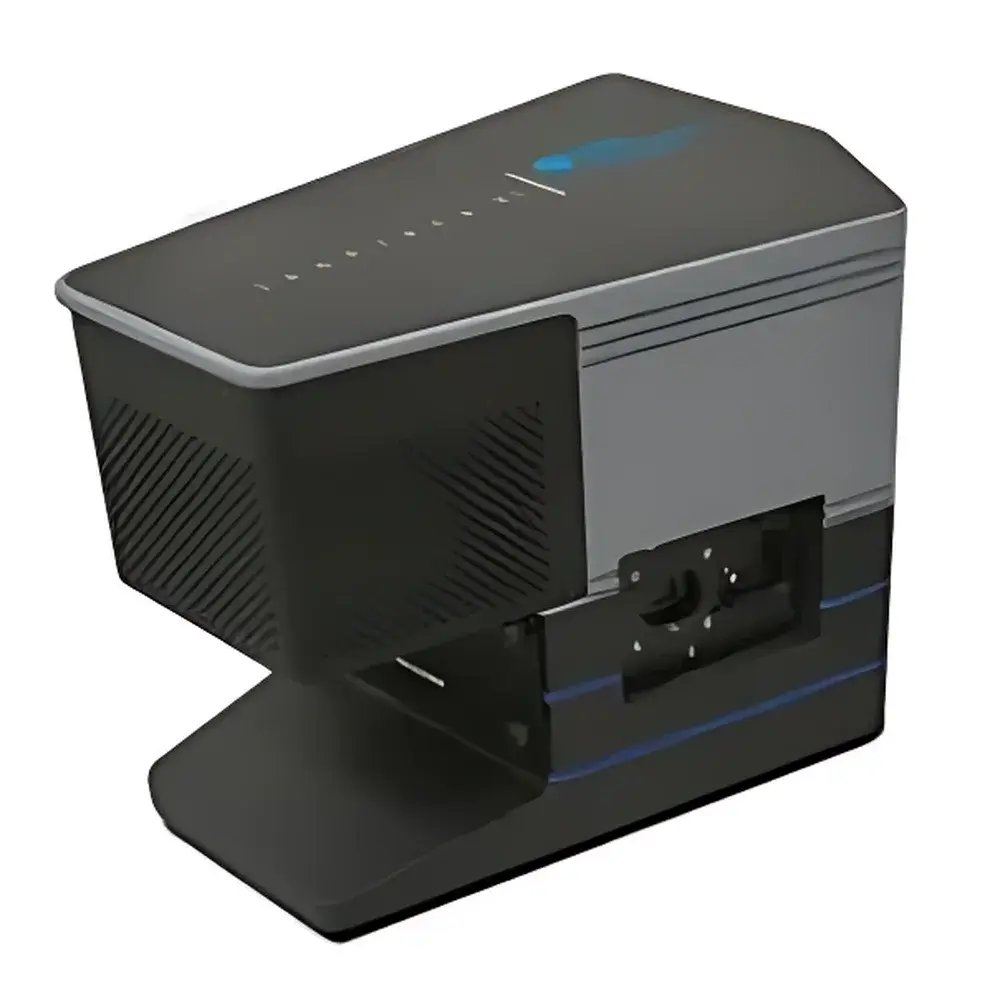
Princeton Instruments IsoPlane 81 Imaging Spectrograph
| Brand | Princeton Instruments (Teledyne) |
|---|---|
| Origin | USA |
| Model | IsoPlane81-BRX/BX-VR, IsoPlane81-BRX-UR |
| Spectral Range | 200–1100 nm |
| Focal Length | 80.0 mm |
| f-number | f/4 |
| Spectral Resolution (FWHM) | 0.1 nm |
| Slit Width | 10–500 µm |
| Sensor Format | 1024 × 256 |
| Cooling | Thermoelectric to –45 °C |
| Peak Quantum Efficiency | >95% (up to >97% with eXcelon™) |
| Interface | USB 3.0 |
| Grating Options | 150–4320 g/mm |
| Optical Coating | Protected silver |
Overview
The Princeton Instruments IsoPlane 81 Imaging Spectrograph is a high-performance, all-reflective, zero-aberration spectrograph engineered for demanding scientific applications requiring simultaneous spectral fidelity and spatial integrity across the UV-NIR spectrum (200–1100 nm). Unlike conventional Czerny-Turner or crossed-beam spectrographs, the IsoPlane 81 employs a patented off-axis parabolic mirror-based optical architecture that eliminates coma, astigmatism, and field curvature—achieving diffraction-limited imaging performance across the entire focal plane. This intrinsic aplanatic design ensures symmetric, Gaussian-like spectral line profiles at all wavelengths and grating angles, directly translating into superior peak resolution, enhanced signal-to-noise ratio (SNR), and quantitative accuracy in both spectroscopic and hyperspectral imaging modes. The instrument serves as a core component in time-resolved photoluminescence, micro-Raman mapping, laser-induced breakdown spectroscopy (LIBS), and synchrotron beamline experiments where spectral calibration stability, pixel-level radiometric consistency, and minimal stray light are non-negotiable.
Key Features
- Zero-aberration optical design delivering diffraction-limited imaging performance across the full 1024 × 256-pixel focal plane—eliminating wavelength-dependent peak asymmetry and enabling rigorous quantitative spectral deconvolution.
- Back-illuminated, deep-depletion frame-transfer CCD sensors with eXcelon™ technology: models include UV-enhanced (200–1100 nm) and NIR-optimized (>97% peak QE at 900 nm) variants, supporting both high-sensitivity and long-exposure applications.
- Integrated thermoelectric cooling to –45 °C, reducing dark current by >99% compared to uncooled operation—critical for low-light, extended-integration measurements compliant with ASTM E131 and ISO/IEC 17025 traceability requirements.
- Modular, pre-aligned optical ecosystem: interchangeable slits (10–500 µm width), motorized grating turrets, fiber-coupled input ports, and laser excitation interfaces enable rapid reconfiguration without realignment—supporting absorption, transmission, fluorescence, and Raman modalities under a single platform.
- High-speed data acquisition: USB 3.0 interface supports full-frame readout at 34 fps and spectral line rates exceeding 1 kHz (with 10-line binning), facilitating microsecond-scale kinetic spectroscopy and pump-probe experiments.
- Factory spectral calibration traceable to NIST-standard emission lines (Hg, Ne, Ar), with optional on-board wavelength and intensity calibration modules for GLP/GMP environments requiring audit-ready documentation per FDA 21 CFR Part 11.
Sample Compatibility & Compliance
The IsoPlane 81 accommodates diverse sample geometries via flexible input coupling—including free-space beams, multimode optical fibers (core diameters 50–600 µm), and microscope-integrated configurations. Its 3.3 mm slit height enables efficient light collection from extended sources such as plasma plumes, luminescent thin films, or biological tissue sections. All models comply with IEC 61326-1 (EMC for laboratory equipment) and UL 61010-1 safety standards. The sensor’s deep-depletion architecture ensures linear response over 4–5 orders of magnitude (per ISO 15739:2013), while the absence of refractive elements eliminates chromatic dispersion artifacts—making it suitable for certified reference material (CRM) analysis under ISO Guide 35 and USP spectroscopic validation protocols.
Software & Data Management
Controlled via Princeton Instruments’ LightField® software (v6.5+), the IsoPlane 81 supports fully automated experiment sequencing, hardware-synchronized triggering, and real-time spectral image stacking. LightField implements built-in spectral calibration correction algorithms, pixel-response non-uniformity (PRNU) compensation, and dark-frame subtraction routines compliant with ISO/IEC 17025 clause 7.7 (uncertainty estimation). Raw data export is available in HDF5 and FITS formats—enabling direct ingestion into MATLAB, Python (via astropy.io.fits or h5py), and third-party chemometric platforms. Audit trails, user access logs, and electronic signatures satisfy FDA 21 CFR Part 11 requirements for regulated laboratories conducting QC/QA in pharmaceutical, materials science, or environmental testing.
Applications
- Time-resolved photoluminescence (TRPL): Microsecond kinetics acquisition using frame-transfer mode, with temporal gating synchronized to pulsed lasers (e.g., Ti:Sapphire, OPOs).
- Hyperspectral Raman imaging: Diffraction-limited spatial resolution coupled with sub-0.1 nm spectral fidelity enables unambiguous identification of polymorphic phases in pharmaceutical APIs.
- Synchrotron and FEL beamline diagnostics: Radiation-hardened optics and vacuum-compatible flange options (CF-35/CF-63) support in-situ XUV/VUV spectral monitoring.
- Plasma diagnostics: Simultaneous multi-line intensity ratio analysis of atomic/ionic emission spectra (e.g., O I 777 nm, N II 500 nm) for electron temperature and density determination per ASTM D7277.
- Quantum dot and 2D material characterization: High-contrast excitonic peak separation in monolayer MoS₂ or perovskite nanocrystals under ambient or cryogenic conditions.
FAQ
What distinguishes the IsoPlane 81 from traditional Czerny-Turner spectrographs?
The IsoPlane 81 uses an all-reflective, off-axis parabolic optical train eliminating refractive elements and associated chromatic aberrations—delivering uniform spectral resolution and intensity response across the full detector array without software-based correction.
Can the IsoPlane 81 be integrated into a vacuum or UHV environment?
Yes—select models offer CF-flanged versions rated for ≤10⁻⁹ mbar; custom vacuum-compatible sensor windows and feedthroughs are available upon request.
Is spectral recalibration required after changing gratings or slits?
No—pre-aligned modular components maintain factory-calibrated wavelength accuracy within ±0.02 nm RMS across all configurations.
Does the system support external trigger synchronization for pump-probe experiments?
Yes—TTL-compatible input/output ports enable hardware-level synchronization with lasers, delay generators, and shutter controllers at sub-microsecond jitter.
How is detector linearity validated for quantitative applications?
Each unit ships with a NIST-traceable linearity certificate (ISO 15739:2013 compliant), verified via neutral-density step wedge measurements across 10 decades of photon flux.





