
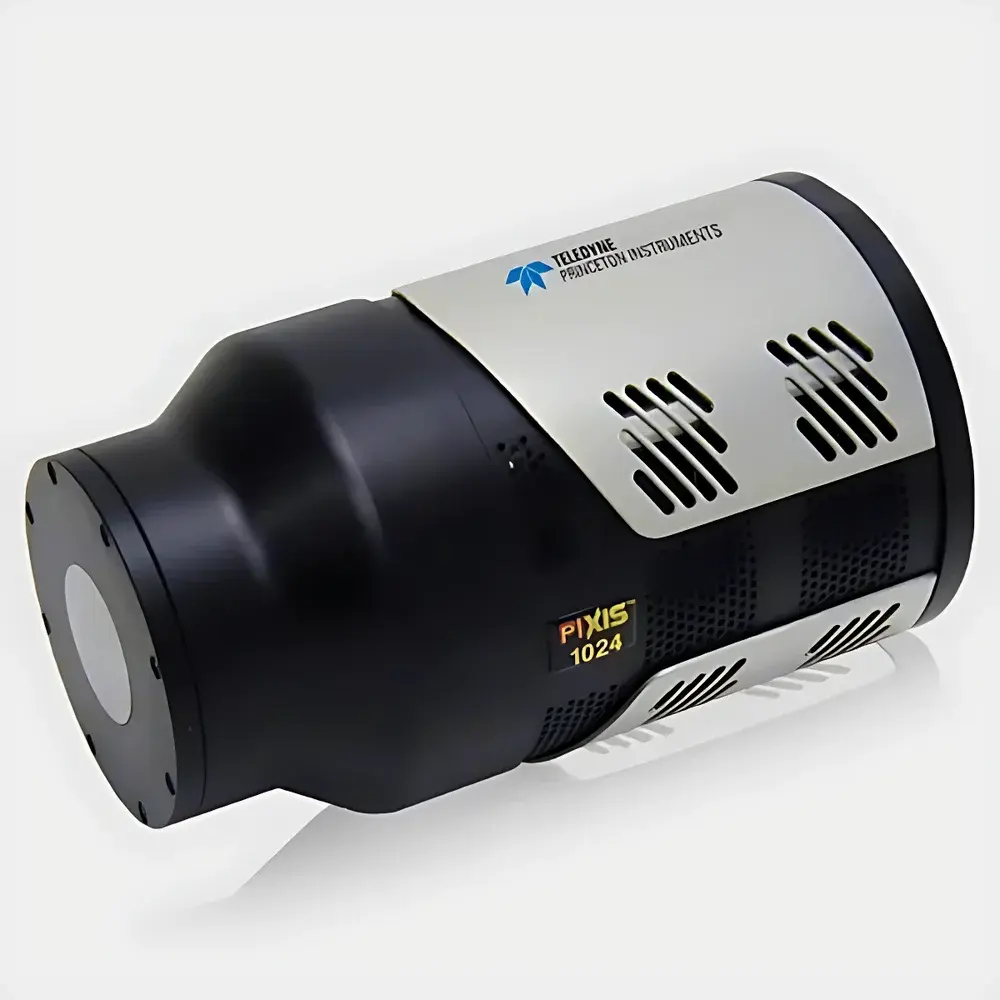
Princeton Instruments PIXIS-XF Low-Noise Indirect-Detection X-Ray Camera
| Brand | Princeton Instruments |
|---|---|
| Origin | Shanghai, China (Manufactured under OEM partnership with auniontech) |
| Model | PIXIS-XF |
| Detection Principle | Indirect detection via scintillator + fiber-optic coupling |
| X-ray Energy Range | 3–20 keV |
| Readout Noise | <3 e⁻ rms (high-sensitivity amplifier mode) |
| Dark Current | 0.035 e⁻/pixel/sec @ −40°C |
| Cooling | Thermoelectric (air or liquid) |
| Interface | USB 2.0 |
| Software Support | LightField v7+, PICAM SDK, LabVIEW® and MATLAB® integration |
| Compliance | ASTM E1444, ISO 17636-2, FDA 21 CFR Part 11 (audit trail enabled in LightField) |
Overview
The Princeton Instruments PIXIS-XF is a scientific-grade, low-noise, indirect-detection X-ray camera engineered for high-fidelity imaging across the soft-to-hard X-ray spectrum (3–20 keV). Unlike direct-detection sensors, the PIXIS-XF employs a scintillator-based conversion architecture: incident X-rays are first absorbed by a replaceable phosphor screen (e.g., Gd₂O₂S:Tb, CsI:Tl, or custom thin-film scintillators), generating visible photons that are then coupled via a high-transmission fiber-optic faceplate into a back-illuminated, deep-depletion CCD sensor. This optical isolation ensures minimal charge diffusion and preserves spatial resolution while enabling energy-tailored sensitivity. The integrated thermoelectric cooling system stabilizes the sensor at −40°C, suppressing dark current to 0.035 e⁻/pixel/sec — critical for long-exposure applications such as micro-CT reconstruction, synchrotron beamline imaging, and high-resolution industrial NDT. Its vacuum-compatible mechanical design extends the fiber-optic panel beyond the sensor vacuum envelope, allowing precise alignment and optimization for specific X-ray source spectra and geometry constraints.
Key Features
- Replaceable scintillator module supporting rapid interchange of phosphor types (e.g., for enhanced quantum efficiency at 8 keV Cu-Kα or 17.5 keV Mo-Kα lines)
- Dual-gain amplifier architecture: high-sensitivity mode (<3 e⁻ read noise) for weak-signal detection; high-capacity mode (≥100k e⁻ full well) for extended dynamic range in mixed-intensity fields
- Back-illuminated, 1024 × 1024 pixel CCD sensor with >95% quantum efficiency in visible band and optimized spectral response for scintillation light
- Thermoelectric cooling with air or liquid heat-sink options, maintaining stable −40°C operation without cryogenics
- USB 2.0 interface with deterministic latency and hardware-triggered acquisition (external TTL sync supported)
- Fiber-optic coupling with 85% light transmission efficiency
Sample Compatibility & Compliance
The PIXIS-XF is compatible with laboratory X-ray sources (microfocus tubes, rotating anodes), synchrotron beamlines, and portable XRF systems. Its modular scintillator mount accepts standard 25 mm and 50 mm diameter screens with thicknesses from 50 µm to 1 mm — enabling optimization for either resolution (thin screens) or detection efficiency (thick screens). The system complies with ASTM E1444 (standard practice for magnetic particle testing) and ISO 17636-2 (non-destructive testing of welds using industrial radiographic film and digital detectors). When operated with LightField software, it supports audit-trail logging, electronic signatures, and data integrity features required under FDA 21 CFR Part 11 for regulated environments. All firmware and calibration metadata are stored in embedded non-volatile memory, ensuring traceability per GLP/GMP documentation requirements.
Software & Data Management
Control and analysis are unified through LightField v7+, a validated scientific imaging platform developed by Teledyne Princeton Instruments. LightField provides real-time image preview, multi-region-of-interest (ROI) photon counting, flat-field correction, and pixel-wise gain/dark reference application. Its built-in mathematical engine supports on-the-fly background subtraction, line-profile extraction, and histogram equalization — all exportable as TIFF, HDF5, or vendor-neutral FITS formats. Seamless API integration is available via native LabVIEW VIs and MATLAB instrument control toolbox drivers. For custom automation, the PICAM SDK (C/C++, Python bindings) delivers low-level access to all hardware registers and timing parameters without middleware overhead. IntelliCal auto-calibration routines ensure consistent intensity and spatial registration across repeated experiments.
Applications
- Micro-computed tomography (micro-CT) of biological specimens, composite materials, and battery electrodes
- In-line industrial radiography for aerospace component inspection and additive manufacturing QA
- Time-resolved X-ray diffraction (TR-XRD) and small-angle X-ray scattering (SAXS) at synchrotron facilities
- Preclinical X-ray imaging including digital radiography and fluoroscopy with dose-efficient protocols
- X-ray fluorescence (XRF) mapping for elemental distribution analysis in geoscience and cultural heritage samples
FAQ
What scintillator options are certified for use with the PIXIS-XF?
Standard configurations include Gd₂O₂S:Tb (green-emitting, optimal for 5–15 keV), CsI:Tl (blue-emitting, higher stopping power above 12 keV), and custom thin-film LuAG:Ce screens for ultra-high resolution. All are pre-aligned and characterized for MTF and DQE.
Can the PIXIS-XF be synchronized with pulsed X-ray sources?
Yes — the camera supports external TTL triggering with sub-microsecond jitter and programmable exposure delay (0–10 s), enabling synchronization with laser-driven plasma X-ray sources or gated microfocus tubes.
Is remote operation supported over Ethernet or GigE Vision?
No — the PIXIS-XF uses USB 2.0 exclusively. For networked deployment, it must be hosted on a local PC with LightField installed; remote desktop or VNC may be used for supervision, but real-time streaming requires local acquisition.
Does LightField support automated batch acquisition for CT scan sequences?
Yes — LightField’s scripting engine (Python-based) allows fully automated acquisition of angular series with motorized rotation stage integration, including automatic dark/flat correction and file naming by projection angle.
What is the maximum frame rate at full resolution?
At 1024 × 1024 pixels and 16-bit depth, the sustained frame rate is 1.2 fps in high-sensitivity mode; binning 2×2 increases throughput to 4.8 fps with preserved SNR.
Related Products





