
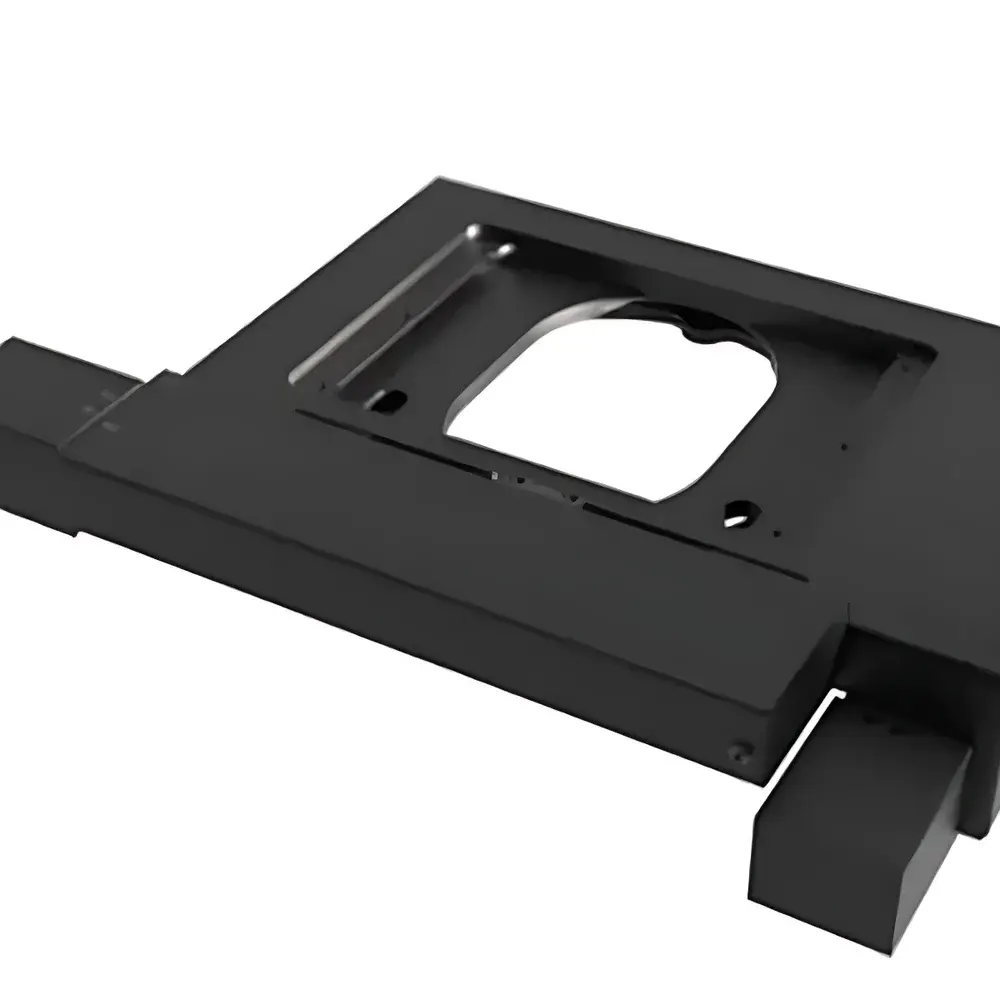
Prior H100A Compact Motorized XY Stage for Upright Microscopes
| Brand | Prior |
|---|---|
| Origin | United Kingdom |
| Manufacturer Type | Authorized Distributor |
| Origin Category | Imported |
| Model | H100A |
| Pricing | Contact for Quotation |
| Travel Range | 75 mm × 50 mm |
| Unidirectional Repeatability | < 0.7 µm |
| Bidirectional Repeatability | < 1.9 µm |
| Metric Accuracy | < 0.09 µm/mm |
| Full-Travel Accuracy | < 7.2 µm |
| Resolution | 0.02 µm |
| Perpendicularity | < 35 arcsec |
| Maximum Speed | 30 mm/s |
| Maximum Load Capacity | 5 kg |
| Encoder | None |
| Motor Type | 200-step Stepper Motor |
| Lead Screw Pitch | 1 mm |
| Weight | 2.5 kg |
Overview
The Prior H100A is a compact, high-precision motorized XY translation stage engineered specifically for integration with upright optical microscopes. It operates on a precision-ground 1 mm pitch stainless steel lead screw actuated by a 200-step hybrid stepper motor—delivering deterministic open-loop motion control without encoder feedback. Its mechanical architecture follows classical micrometer-grade kinematic principles, ensuring linear displacement fidelity and minimal Abbe error across the full 75 mm × 50 mm travel envelope. Designed for applications demanding sub-micron positional stability—including automated slide scanning, fluorescence tile acquisition, and metrology-grade surface mapping—the H100A achieves unidirectional repeatability of < 0.7 µm and full-travel accuracy of < 7.2 µm, meeting performance benchmarks typical of Prior’s ProScan-class platforms while occupying significantly less footprint. Its 2.5 kg mass and low-profile form factor (height < 42 mm) enable seamless integration into constrained optical layouts, including custom OEM instrumentation and modular optical platform assemblies.
Key Features
- Compact footprint (128 mm × 102 mm base) optimized for space-limited microscope frames and optical breadboard systems.
- Open-loop stepper-driven motion with 0.02 µm theoretical resolution and < 0.7 µm unidirectional repeatability—validated per ISO 230-2 Annex B protocols.
- Rigid aluminum alloy housing with hardened stainless steel lead screws and preloaded anti-backlash nuts to minimize hysteresis and thermal drift.
- Modular mounting interface compatible with standard M4 and 1/4″-20 threaded holes; includes optional dovetail adapters for Nikon, Olympus, and Zeiss upright stand integration.
- Supports interchangeable sample carriers—including standard glass slide holders (76 × 26 mm), filter paper clamps, and polished metal calibration artifacts—for multi-modal specimen handling.
- Rated for continuous operation under 5 kg static load, with dynamic acceleration profiles calibrated to maintain positional integrity at maximum speed (30 mm/s).
Sample Compatibility & Compliance
The H100A accommodates standard microscopy substrates such as 1″ × 3″ glass slides, 25 mm diameter filters, and metallurgical cross-sections up to 50 mm in lateral dimension. Its flatness tolerance (< 1.5 µm over 75 mm) and perpendicularity specification (< 35 arcsec) ensure minimal Z-axis coupling during XY rastering—critical for confocal z-stack registration and focus-map alignment. While the stage itself carries no intrinsic regulatory certification, its mechanical design and material selection (RoHS-compliant anodized aluminum, non-magnetic stainless components) support deployment in GLP-compliant laboratories. When paired with Prior’s optional USB/Ethernet controller (H100A-Ctrl), system-level audit trails and motion log export comply with FDA 21 CFR Part 11 requirements for electronic records in regulated QC environments.
Software & Data Management
The H100A operates natively via Prior’s established command set (ASCII-based serial protocol over USB or RS-232), enabling plug-and-play compatibility with widely adopted microscopy software suites including MetaMorph, NIS-Elements, ZEN Blue, and MicroManager. Third-party API support includes Python (via PyPrior), MATLAB Instrument Control Toolbox, and LabVIEW drivers—facilitating custom automation workflows for high-throughput screening or time-lapse mosaic acquisition. Motion logs capture timestamped position data at user-defined intervals (down to 10 ms resolution), supporting post-acquisition spatial correlation with image metadata. No proprietary runtime or license fees are required for basic stage control; advanced features such as closed-loop correction or trajectory interpolation require external encoder integration and firmware upgrade.
Applications
- Automated histopathology slide scanning in clinical and research laboratories.
- Multi-field fluorescence imaging for co-localization analysis and FRET quantification.
- Surface topography mapping of polished wafers, optical coatings, and MEMS devices using reflected-light contrast techniques.
- Integration into custom-built optical trapping or holographic tweezers platforms requiring precise sample repositioning.
- Calibration artifact positioning in metrology labs adhering to ISO 10110-5 and ASTM E2594 standards for optical component verification.
- OEM incorporation into industrial machine vision systems for PCB inspection, semiconductor wafer defect review, and precision assembly guidance.
FAQ
Is the H100A compatible with inverted microscopes?
No—the H100A is mechanically and dimensionally optimized for upright microscope configurations. Inverted systems require stages with bottom-accessible mounting and reversed Z-clearance; consider the Prior H117 series for such applications.
Does the stage include built-in position feedback?
No. The H100A is an open-loop stepper system without integrated encoders. For closed-loop validation, users must integrate external linear encoders or adopt Prior’s optional H100A-E model with incremental optical sensing.
Can the H100A be used in vacuum or cleanroom environments?
It is not rated for vacuum operation due to lubricant outgassing and lack of venting provisions. However, it meets ISO Class 5 particulate limits when operated in laminar flow hoods with standard maintenance.
What is the recommended maintenance interval?
Under continuous daily use, inspect lead screw lubrication every 6 months and verify perpendicularity annually using a laser interferometer or autocollimator per ISO 230-1 Annex D guidelines.
Is firmware update capability supported?
Yes—firmware revisions are distributed via Prior’s official support portal and applied through the H100A-Ctrl interface using Prior’s StageConfig utility, ensuring backward compatibility with legacy host software.





