
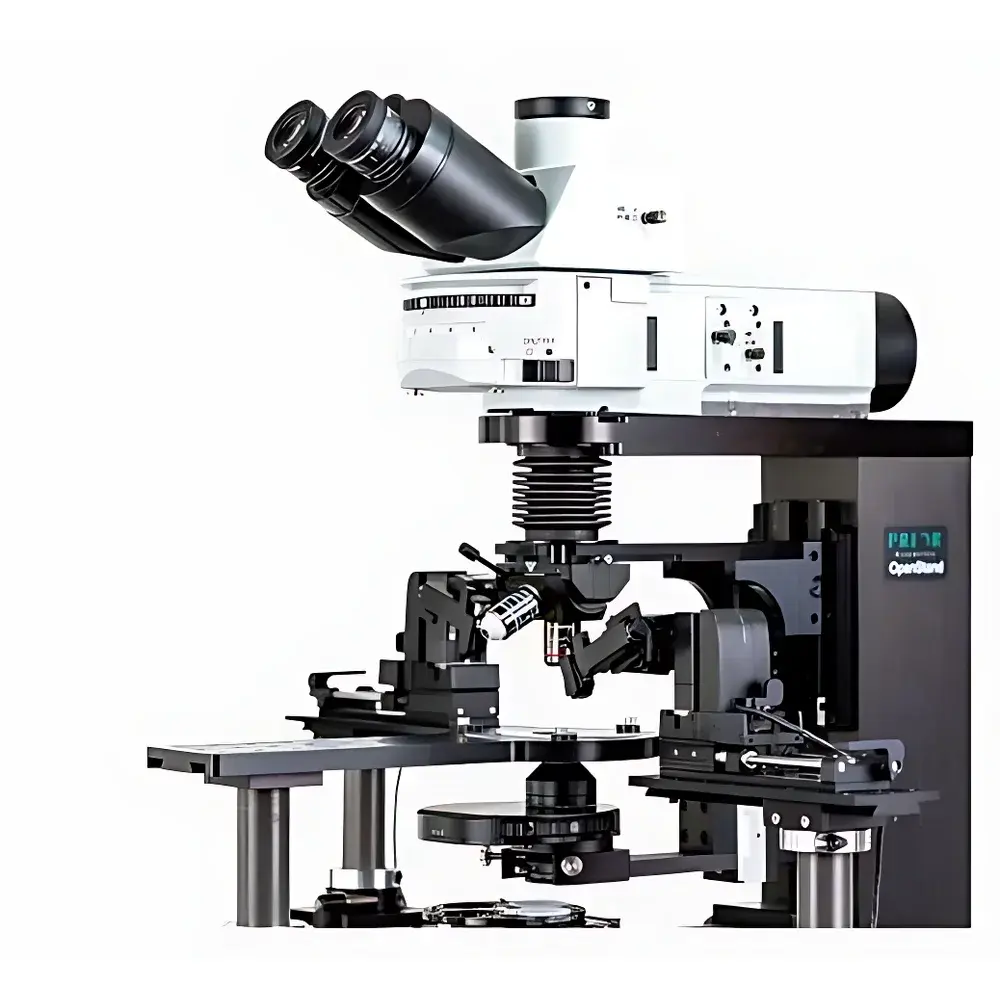
Prior OpenStand® Electric Optical Stand
| Brand | Prior |
|---|---|
| Origin | United Kingdom |
| Model | OpenStand® |
| Type | Motorized Electrophysiology-Compatible Optical Platform |
| Z-Axis Travel | 100 mm |
| Throat Depth | 200 mm |
| Condenser Adjustment Range | 35 mm |
Overview
The Prior OpenStand® Electric Optical Stand is a purpose-engineered, motorized optical platform designed specifically for demanding in vivo and in vitro electrophysiological and optophysiological experiments. Built upon Couette-flow-aligned mechanical architecture and precision-machined aluminum alloy frames, the OpenStand® implements a rigid, low-vibration modular base that serves as the structural and functional backbone for integrated patch-clamp rigs, two-photon imaging systems, and optogenetic stimulation setups. Its core measurement capability centers on high-stability, closed-loop Z-axis positioning—critical for maintaining focus during long-duration recordings across variable sample thicknesses, from cultured neurons to intact rodent brain slices or head-fixed behaving animals. Unlike conventional inverted microscope stands, the OpenStand® eliminates fixed optical pathways in favor of an open-concept mechanical lattice, enabling unobstructed access to the specimen plane and seamless integration of micromanipulators, perfusion lines, gas delivery manifolds, and multi-wavelength light sources.
Key Features
- 100 mm motorized Z-axis travel with sub-micron repeatability—engineered to accommodate both high-NA water-immersion objectives and long-working-distance objectives used in chronic cranial window preparations;
- Modular transmitted-light illumination system with tool-free removal—maximizing objective clearance and eliminating mechanical interference during simultaneous epifluorescence and IR-DIC imaging;
- 200 mm throat depth and 35 mm condenser vertical adjustment range—supporting large-diameter objectives (e.g., 40 mm clear aperture), custom lens mounts, and multi-angle illumination geometries;
- Digital potentiometer-based fine-positioning interface for Z-axis (and optional XY stages)—enabling tactile, analog-style control with programmable step resolution down to 10 nm per encoder count;
- Zero-current holding mode—eliminates electromagnetic interference (EMI) and thermal drift during voltage-clamp or current-clamp recordings, ensuring baseline stability compliant with IEEE Std 1003.1-2017 signal integrity requirements;
- Fast up/down toggle function—providing rapid coarse focusing without compromising positional memory or encoder homing integrity;
- Standardized M6 and 1/4″-20 threaded mounting interfaces across all structural plates—ensuring mechanical compatibility with Prior’s full ecosystem of physiological accessories, including OSM-TL-VD20, OS-TL-ZD, OSM-TL-3P20, and OS-TL-3P12M modules.
Sample Compatibility & Compliance
The OpenStand® accommodates specimens ranging from single-cell suspensions in chambered coverslips to head-fixed mice under stereotaxic frames. Its open geometry supports dual-sided optical access—essential for combined optogenetic stimulation (473 nm/594 nm lasers) and simultaneous calcium imaging (e.g., GCaMP6f via 920 nm two-photon excitation). The platform conforms to ISO 14644-1 Class 5 cleanroom-compatible assembly protocols and meets mechanical safety requirements outlined in EN 61000-6-2 (immunity) and EN 61000-6-4 (emission) for laboratory-grade instrumentation. All motor controllers implement hardware-level current limiting and thermal shutdown, satisfying IEC 61010-1:2010 Clause 6.3.2 for protection against hazardous energy release during extended operation.
Software & Data Management
The OpenStand® integrates natively with Prior’s ProView™ control suite (v6.4+), supporting deterministic command timing via USB 2.0 HID and Ethernet TCP/IP interfaces. Positional metadata—including absolute Z-coordinates, encoder timestamps, and motor status flags—is logged in HDF5 format with embedded Blosc compression, enabling direct ingestion into Python-based analysis pipelines (e.g., Neo, Elephant, or NWB 2.6 schemas). The system supports audit-trail logging compliant with FDA 21 CFR Part 11 when deployed in GLP/GMP-regulated neuropharmacology studies, with user-authenticated session initiation and immutable position-history export.
Applications
- In vivo whole-cell patch-clamp recordings during behaviorally engaged tasks;
- Multi-region optogenetic perturbation coupled with widefield or two-photon calcium imaging;
- Chronic longitudinal imaging through cranial windows with periodic re-focusing across weeks;
- Combined extracellular LFP/MEG probe insertion and confocal structural imaging;
- High-throughput screening of neuronal network dynamics using microelectrode arrays (MEAs) mounted directly onto the stage.
FAQ
Is the OpenStand® compatible with non-Prior micromanipulators and imaging systems?
Yes—the platform features standardized kinematic mounting surfaces and provides native support for third-party controllers via RS-232, TTL trigger inputs, and analog voltage interfaces.
Does it support vacuum or pressure-controlled environmental chambers?
The baseplate includes four dedicated 8-mm through-holes for pneumatic line routing and optional vacuum-sealed gasket grooves; chamber integration requires custom adapter plates (available under Prior P/N AP-OS-VAC).
Can Z-axis position be synchronized with electrophysiology acquisition software?
Yes—via TTL sync pulses or shared clock distribution using the ProView™ SyncBus protocol, enabling sub-millisecond alignment between focus position and digitized membrane potential traces.
What maintenance is required for long-term Z-axis performance?
No scheduled lubrication is needed; the lead-screw drive uses self-lubricating polymer nuts with >10⁶ cycle lifetime per ISO 12215-2:2021 accelerated wear testing.



