
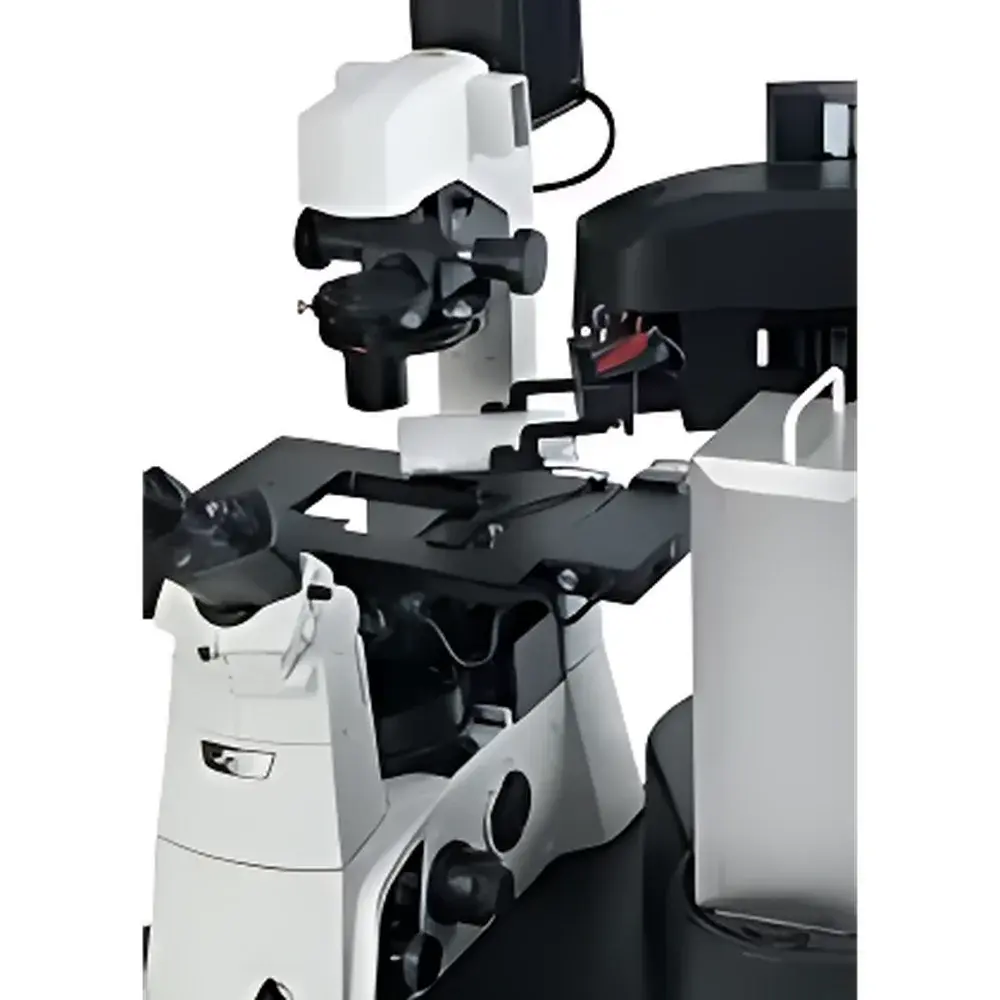
Prior PLW20 Multi-Well Plate Auto-Loader System
| Brand | Prior |
|---|---|
| Origin | United Kingdom |
| Model | PLW20 |
| Capacity | 20 microplates (2 racks × 10) |
| Motion Axes | 3 independently controlled and encoded axes (X, Y, Z/rotation) |
| Plate Height Compatibility | Up to 19 mm (with or without lid) |
| Construction | Stainless steel rack assembly |
| Controller Compatibility | ProScan II, ProScan III, and Focus Controllers via DLL interface |
| Safety & Sensing | Integrated plate presence detection sensors |
| Microscope Integration | Designed for inverted microscopes |
| Compliance | Compatible with GLP/GMP workflows requiring audit-trail-capable automation |
Overview
The Prior PLW20 Multi-Well Plate Auto-Loader System is an engineered solution for automated, high-throughput sample handling in inverted microscope-based imaging workflows. Built on a robust mechanical architecture, the PLW20 integrates seamlessly with Prior’s ProScan II and ProScan III motion control platforms to deliver precise, repeatable positioning of standard multi-well plates—ranging from 6- to 384-well formats—within the field of view of high-resolution optical microscopy systems. Its operational principle relies on coordinated, encoder-feedback-driven motion across three orthogonal axes: horizontal (X), lateral (Y), and vertical (Z) or rotational (θ), enabling full plate access—including edge wells—and dynamic repositioning during time-lapse or multi-position acquisition protocols. The system is not a standalone imager but a deterministic sample-handling module, designed to eliminate manual intervention, reduce operator-induced variability, and support unattended overnight or multi-day acquisition campaigns typical in phenotypic screening, cell-based assay development, and live-cell kinetics studies.
Key Features
- 20-plate capacity achieved via dual stainless-steel racks (10 plates per rack), each accommodating plates up to 19 mm in total height—compatible with both lidded and lidless configurations.
- Three independently controlled, high-resolution encoded motion axes ensure sub-millimeter repeatability and positional fidelity across all plate positions.
- Integrated proximity sensors detect rack presence and orientation, allowing conditional logic execution (e.g., automatic pause/resume upon rack swap) within scripted acquisition sequences.
- Compact footprint (W × D × H ≈ 320 × 410 × 270 mm) enables installation beneath most inverted microscope stages without obstructing objective turret rotation or condenser adjustment.
- Native DLL-based software interface supports bidirectional communication with Prior’s ProScan controllers and third-party acquisition packages (e.g., Micro-Manager, MetaMorph, NIS-Elements) via standardized COM or .NET bindings.
- No proprietary firmware lock-in: All motion parameters—including acceleration profiles, dwell times, and coordinate mapping—are programmable via ASCII command set or high-level API calls.
Sample Compatibility & Compliance
The PLW20 accepts ANSI/SBS-standard microplates (including black, white, clear, and glass-bottom variants) across common well geometries: 6-, 12-, 24-, 48-, 96-, 384-, and 1536-well formats. Plate thickness tolerance (0.8–2.2 mm) and flange geometry are verified against ANSI SLAS-1-2004 specifications. For regulated environments, the system supports integration into 21 CFR Part 11-compliant workflows when paired with audit-trail-enabled host software and electronic signature modules. While the PLW20 itself carries no intrinsic certification, its deterministic motion behavior, sensor-monitored state transitions, and scriptable error recovery pathways align with GLP and GMP documentation requirements for automated microscopy systems used in preclinical assay validation.
Software & Data Management
The PLW20 operates exclusively through Prior’s ProScan controller ecosystem. Its DLL interface exposes low-level motor control, position reporting, sensor status, and rack identification functions—enabling custom scripting in Python, MATLAB, or C#. Acquisition software can query real-time plate coordinates, trigger hardware synchronization pulses (TTL), and log timestamped motion events alongside image metadata. All movement commands are logged with microsecond-resolution timestamps, supporting retrospective correlation between stage position and image acquisition timing—a prerequisite for quantitative co-localization analysis and drift-corrected time-series registration. No cloud dependency or vendor-hosted license server is required; local deployment ensures data sovereignty and network isolation for secure laboratory environments.
Applications
- High-content screening (HCS) of adherent mammalian cell lines under pharmacological or genetic perturbation.
- Automated z-stack acquisition across multiple fields per well in 96-well assays for morphometric profiling.
- Time-lapse imaging of organoid cultures across 24- or 48-well plates with synchronized focus correction.
- Multi-site fluorescence intensity quantification in reporter-based toxicity assays (e.g., Ca2+, ROS, mitochondrial membrane potential).
- Integration with environmental chambers for long-term live-cell imaging under controlled CO2, temperature, and humidity conditions.
FAQ
Does the PLW20 require a Prior ProScan controller to operate?
Yes—the PLW20 has no onboard motion controller and must be driven via ProScan II or ProScan III hardware with compatible firmware (v5.3 or later).
Can the PLW20 handle thick plates such as spheroid culture dishes or glass-bottom 24-well plates?
Yes—its vertical travel range accommodates plates up to 19 mm tall, including commercially available spheroid-compatible vessels with integrated optics.
Is calibration required before each experiment?
No—mechanical homing and encoder zeroing are performed once during initial setup; subsequent runs rely on absolute position tracking without recalibration.
How is plate identification managed when multiple racks are used?
Each stainless-steel rack contains a unique mechanical keying pattern detected by internal sensors, enabling software-level rack differentiation and context-aware script branching.
Does the system support autofocus integration?
Yes—via TTL sync output and software-triggered focus controller commands, enabling closed-loop focus maintenance during plate-to-plate transitions.




