
PRO Multi-Prep High-Throughput Probe Homogenizer
| Brand | PRO |
|---|---|
| Origin | USA |
| Model | Multi-Prep |
| Instrument Type | Probe-type Rotor-Stator Homogenizer |
| Dimensions (W×D×H) | 270 × 370 × 370 mm |
| Speed Range | 2000 – 18,000 rpm |
| Power | 805 W |
| Noise Level | 68 dB(A) |
| Weight | 19 kg |
| Sample Capacity | 6 × 15 mL or 6 × 50 mL conical centrifuge tubes |
| Compatible Vessel Volume | 2.0–15 mL (15 mL tubes) / 4.5–50 mL (50 mL tubes) |
| Certification | CE |
| Probe Material | 316 Stainless Steel + PTFE |
| Sterilization Compatibility | Autoclave (121°C, 20 min), flame, and chemical methods |
| Standard Accessories | 12 × Multi-Prep probes, multi-position rack (15 mL or 50 mL), 12 × conical tubes, LCD controller with 10 programmable protocols |
Overview
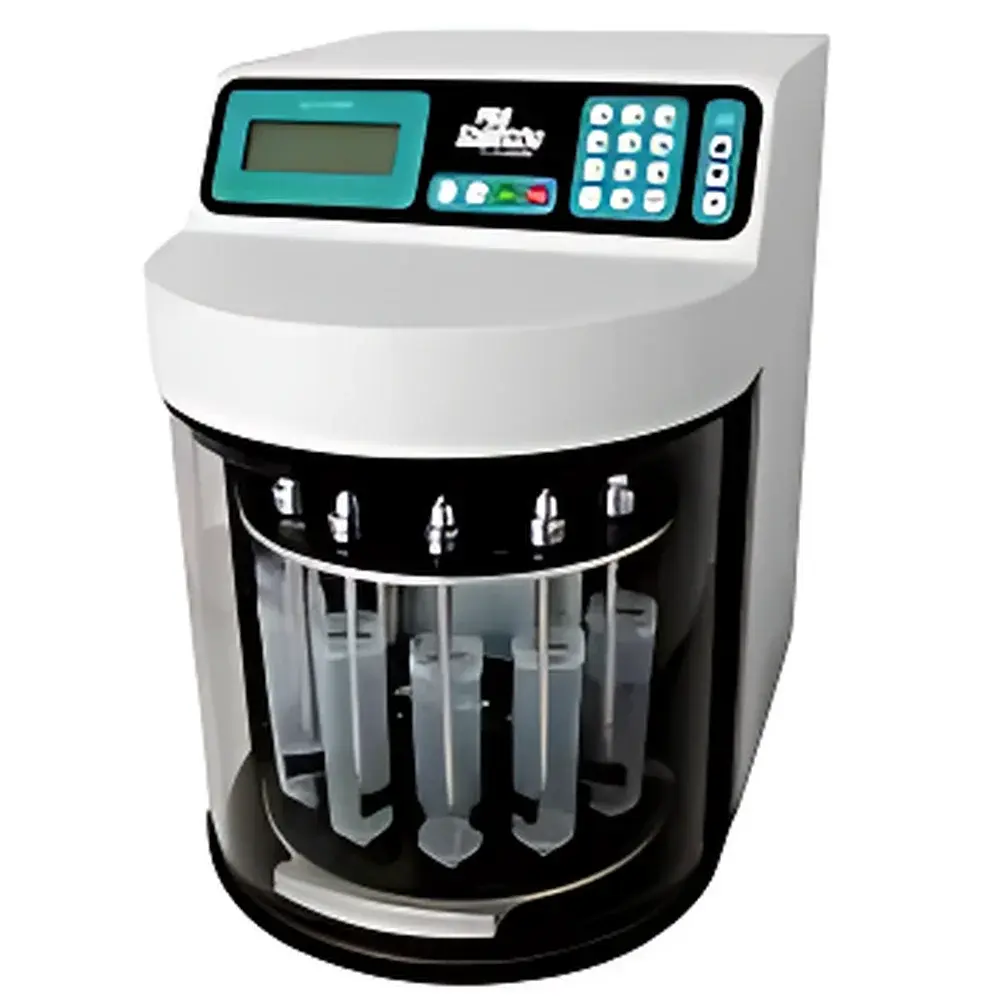
The PRO Multi-Prep High-Throughput Probe Homogenizer is an engineered solution for laboratories requiring reproducible, scalable, and contamination-controlled mechanical homogenization of multiple biological, pharmaceutical, or environmental samples in parallel. Based on rotor-stator shear principle, the system delivers controlled high-shear forces through precision-machined stainless steel and PTFE-coated probes rotating at speeds up to 18,000 rpm—generating turbulent flow and cavitation within sample vessels to achieve efficient cell lysis, tissue disruption, emulsification, and particle size reduction. Unlike single-sample homogenizers, the Multi-Prep platform accommodates six conical centrifuge tubes simultaneously—either 15 mL or 50 mL—enabling statistically robust experimental designs without sequential processing delays. Its compact footprint (270 × 370 × 370 mm) and integrated acoustic shielding make it suitable for shared lab environments where space and noise management are critical.
Key Features
- Parallel processing of up to six samples per cycle—reducing inter-run variability and improving throughput consistency
- Programmable LCD interface storing up to ten user-defined protocols (speed, duration, pulse mode, and probe oscillation frequency)
- Automated probe engagement/disengagement mechanism ensures repeatable insertion depth and eliminates manual alignment errors
- 60-cycle-per-minute vertical probe oscillation enhances mixing uniformity and minimizes vortexing-induced sample splashing
- Optically transparent polycarbonate sound enclosure enables real-time visual monitoring while attenuating operational noise to ≤68 dB(A)
- Twelve sterilizable probes included standard—each constructed from medical-grade 316 stainless steel with PTFE-coated shafts for chemical resistance and biocompatibility
- Compatible with common laboratory consumables: conical-bottom polypropylene centrifuge tubes (15 mL and 50 mL), eliminating need for proprietary vessels
Sample Compatibility & Compliance
The Multi-Prep supports a broad range of sample types including soft animal tissues (liver, spleen), cultured cells, plant material, bacterial pellets, and viscous suspensions such as soil extracts or food emulsions. Its validated working volume ranges from 2.0–15 mL in 15 mL tubes and 4.5–50 mL in 50 mL tubes—ensuring optimal fill ratios for consistent energy transfer. All wetted components comply with USP Class VI and ISO 10993-5 cytotoxicity standards. The system meets CE marking requirements under the EU Machinery Directive 2006/42/EC and Electromagnetic Compatibility Directive 2014/30/EU. While not inherently 21 CFR Part 11 compliant, audit trails and protocol logs can be exported in CSV format for integration into validated GxP workflows under laboratory-defined SOPs.
Software & Data Management
The embedded microcontroller provides non-volatile memory for parameter retention across power cycles. Each stored protocol includes speed setpoint (rpm), total run time (0.1–999 s), pulse interval (on/off ratio), and oscillation frequency (0–60 cpm). No external software is required; however, timestamped operation logs—including date/time stamp, program ID, and actual speed feedback—are accessible via USB export. For GLP/GMP environments, users may implement third-party electronic lab notebook (ELN) integrations using standardized CSV schema. Firmware updates are delivered via secure download and require physical USB key authentication to maintain configuration integrity.
Applications
- High-yield nucleic acid and protein extraction from mammalian, microbial, or plant sources
- Preparation of homogeneous suspensions for particle size analysis (e.g., DLS or laser diffraction)
- Routine QC homogenization of reference standards in pharmaceutical manufacturing
- Environmental sample processing—soil slurry homogenization prior to microbial enumeration or metal leaching assays
- Formulation development of nanoemulsions and liposomal drug carriers
- Biobanking workflows requiring rapid, low-heat lysis to preserve biomolecule integrity
FAQ
What tube formats are supported?
The system accepts standard conical-bottom polypropylene centrifuge tubes—15 mL or 50 mL—with compatibility confirmed for major global suppliers (e.g., Eppendorf, Thermo Fisher, Sarstedt).
Can the probes be autoclaved?
Yes—probes are rated for repeated steam sterilization at 121°C for 20 minutes; PTFE coating remains stable under these conditions.
Is cross-contamination minimized during multi-sample runs?
Each probe operates independently within its designated tube position; the automatic engagement system prevents lateral probe contact, and probe-to-probe spacing exceeds ISO 22196 antimicrobial test spacing guidelines.
How is speed accuracy maintained across load variations?
Closed-loop tachometric feedback adjusts motor torque in real time to sustain ±1.5% speed tolerance across the full 2000–18,000 rpm range, verified per ISO 5725-2 repeatability protocols.
Does the unit support variable-speed ramping?
No—speed is set instantaneously at program initiation; gradual acceleration profiles are not implemented to prioritize mechanical durability and thermal stability.



