
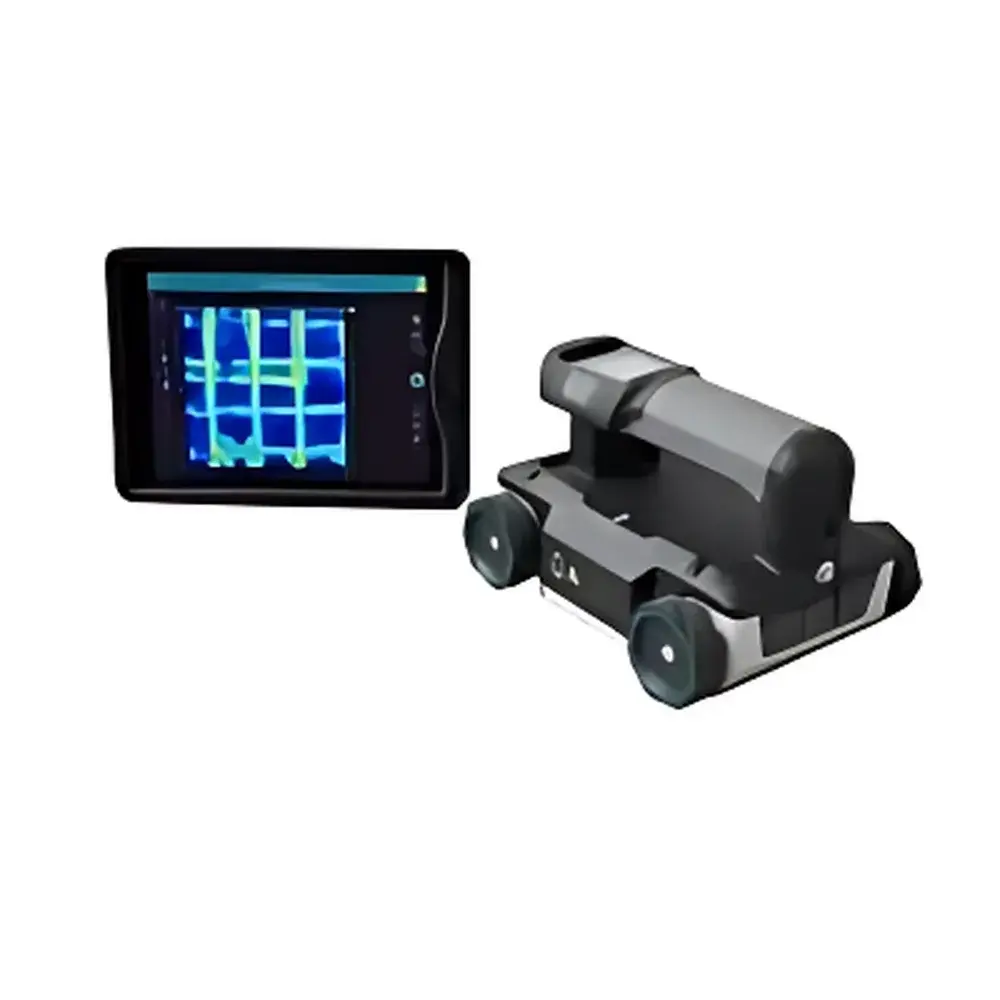
Proceq GP8000 Portable Ground Penetrating Radar
| Origin | Guangdong, China |
|---|---|
| Manufacturer Type | Authorized Distributor |
| Origin Category | Domestic (China) |
| Model | GP8000 |
| Pricing | Available Upon Request |
Overview
The Proceq GP8000 Portable Ground Penetrating Radar is a high-performance, battery-powered subsurface imaging instrument engineered for rapid, non-invasive structural assessment of concrete, masonry, asphalt, and soil. It operates on the principle of ultra-wideband (UWB) electromagnetic pulse transmission and time-domain reflection analysis: a compact antenna transmits short-duration radar pulses into the material, and reflected signals from dielectric contrasts—such as rebar, post-tensioning ducts, voids, delaminations, or utility conduits—are captured, digitized, and processed in real time. Unlike conventional GPR systems requiring bulky cart-based deployment or external laptops, the GP8000 integrates a fully wireless, handheld antenna unit with embedded signal conditioning electronics and Bluetooth 5.0 connectivity—designed specifically for one-handed operation and immediate visualization on iOS devices. Its UWB architecture enables simultaneous resolution across multiple depth ranges, supporting both shallow high-resolution scanning (e.g., cover depth measurement per ASTM C1740) and deeper structural profiling (up to ~60 cm in standard reinforced concrete under optimal conditions).
Key Features
- Ultra-Wideband Antenna System: 1.6 GHz–2.6 GHz center-frequency range optimized for concrete inspection, delivering balanced penetration depth and spatial resolution without hardware switching.
- Wireless Handheld Design: Fully integrated antenna, battery, and data acquisition module; weighs less than 1.8 kg with ergonomic grip and IP54-rated enclosure for field durability.
- iOS-Centric Operation: Native application compatible with iPad (iOS 12 or later); supports offline data collection, on-device gain adjustment, real-time A-scan/B-scan rendering, and automatic hyperbola migration.
- Augmented Reality (AR) Visualization: Overlays interpreted GPR results—including rebar location, depth estimates, and anomaly confidence indicators—directly onto the live iPad camera feed using ARKit-based spatial registration.
- Embedded Quality Assurance Tools: Built-in calibration verification routine, temperature-compensated timing circuits, and automatic noise floor estimation ensure measurement repeatability across ambient conditions.
- Regulatory-Ready Data Handling: All scans include timestamp, GPS metadata (via iPad), operator ID, project tag, and raw I/Q sample export (IEEE 32-bit float format) for traceability and third-party analysis.
Sample Compatibility & Compliance
The GP8000 is validated for use on common construction materials including cast-in-place and precast concrete (with compressive strengths 20–60 MPa), brick masonry, asphalt overlays, and compacted granular soils. It complies with EN 1504-4:2013 (evaluation of concrete structures), ASTM D6432-19 (standard guide for GPR in environmental and engineering investigations), and ISO 12504-2:2020 (non-destructive testing — terminology — part 2: ultrasonic, electromagnetic, acoustic emission, and radiographic methods). While not certified for explosive atmospheres or underwater deployment, its electromagnetic emissions conform to FCC Part 15 Class B and CE RED Directive 2014/53/EU limits. Data integrity workflows support GLP-aligned documentation requirements, including audit trails for parameter changes and user authentication logs.
Software & Data Management
The dedicated GP8000 Field App (v3.x) provides full control over acquisition parameters—including time window (10–30 ns), sampling rate (up to 50 GS/s equivalent), and stacking count (1–128)—without requiring PC-based configuration. Processed data exports include georeferenced PNG/BMP cross-sections, CSV-formatted coordinate-depth tables, and proprietary .gpr binary files containing unprocessed ADC samples. Integration with Proceq Cloud enables secure, role-based synchronization of projects across teams, version-controlled report generation (PDF with embedded metadata), and automated compliance tagging for ISO 9001 internal audits. Raw datasets are exportable in SEG-Y Rev 1 format for interoperability with industry-standard processing platforms such as ReflexW or GPR-Slice.
Applications
- Concrete Infrastructure Assessment: Detection and mapping of reinforcing steel (rebar), tendons, dowels, and anchor bolts; estimation of concrete cover depth per ACI 228.2R guidelines.
- Construction Quality Control: Verification of as-built element geometry, identification of honeycombing, voids, or grouting defects behind tunnel linings or bridge abutments.
- Historic Structure Preservation: Non-invasive investigation of masonry wall composition, hidden chambers, or deterioration patterns beneath plaster finishes.
- Municipal Utility Mapping: Shallow-depth localization of PVC, cast iron, or clay pipes prior to excavation—especially where electromagnetic induction tools fail due to non-conductive materials.
- Forensic Engineering Surveys: Post-event evaluation of impact damage, fire-induced spalling, or progressive deterioration mechanisms in aging infrastructure.
FAQ
Is the GP8000 suitable for use in wet or rain-exposed environments?
Yes—the antenna housing meets IP54 ingress protection standards, permitting operation in light rain and high-humidity conditions; however, prolonged submersion or direct high-pressure water jet exposure is not supported.
Does the system require annual factory recalibration?
No scheduled recalibration is mandated; the device performs self-diagnostic checks at startup and includes a field-verifiable reference target protocol compliant with ASTM D6432 Annex A3.
Can data be exported for regulatory submission under FDA or EU Annex 11 requirements?
While primarily deployed in civil engineering contexts, the GP8000’s audit trail, electronic signature support, and immutable metadata embedding enable adaptation to regulated environments requiring ALCOA+ data integrity principles.
What iPad models are officially supported?
iPad Air (3rd gen and later), iPad Pro (all models with iOS 12+), and iPad (8th gen and later); Apple Pencil compatibility is optional and used only for on-screen annotation.
Is training provided with purchase?
Proceq-certified instructor-led field training (half-day onsite or virtual) is included with every GP8000 system, covering acquisition best practices, interpretation fundamentals, and report generation workflows aligned with ISO 12504-2 competency benchmarks.



