ProOpto EUV/UV Hartmann-Shack Wavefront Sensor
| Brand | ProOpto |
|---|---|
| Origin | Germany |
| Manufacturer Type | Authorized Distributor |
| Import Status | Imported |
| Model | EUV/UV |
| Pricing | Upon Request |
Overview
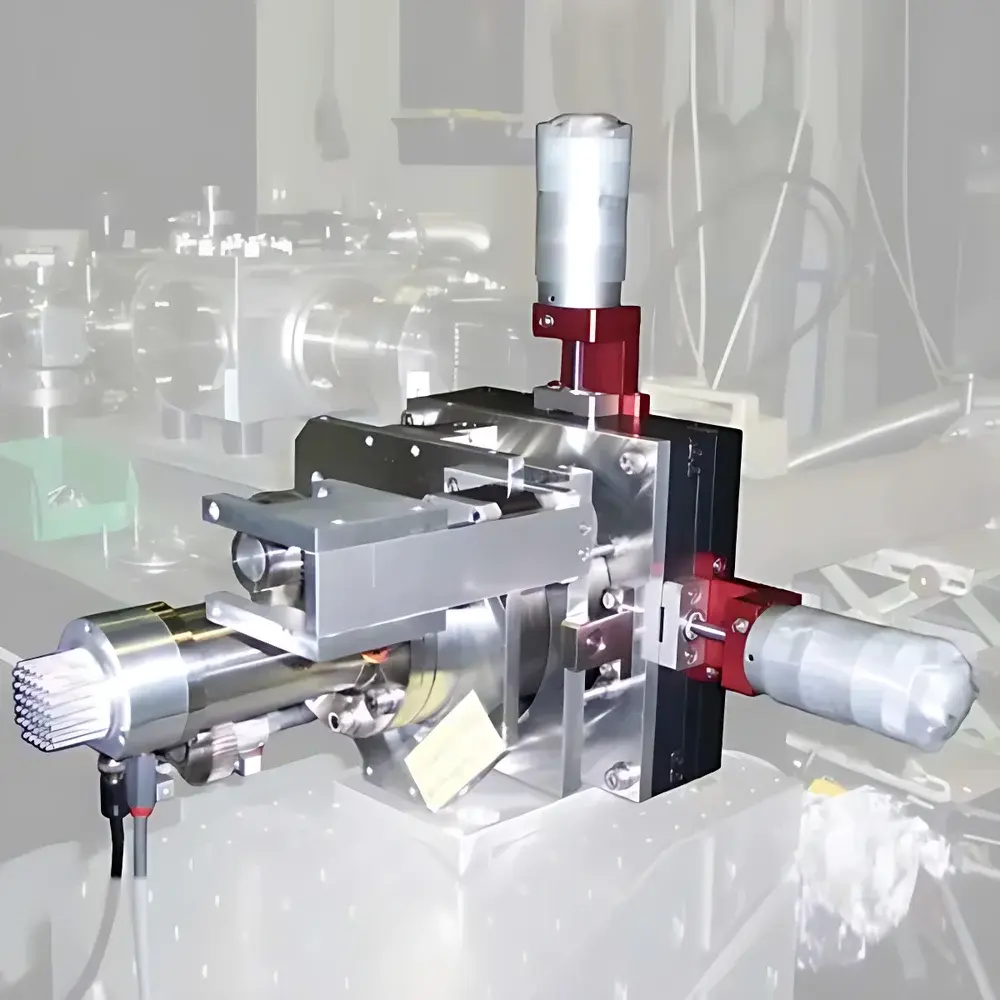
The ProOpto EUV/UV Hartmann-Shack Wavefront Sensor is a precision metrology instrument engineered for quantitative, single-shot characterization of extreme ultraviolet (EUV) and soft X-ray optical beams. Operating on the principle of Hartmann-Shack wavefront sensing—where an incident beam is sampled by a micro-lens array (MLA) and imaged onto a high-resolution, vacuum-compatible camera—the system reconstructs both the intensity distribution and phase front with sub-wavelength accuracy. Designed explicitly for demanding radiation environments including synchrotron beamlines, free-electron lasers (FELs), high-harmonic generation (HHG) sources, and EUV lithography (EUVL) plasma sources, it enables rigorous beam propagation modeling, M² factor determination per ISO 11146, and real-time optical alignment feedback. Its quantum-efficiency-optimized MLA—featuring precision-pierced pinholes (Ø75 µm, 250 µm pitch) and UHV-compatible CF63 flange integration—ensures stable, repeatable measurements under ultra-high vacuum (UHV) conditions down to 10⁻⁹ mbar.
Key Features
- Single-pulse wavefront reconstruction capability with root-mean-square (RMS) repeatability of λ/116 (wrms) at 13.5 nm—validated on FLASH FEL (DESY, Hamburg)
- Extended spectral sensitivity from <1 nm to 60 nm, enabled by custom quantum conversion coatings optimized for EUV photon detection
- Modular micro-lens array design supporting interchangeable MLA configurations and >20 compatible camera types (including back-illuminated sCMOS and CCD sensors)
- Adjustable XY translation stage (±10 mm range) and ±10° tip/tilt control for precise beam positioning and alignment verification
- Compact, rigid mechanical architecture with UHV-rated materials and CF63 vacuum flange interface for seamless integration into beamline end stations
- Real-time wavefront analysis and closed-loop optical correction support via hardware-triggered acquisition and low-latency data streaming
Sample Compatibility & Compliance
The sensor accommodates divergent, partially coherent, and pulsed EUV sources—including laser-produced plasmas (LPP), discharge-produced plasmas (DPP), HHG-driven attosecond pulses, and seeded/unseeded FELs. Its measurement methodology conforms to multiple ISO standards governing laser beam characterization: ISO 11146 (beam width, divergence, M²), ISO 13694 (beam profile uniformity), ISO 11670 (pointing stability), and ISO 15367 (wavefront phase distribution). All calibration procedures follow traceable NIST-equivalent protocols; system validation reports include Zernike polynomial decomposition up to 36 terms and residual error mapping against reference flat-wavefront optics.
Software & Data Management
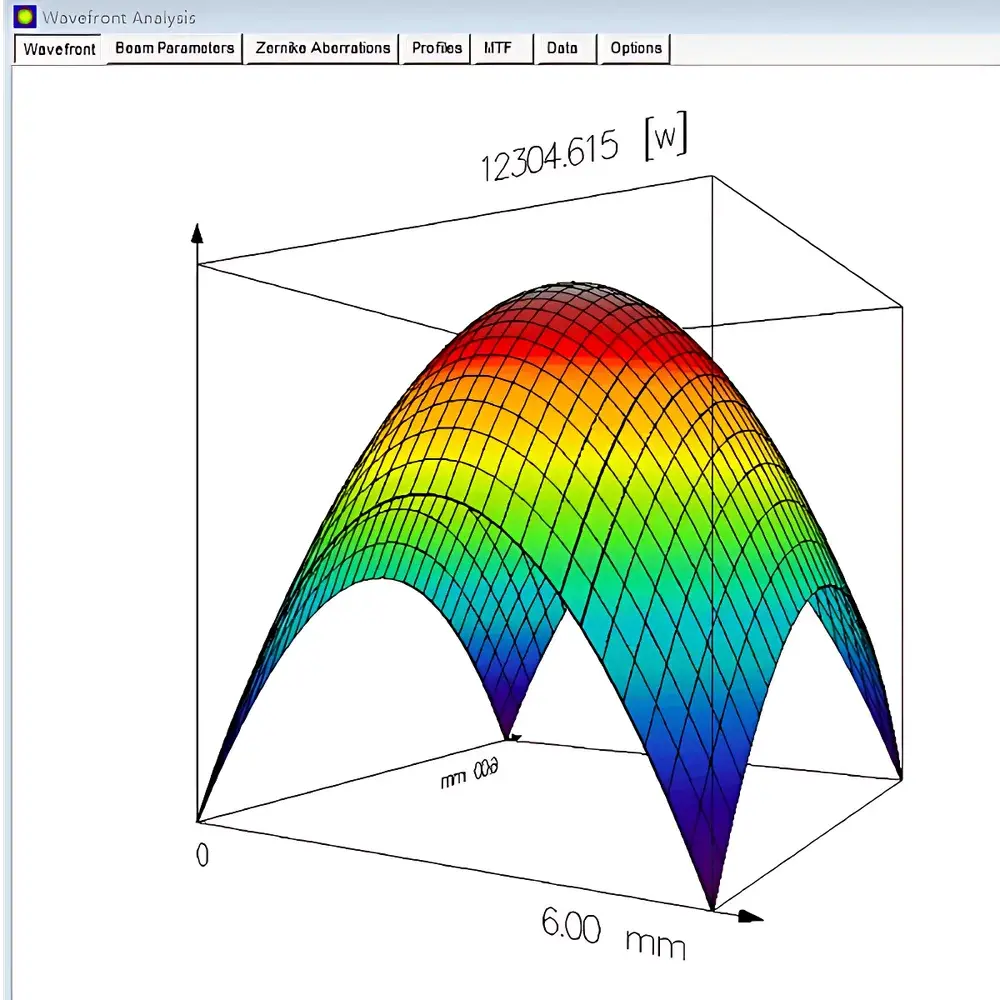
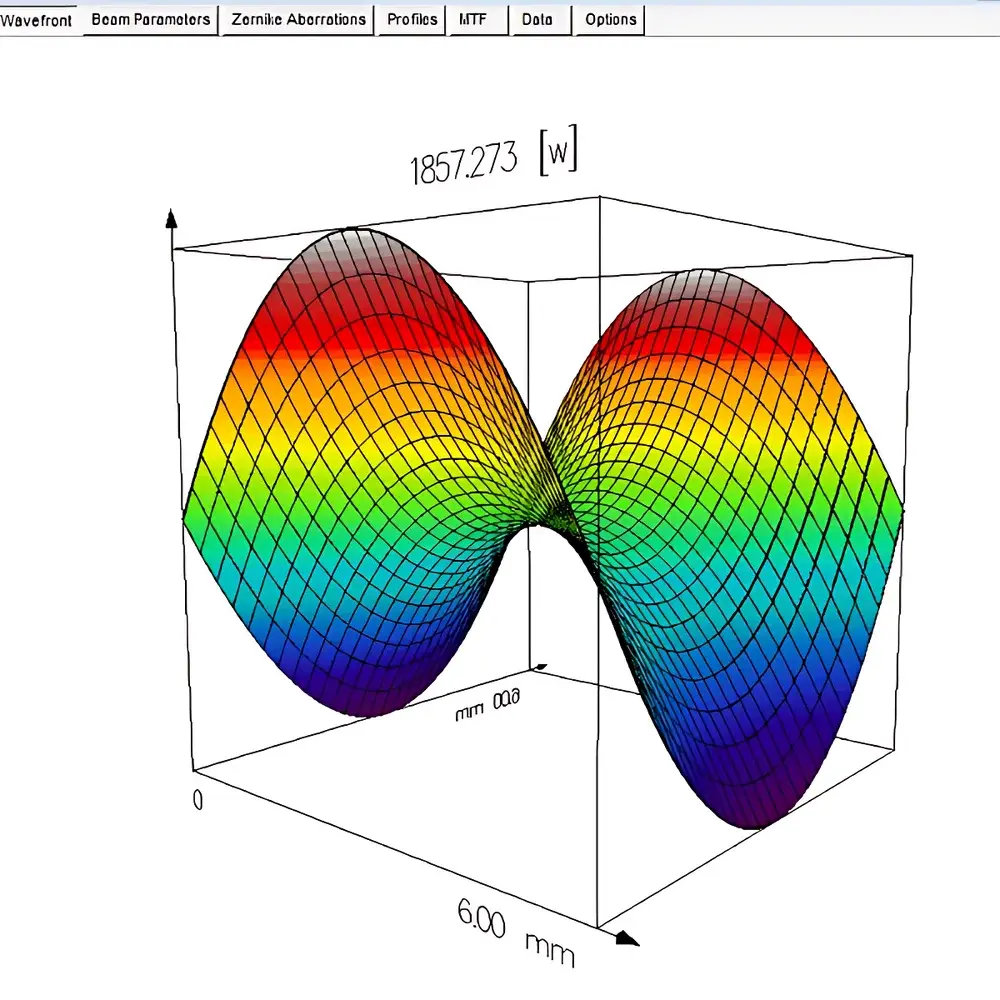
The proprietary wavefront analysis software provides full ISO-compliant reporting, including automated M² calculation, beam propagation simulation (Rayleigh range, confocal parameter), Zernike coefficient extraction, and aberration classification (defocus, astigmatism, coma, spherical). Data export supports HDF5, TIFF, and CSV formats for integration with MATLAB, Python (SciPy/NumPy), or LabVIEW-based control environments. Audit-trail logging, user-access controls, and electronic signature functionality align with GLP/GMP and FDA 21 CFR Part 11 requirements where applicable. Software updates are delivered via secure HTTPS channels with SHA-256 integrity verification.
Applications
- Beamline commissioning and in-situ diagnostics at FEL facilities (e.g., FLASH, LCLS, SACLA, European XFEL)
- EUV source development and optical train optimization for next-generation lithography tools
- Wavefront error budgeting in multilayer mirror metrology and adaptive optic correction loops
- Coherence length estimation and partial coherence analysis using intensity–phase cross-correlation metrics
- Time-resolved wavefront dynamics studies during plasma evolution or HHG pulse generation
- Validation of computational models (e.g., physical optics propagation codes such as PROOF or SRW)
FAQ
What vacuum compatibility does the sensor offer?
The sensor integrates a CF63 stainless-steel vacuum flange and is rated for continuous operation under UHV conditions (<10⁻⁹ mbar), with all internal components selected for minimal outgassing per ASTM E595.
Can the system measure non-coherent EUV sources?
Yes—it functions with both temporally and spatially incoherent radiation, including broadband plasma sources, as confirmed by measurements on DPP-based EUVL prototypes.
Is Zernike analysis included in the standard software package?
Yes—full Zernike decomposition (up to radial order 8) and RMS wavefront error reporting are embedded features, with customizable polynomial truncation and masking options.
How is calibration traceability ensured?
Each unit ships with a factory calibration certificate referencing NIST-traceable flatness standards and wavelength-specific quantum efficiency curves measured at PTB (Physikalisch-Technische Bundesanstalt).
Does the system support synchronization with external laser triggers?
Yes—TTL-compatible trigger input enables single-pulse acquisition synchronized to FEL macropulses or HHG pump-probe delays with jitter <100 ps.