
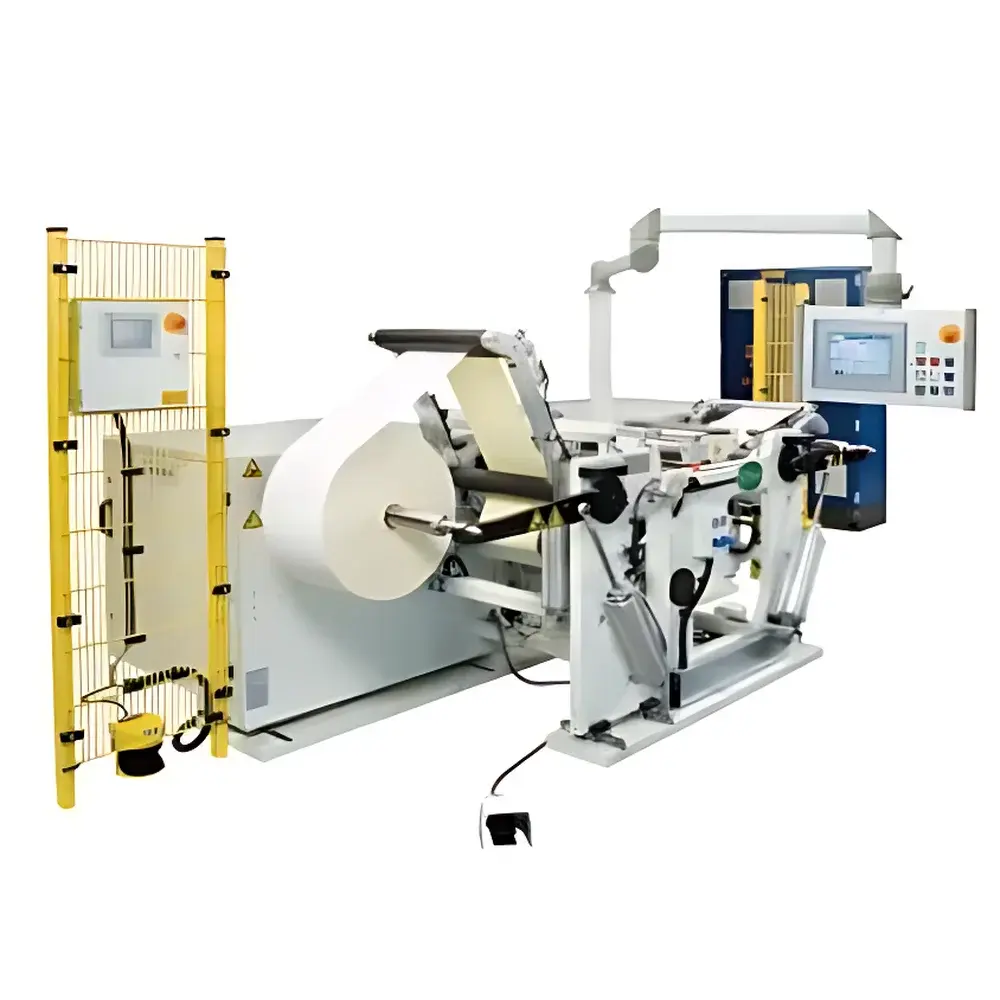
PSA MiniSlit Small-Scale Inspection and Rewinding Machine
| Brand | PSA |
|---|---|
| Origin | Germany |
| Manufacturer Type | Authorized Distributor |
| Import Status | Imported |
| Model | MiniSlit |
| Pricing | Available Upon Request |
| Maximum Web Width | 1000 mm |
| Maximum Unwind Roll Weight | 1000 kg |
| Maximum Unwind Diameter | Φ1200 mm |
| Core Diameter Range | 50–200 mm |
| Slitting Methods | Rotary Shear, Razor Blade, and Traction-Based Slitting |
| Minimum Slit Width | 10 mm (center or edge slitting) |
| Maximum Rewind Diameter | Φ1200 mm |
| Maximum Line Speed | 600 m/min |
| Compatible Substrates | Flexible Packaging Films (BOPP, PET, PE), Laminates, Paper, Foil Composites, Aluminum Foil |
Overview
The PSA MiniSlit Small-Scale Inspection and Rewinding Machine is an engineered solution for precision slitting, defect detection, and controlled rewinding of flexible packaging substrates in laboratory, R&D, and pilot-line environments. Built upon a modular mechanical architecture and designed for operational flexibility, the MiniSlit employs proven web-handling principles—including tension-controlled unwinding, servo-regulated nip engagement, and dual-drum torque-balanced rewinding—to ensure consistent edge quality, dimensional stability, and minimal substrate distortion across variable roll diameters. Its core functionality integrates real-time visual inspection with automated defect marking and optional inline removal—enabling users to validate material integrity prior to full-scale production. Unlike high-volume industrial slitters, the MiniSlit prioritizes repeatability at low-to-moderate throughput, making it suitable for qualification testing, batch verification, and process development under ISO 9001 and ISO 15378-aligned workflows.
Key Features
- Modular slitting configuration supporting rotary shear, razor blade, and traction-based (drag) cutting—enabling rapid tooling changeover for diverse substrate thicknesses and tensile characteristics.
- Dual independent rewind stations with programmable torque control and diameter-sensing feedback, accommodating core sizes from 50 mm to 200 mm and final roll diameters up to Φ1200 mm.
- Integrated optical inspection system with adjustable LED backlighting and high-resolution line-scan camera, capable of detecting pinholes, gels, coating inconsistencies, and surface contaminants down to 50 µm in size.
- Defect marking and removal module: automatically logs defect coordinates, triggers audible/visual alerts, and optionally engages pneumatic cut-off or localized slit trimming for immediate rejection of compromised sections.
- Human-machine interface (HMI) with touch-enabled PLC control panel, preloaded with standard operating procedures (SOPs) for common packaging materials including BOPP, metallized PET, aluminum foil laminates, and paper-based composites.
- CE-compliant safety architecture featuring light curtains, emergency stop redundancy, and interlocked guard doors conforming to EN ISO 13857 and EN 62061 standards.
Sample Compatibility & Compliance
The MiniSlit accommodates a broad spectrum of packaging-grade webs, including monolayer and multilayer polymer films (e.g., LDPE, CPP, PVDC-coated films), coated and uncoated papers (up to 300 g/m²), metallic foils (aluminum, copper), and adhesive-backed laminates. It maintains stable tension control across substrates ranging from 12 µm thin PET to 300 µm rigid board-laminates. All mechanical and electrical subsystems comply with EU Machinery Directive 2006/42/EC and electromagnetic compatibility requirements per EN 61000-6-2/6-4. Optional documentation packages support audit readiness for GMP-regulated environments (e.g., pharmaceutical blister packaging qualification) and traceability per ISO/IEC 17025 when paired with calibrated tension sensors and speed encoders.
Software & Data Management
The embedded control software records all operational parameters—including line speed, unwind/rewind torque, slitting position offsets, defect count per linear meter, and timestamped image thumbnails—for export in CSV and XML formats. Audit trail functionality complies with FDA 21 CFR Part 11 requirements when deployed with user authentication, electronic signatures, and immutable log archiving. Optional integration with LabVantage LIMS or SAP QM modules enables direct ingestion of slitting performance data into enterprise quality management systems. Firmware updates are delivered via secure HTTPS and validated using SHA-256 checksums.
Applications
- Pre-production validation of new film formulations or supplier materials in packaging R&D labs.
- Batch release testing for medical device pouches, pharmaceutical blister lidding, and food-grade barrier films.
- Root cause analysis of edge defects, telescoping, or winding-induced wrinkles during process troubleshooting.
- Calibration and verification of inline vision systems used in full-scale converting lines.
- Educational use in packaging engineering curricula for hands-on demonstration of web dynamics, slitting mechanics, and QC protocol design.
FAQ
What types of slitting methods does the MiniSlit support?
Rotary shear slitting, razor blade slitting, and traction-based (drag) slitting—each configurable via quick-change tooling mounts.
Can the system detect and remove defects automatically?
Yes—the optical inspection module identifies defects ≥50 µm and supports either manual flagging or automated pneumatic cutoff; full removal requires optional trim station integration.
Is the MiniSlit suitable for GMP or ISO 13485-certified facilities?
With validated firmware, electronic signature capability, and documented IQ/OQ protocols, it meets baseline requirements for regulated environments; full qualification support is available through PSA’s Application Engineering team.
What is the minimum slit width achievable?
10 mm for center or edge slitting, subject to substrate stiffness and tension stability.
Does the machine support non-standard core diameters outside the 50–200 mm range?
Custom mandrel adapters are available upon request for cores as small as 38 mm or as large as 305 mm, subject to mechanical clearance verification.






