
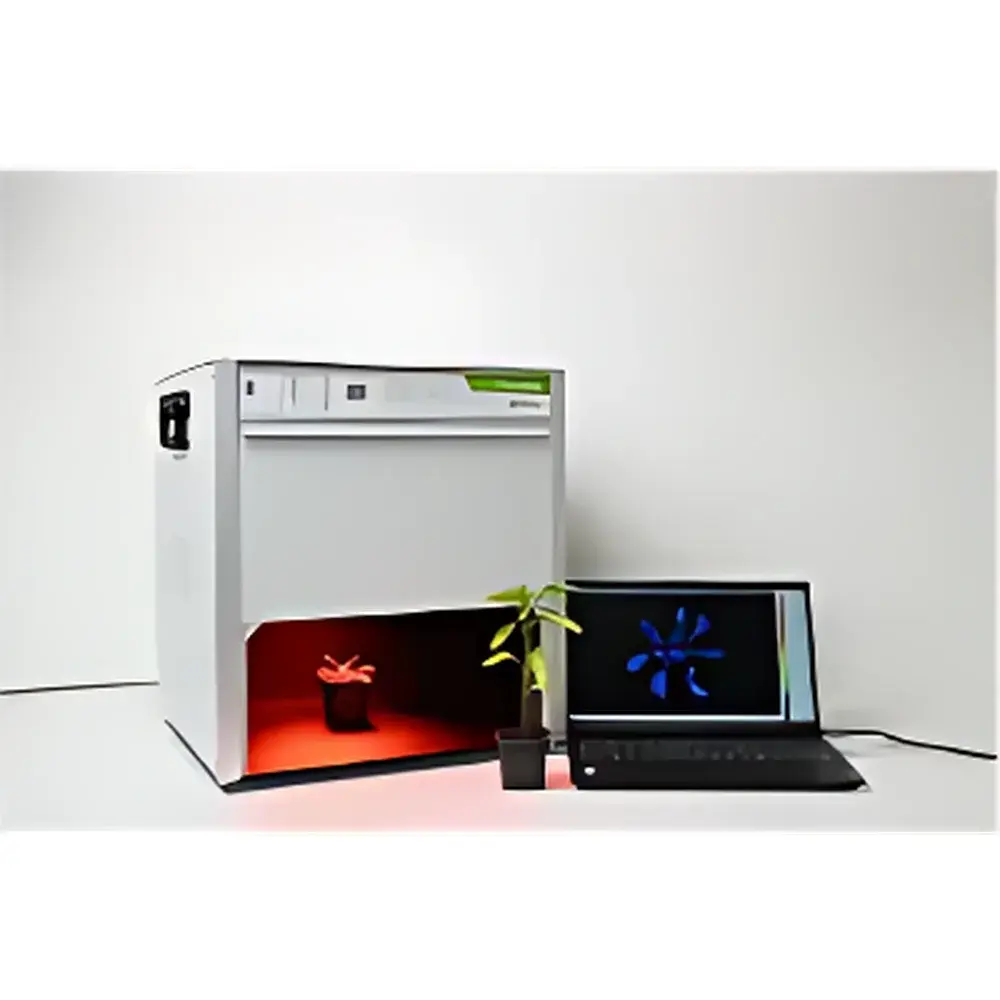
PSI FluorCam Closed-Box Chlorophyll Fluorescence Imaging System
| Brand | PSI (Photosynthesis Systems Instruments) |
|---|---|
| Origin | Czech Republic |
| Model | FluorCam Closed-Box |
| Imaging Area | 13 × 13 cm |
| CCD Sensor | TOMI-2, 1360 × 1024 px, 16-bit A/D, 20 fps max |
| LED Excitation Sources | 4 high-stability LED panels (standard: 2 red-orange + 2 white) |
| Fluorescence Parameters | >50 quantitative parameters including Fo, Fm, Fv/Fm, Y(II), NPQ, qP, qL, Rfd, ETR, OJIP-derived indices (e.g., PIabs, Vj), QA-reoxidation kinetics, PAR absorption & NDVI (optional modules) |
| Software | FluorCam v8.x with protocol editor, time-stamped automated acquisition, GLP-compliant data logging, export to CSV/HDF5 |
| Compliance | Designed for ISO/IEC 17025-aligned plant phenotyping labs |
| Dimensions | 472 × 479 × 513 mm (W×D×H) |
| Weight | 35 kg |
| Power | 88–264 V AC, 240–300 W |
Overview
The PSI FluorCam Closed-Box Chlorophyll Fluorescence Imaging System is a research-grade, fully integrated platform engineered for non-invasive, spatially resolved quantification of photosynthetic performance in intact plant tissues and whole organisms. Developed by Photosynthesis Systems Instruments (PSI), a pioneer in chlorophyll fluorescence instrumentation since the 1990s, this system combines pulse-amplitude modulation (PAM) fluorometry with high-resolution CCD imaging within a light-tight enclosure—enabling standardized dark-adaptation protocols and eliminating ambient light interference. Its core measurement principle relies on the photochemical quenching behavior of Photosystem II (PSII), where variable fluorescence (Fv) reflects the functional quantum yield of electron transport, while kinetic transients (e.g., OJIP, QA-reoxidation) resolve electron transfer efficiency across the photosynthetic chain. The system delivers two-dimensional parameter maps—not just point measurements—thereby transforming classical chlorophyll fluorescence into a scalable, high-content phenotyping modality applicable to leaves, seedlings, algae cultures, bryophytes, lichens, multi-well plates, and small whole plants.
Key Features
- Integrated dark-adaptation chamber with 7-position adjustable sample stage, ensuring consistent pre-measurement physiological state across replicates.
- Dual-wavelength actinic illumination (red-orange + white LEDs, configurable ratio) enabling wavelength-specific photosynthetic response profiling under controlled irradiance (up to 3000 µmol·m⁻²·s⁻¹).
- Four high-uniformity LED excitation panels delivering precise saturating flashes (up to 6000 µmol·m⁻²·s⁻¹) and low-intensity measuring light, calibrated for photobiological reproducibility.
- TOMI-2 scientific CCD sensor: 1360 × 1024 resolution, 16-bit dynamic range (65,536 gray levels), 20 fps video capture, and progressive scan architecture optimized for transient fluorescence kinetics.
- Comprehensive protocol engine supporting user-defined experimental sequences—including Fv/Fm, Kautsky induction, light-response curves (LC), NPQ analysis, OJIP kinetics, QA-reoxidation, PAR absorption, NDVI, and GFP imaging—with full automation and timestamped data export.
- Optional modules: OJIP rapid fluorescence kinetics imager (20+ derived parameters), QA-reoxidation dynamics module, PAR/NDVI imaging unit, TetraCam color morphology imager (20 × 25 cm FOV), UV/FR top-light panel, and temperature-controlled 48-well sample stage (15–75 °C, ±0.2 °C stability).
Sample Compatibility & Compliance
The FluorCam Closed-Box system accommodates diverse biological specimens without dissection or labeling: detached leaves, intact seedlings, potted plants, algal suspensions in cuvettes or Petri dishes, moss or lichen thalli, and standardized microplate formats (96-/384-well). Its enclosed architecture ensures compliance with standard dark-adaptation requirements defined in ISO 10211 (plant physiology testing) and ASTM E2921 (fluorescence-based stress assessment). Data acquisition workflows support traceable metadata tagging (operator, timestamp, environmental conditions, protocol version), fulfilling documentation prerequisites for GLP-compliant studies. When implemented with validated network storage and user access controls, the FluorCam software environment meets foundational criteria for FDA 21 CFR Part 11 adherence—including electronic signature capability, audit trail generation, and data integrity safeguards.
Software & Data Management
FluorCam v8.x software provides a modular interface with four primary workspaces: Live (real-time preview and manual acquisition), Protocols (graphical protocol builder with conditional logic and parameter constraints), Pre-processing (background subtraction, ROI masking, motion correction), and Results (statistical mapping, temporal trend visualization, batch export). All raw and processed datasets are stored in hierarchical directory structures with embedded EXIF-like metadata and machine-readable timestamps. Export formats include CSV (for spreadsheet integration), HDF5 (for MATLAB/Python analysis), and TIFF stacks (for ImageJ/Fiji compatibility). The software supports scheduled unattended operation—enabling diurnal or multi-day kinetics experiments with programmable repetition intervals and failure recovery protocols. Data provenance is preserved through immutable log files recording hardware configuration, calibration history, and user actions.
Applications
This system serves as a cornerstone instrument in academic and industrial plant science laboratories conducting: photosynthetic efficiency screening in crop breeding programs; abiotic stress phenotyping (drought, salinity, heavy metal toxicity, temperature extremes); biotic interaction studies (pathogen or herbivore-induced PSII inhibition); functional validation of genetic edits (e.g., CRISPR lines affecting electron transport components); algal biofuel strain optimization; ecological monitoring of bryophyte and lichen vitality in pollution biomonitoring; and high-throughput validation of remote-sensing vegetation indices via ground-truth NDVI correlation. Its capacity to generate spatially explicit, quantitative fluorescence maps makes it particularly valuable for detecting early sub-lethal stress responses before visible symptomology emerges—supporting predictive phenotyping strategies aligned with FAO and CGIAR climate-resilience initiatives.
FAQ
What is the minimum sample size resolvable at full sensor resolution?
The system resolves features ≥100 µm in lateral dimension at 13 × 13 cm field-of-view using the standard 6 mm f/1.4 lens; optional 8 mm or 12 mm lenses enable higher magnification for smaller samples.
Can the system be used for long-term time-lapse experiments?
Yes—fully automated protocols support unattended acquisition over days or weeks, with data automatically timestamped, folder-organized, and archived to network storage.
Is spectral calibration traceable to NIST standards?
PSI provides factory calibration certificates for LED irradiance output (measured with calibrated spectroradiometer) and sensor quantum efficiency; users may perform in-house verification using reference standards such as Spectralon® reflectance tiles.
How does the system handle sample movement during acquisition?
The software includes frame-to-frame registration algorithms that correct for minor drift or growth-induced displacement, preserving spatial fidelity across time-series datasets.
Are software updates included post-purchase?
PSI offers 12 months of complimentary software maintenance and technical support upon system installation; extended service contracts are available for continuous feature upgrades and regulatory compliance updates.
Related Products




