
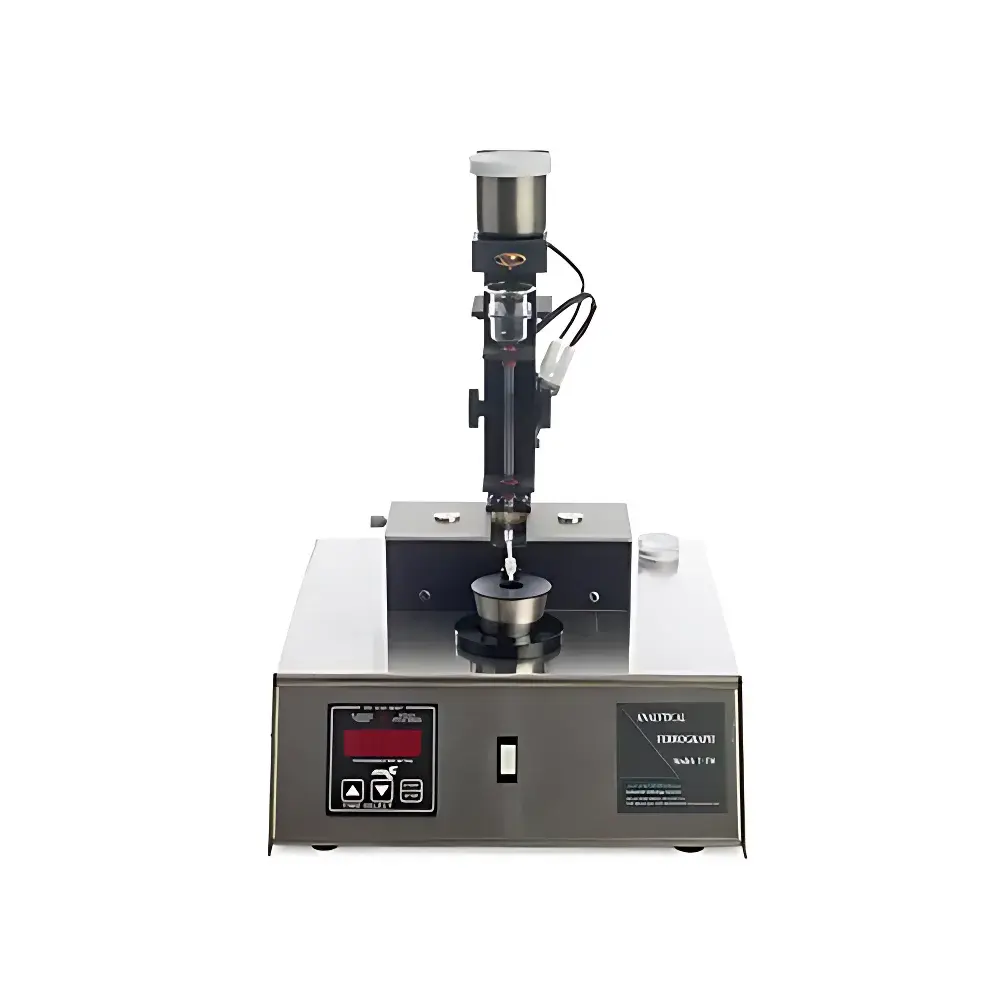
Spectro Scientific T2FM 500 Capillary-Flow Ferroscope
| Brand | Spectro Scientific |
|---|---|
| Origin | USA |
| Model | T2FM 500 |
| Particle Analysis Range | 0–800 µm |
| Compliance | ASTM D7684, ASTM D7690 |
| Configuration | Capillary-flow ferrographic deposition system with dual-color microscope, digital camera, optional densitometer and heating stage |
Overview
The Spectro Scientific T2FM 500 Capillary-Flow Ferroscope is a precision-engineered analytical ferrography system designed for the quantitative and morphological characterization of ferromagnetic wear debris and contaminant particles suspended in lubricating oils, hydraulic fluids, coolants, and fuels. Unlike pressure-driven or centrifugal ferrographic methods, the T2FM 500 employs gravity-fed capillary flow—where diluted oil samples pass at controlled velocity through a calibrated glass capillary tube (the “thistle tube”) directly onto a chemically treated glass ferrogram slide positioned within a precisely engineered gradient magnetic field. This passive, force-free deposition mechanism preserves particle integrity by eliminating shear stress, compression, or impact-induced deformation during preparation—a critical requirement for reliable wear mode identification. The resulting ferrogram enables high-fidelity microscopic evaluation of particle size, shape, composition (via color contrast under dual-wavelength illumination), orientation, and spatial distribution, forming the basis for root-cause failure analysis in rotating machinery, gearboxes, turbines, and hydraulic systems.
Key Features
- Gravity-driven capillary deposition ensures zero mechanical distortion of wear particles—preserving morphology essential for ASTM-compliant interpretation.
- Optimized gradient magnetic field architecture (patented design refined over 30+ years of field deployment) delivers consistent, repeatable particle separation across the full 0–800 µm range.
- Integrated solvent flow control module enables precise, programmable washing of non-magnetic matrix components without dislodging deposited ferrous debris.
- Modular configuration includes a dedicated ferrogram preparation station, dual-color transmitted-light microscope (50×–500× magnification), high-resolution digital camera, and optional optical densitometer for semi-quantitative particle concentration assessment.
- Optional heated stage supports accelerated drying of ferrograms under controlled thermal conditions, minimizing solvent residue artifacts.
- Minimal moving parts and consumables—no pumps, no rotors, no disposable cartridges—reducing maintenance overhead and long-term operational cost.
Sample Compatibility & Compliance
The T2FM 500 accommodates a broad spectrum of petroleum-based and synthetic lubricants, including mineral oils, PAOs, esters, and glycol-based coolants. Sample preparation follows standardized dilution protocols per ASTM D7690, using isopropyl alcohol or chlorinated solvents compatible with ferrographic deposition chemistry. All hardware and procedural workflows are validated against ASTM D7684 (“Standard Guide for Microscopic Characterization of Particles from In-Service Lubricants”) and ASTM D7690 (“Standard Practice for Microscopic Characterization of Particles from In-Service Lubricants by Ferrography”). The system supports GLP-compliant documentation when paired with Spectro’s certified image acquisition software, enabling audit-ready metadata capture (timestamp, operator ID, sample ID, magnification, illumination mode) required for ISO/IEC 17025-accredited laboratories.
Software & Data Management
The T2FM 500 integrates with Spectro’s proprietary FerroGraph™ Image Acquisition and Analysis Software, which provides calibrated pixel-to-micron scaling, automated particle boundary detection, and classification templates aligned with Anderson’s *Ferrous Debris Atlas* (the industry reference standard). Software features include configurable annotation layers, comparative side-by-side ferrogram viewing, batch export of TIFF/PDF reports with embedded metadata, and export-ready CSV files for integration into CMMS or predictive maintenance platforms. All image acquisition sessions generate immutable audit trails compliant with FDA 21 CFR Part 11 requirements when deployed on validated Windows OS environments with user access controls and electronic signature capability.
Applications
This ferroscope serves as a cornerstone tool in condition-based maintenance programs across aerospace, power generation, marine propulsion, wind turbine operations, and heavy-duty industrial equipment fleets. It is routinely deployed to distinguish between sliding, rolling, cutting, and fatigue wear modes; identify abnormal contamination (e.g., rust, sand, fiber); detect early-stage bearing spalling or gear tooth micropitting; and correlate particle morphology trends with vibration or thermographic anomalies. Its ability to resolve sub-5 µm ferrous fines—often precursors to catastrophic failure—makes it indispensable for proactive reliability engineering and remaining useful life estimation.
FAQ
What distinguishes capillary-flow ferrography from rotary or direct-read methods?
Capillary-flow deposition eliminates external forces that alter particle geometry, enabling definitive wear mode diagnosis—unlike direct-read instruments that only quantify total ferrous content.
Is the T2FM 500 suitable for field laboratories or only fixed-site facilities?
Its robust mechanical design, minimal calibration dependencies, and low-power operation make it deployable in mobile labs and offshore platforms, provided stable benchtop mounting and ambient temperature control (15–30°C) are maintained.
Can the system be integrated with existing LIMS or enterprise asset management systems?
Yes—FerroGraph™ software supports ODBC-compliant database connectivity and HL7-compatible structured data export for seamless ingestion into third-party analytics ecosystems.
What training and technical support resources are available?
Spectro offers factory-certified application training, ASTM-aligned interpretation workshops, and remote diagnostic support via secure screen-sharing; all documentation conforms to ISO 9001:2015 technical writing standards.
Are replacement slides and calibration standards traceable to NIST?
Ferrogram slides are manufactured to ISO 11171 specifications; magnetic field calibration kits include NIST-traceable flux density references with certificate of conformance.






