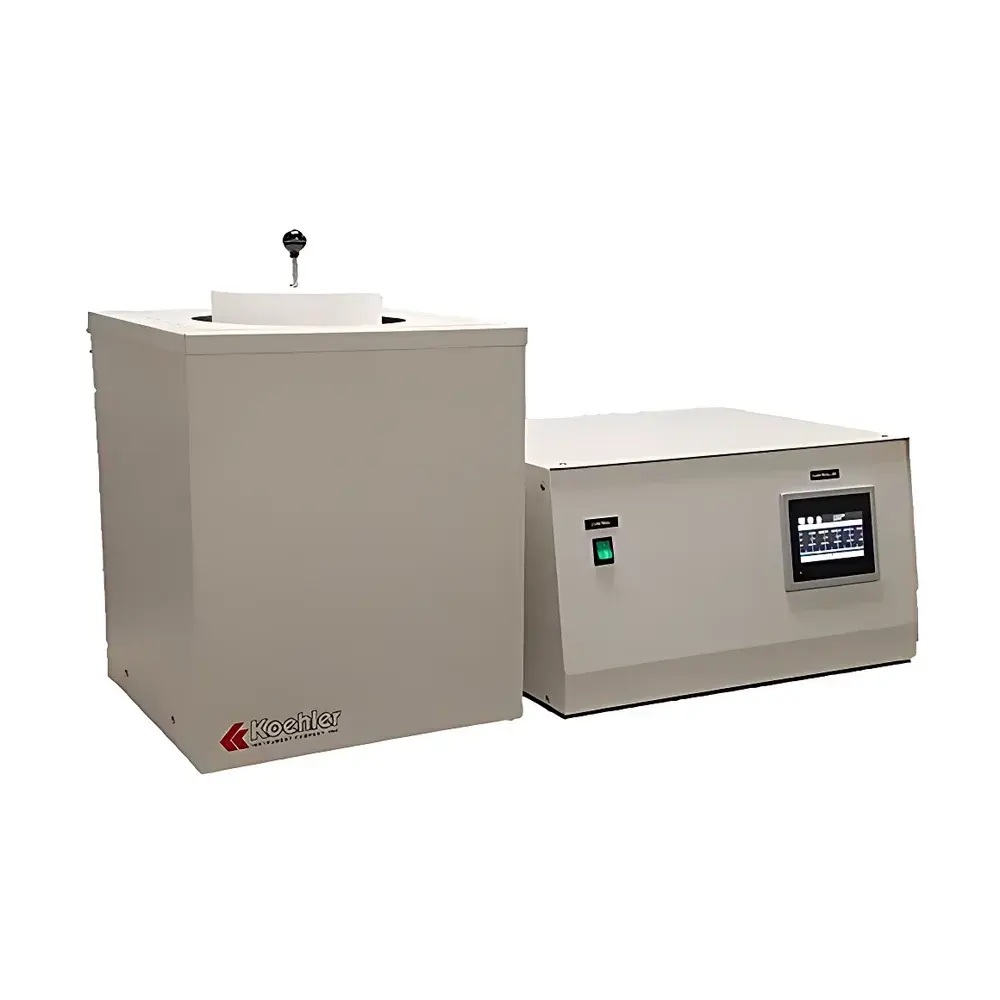
Koehler K47001 Automatic Autoignition Temperature Tester
| Brand | Koehler |
|---|---|
| Origin | USA |
| Manufacturer Status | Authorized Distributor |
| Product Origin | Imported |
| Model | K47001 |
| Pricing | Upon Request |
| Test Method | Open-Cup |
| Operation Mode | Fully Automatic |
| Applicable Standard | ASTM E659 |
| Repeatability | ±5% |
| Ignition Mechanism | Fully Automated |
| Temperature Range | Ambient to 1200 °C |
| Temperature Control Accuracy | ±1 °C |
| Power Supply | 230 V, 50/60 Hz, Single-Phase, 7.7 A |
| Dimensions (W×D×H) | 37″ × 17″ × 25″ (94 cm × 43.2 cm × 63.5 cm) |
| Net Weight | 85 lb (38.6 kg) |
Overview
The Koehler K47001 Automatic Autoignition Temperature Tester is a precision-engineered laboratory instrument designed for the quantitative determination of the autoignition temperature (AIT) of liquid and solid chemical substances under controlled open-cup conditions. Based on the fundamental thermochemical principle that autoignition occurs when a sample’s exothermic oxidation rate exceeds its heat dissipation capacity—leading to thermal runaway—the K47001 implements a standardized heating ramp protocol in accordance with ASTM E659, “Standard Test Method for Autoignition Temperature of Liquid Chemicals.” The system employs a calibrated vertical furnace with dual independent temperature monitoring: one sensor tracks ambient furnace chamber temperature, while a second high-stability thermocouple measures real-time vapor-phase temperature inside the reaction flask. Upon spontaneous ignition—detected optically via integrated flame-sensing photodiodes—the instrument records the peak temperature at the moment of rapid thermal excursion as the AIT value. This measurement is critical for hazard classification (e.g., GHS Category 1–4), process safety design (e.g., NFPA 497, CCPS guidelines), and regulatory compliance in petrochemical, pharmaceutical, and specialty chemical manufacturing.
Key Features
- Fully automated test sequence—from sample introduction and furnace ramping to ignition detection and data logging—minimizing operator intervention and inter-laboratory variability.
- Dual digital temperature control system: furnace setpoint accuracy ±1 °C over the full 25 °C to 1200 °C range; internal flask thermocouple resolution of 0.1 °C for precise ignition event capture.
- Open-cup configuration compliant with ASTM E659 geometry requirements, including specified crucible dimensions, air flow management, and viewing port alignment for unambiguous flame detection.
- Integrated optical flame detection using UV-enhanced photodiodes with adjustable sensitivity thresholds to distinguish true autoignition from transient thermal spikes or background radiation.
- Robust stainless-steel furnace architecture with ceramic fiber insulation, rated for continuous operation up to 1200 °C and engineered for long-term thermal stability and repeatability.
- Front-panel touchscreen interface with intuitive workflow navigation, real-time temperature trend display, and immediate pass/fail indication against user-defined AIT acceptance criteria.
Sample Compatibility & Compliance
The K47001 accommodates liquid samples (including viscous hydrocarbons, solvents, and formulated blends) and finely divided solid powders (e.g., metal hydrides, organic peroxides) within standard ASTM E659 crucibles (typically 10–20 mL volume). Sample volatility, vapor pressure, and thermal decomposition onset are accounted for during method development per ASTM guidance. The instrument meets essential requirements for GLP-compliant environments: audit-trail-enabled data storage, electronic signature support (per FDA 21 CFR Part 11 optional configuration), and traceable calibration using NIST-traceable reference standards. It is routinely validated for use in HAZOP studies, SDS authoring (Section 9), and OSHA Process Safety Management (PSM) programs.
Software & Data Management
Data acquisition and reporting are managed via Koehler’s proprietary K-Soft™ v4.2 software suite (Windows-based, USB-connected). Each test generates a timestamped .csv file containing time-stamped furnace temperature, flask temperature, and optical signal intensity—enabling post-hoc analysis of pre-ignition kinetics. Reports are exportable in PDF format with embedded metadata (operator ID, sample ID, calibration certificate number, environmental conditions). Software supports IQ/OQ documentation templates aligned with ISO/IEC 17025 and ASTM E2500 verification frameworks. All raw data files are write-protected upon generation and retain immutable integrity for regulatory inspection.
Applications
- Determination of AIT for crude oil fractions, distillates, and refinery intermediates to inform storage tank inerting strategies and relief valve sizing.
- Classification of solvent blends used in coatings, adhesives, and cleaning formulations per UN GHS and CLP Regulation Annex VI.
- Thermal safety screening of active pharmaceutical ingredients (APIs) and excipients during early-stage process development.
- Verification of AIT claims in safety data sheets (SDS) submitted to REACH, TSCA, and China MEIC regulatory authorities.
- Supporting DSC and ARC data interpretation by establishing upper-bound thermal stability thresholds under oxidative atmospheres.
FAQ
What distinguishes autoignition temperature (AIT) from flash point or fire point?
AIT is the lowest temperature at which a substance spontaneously ignites in air without an external ignition source—governed by homogeneous gas-phase kinetics. Flash point (ASTM D93/D56) and fire point involve external spark/flame initiation and reflect surface vapor flammability, not bulk thermal runaway.
Can the K47001 be used for gases or aerosols?
No. ASTM E659 explicitly applies to liquids and solids. Gaseous AIT testing requires specialized flow-reactor systems (e.g., ASTM E2079) and is outside the K47001’s mechanical and safety design scope.
Is calibration verification required before each test run?
Per ASTM E659 Section 8.2, daily verification using a certified reference material (e.g., n-heptane, AIT = 205 °C ± 3 °C) is recommended; full calibration traceable to NIST is required annually or after maintenance.
How does the instrument handle samples with low thermal stability?
The programmable ramp rate (default 1 °C/min, adjustable 0.5–5 °C/min) allows optimization for thermally labile compounds; optional nitrogen purge capability (accessory) mitigates premature oxidative degradation prior to target temperature.
Does the system support multi-user access control and electronic signatures?
Yes—when configured with K-Soft™ Enterprise Edition and connected to a domain-authenticated Windows environment, it supports role-based permissions, 21 CFR Part 11-compliant electronic signatures, and full audit trail generation.