
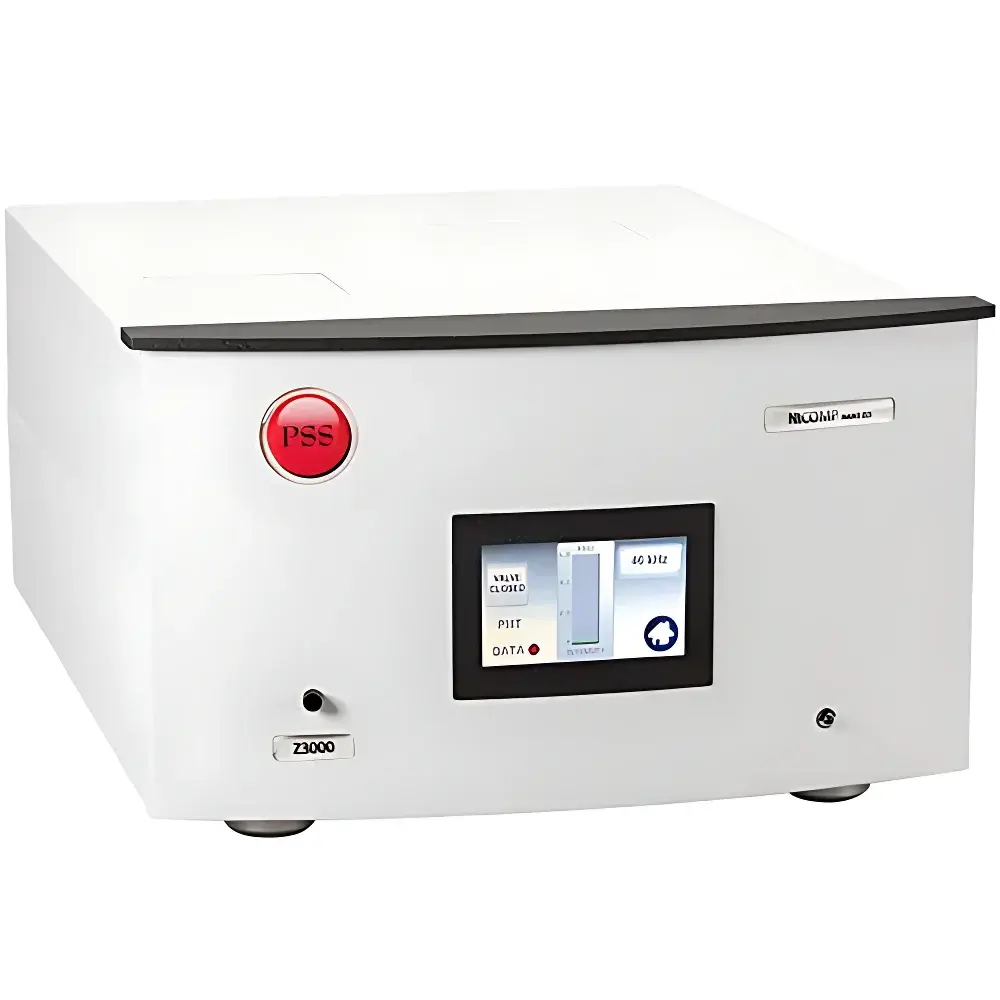
PSS Nicomp N3000 Plus Laser Particle Size Analyzer
| Brand | Particle Sizing Systems (PSS) |
|---|---|
| Origin | USA |
| Manufacturer Type | Authorized Distributor |
| Product Category | Imported Instrument |
| Model | PSS Nicomp N3000 Plus |
| Price Range | USD 42,000 – 85,000 |
| Dispersion Method | Wet Dispersion |
| Instrument Type | Laboratory-Grade Laser Particle Size Analyzer |
| Measurement Range | 0.3 nm – 10 µm |
| Repeatability | ±99% (intensity-weighted distribution) |
| Analysis Time | 1–10 minutes per sample |
| Detection Principle | Dynamic Light Scattering (DLS) |
| Temperature Control Accuracy | ±0.1 °C (0–90 °C) |
| pH Compatibility | 1–14 |
| Maximum Sample Concentration | 40% w/v |
| Laser Options | 35 mW / 50 mW / 100 mW @ 635 nm (red) or 514.4 nm (green) |
| Detection Angles | 10°–175° (0.7° incremental step, including standard 90°) |
| Detector | APD-LDC (Avalanche Photodiode with 7–10× gain vs. PMT) |
| Standard Cuvettes | 4 mL quartz/plastic (1 cm × 4 cm) |
| Software | Research-grade Nicomp Software Suite compliant with FDA 21 CFR Part 11 (audit trail, electronic signatures, user access control) |
| Optional Modules | Auto-dilution system (dilutes up to 50% w/v stock), Multi-Angle Detection (3000/MA), High-Power Laser Driver (3000/HPLD), Automated Sampler (60-position), Zeta Potential Integration (with Metrohm titration module) |
Overview
The PSS Nicomp N3000 Plus Laser Particle Size Analyzer is a laboratory-grade dynamic light scattering (DLS) instrument engineered for high-resolution size distribution analysis of colloidal and nanoscale dispersions. Operating on the physical principle of Brownian motion-induced intensity fluctuations in scattered laser light, the system calculates hydrodynamic diameter via the Stokes-Einstein equation. Its validated measurement range spans 0.3 nm to 10 µm — covering proteins, surfactant micelles, liposomes, polymeric nanoparticles, viral vectors, and submicron emulsions — without requiring chromatographic separation. Unlike conventional DLS instruments constrained to Gaussian-based monomodal interpretation, the Nicomp N3000 Plus implements a proprietary multi-modal deconvolution algorithm that resolves coexisting populations within heterogeneous samples — a capability critical for QC in biopharmaceutical formulation, nanomedicine development, and advanced materials R&D.
Key Features
- APD-LDC detector with 7–10× higher quantum efficiency than standard photomultiplier tubes (PMTs), enabling reliable detection of low-scattering species (e.g., proteins at <1 mg/mL, uncharged polymers, low-refractive-index particles)
- Multi-angle detection architecture (10°–175°, 0.7° resolution) optimized for accurate sizing of particles >100 nm where angular dependence of scattering intensity becomes significant
- Modular laser platform supporting multiple wavelengths (514.4 nm green; 635 nm red) and power levels (35–100 mW), ensuring sufficient photon flux for weakly scattering systems (e.g., dextran, silica sols, biological macromolecules)
- Nicomp multimodal distribution algorithm — independently validated against TEM and SEC-MALS — distinguishes components differing in size by as little as 2:1 intensity ratio (e.g., 93 nm + 150 nm latex standards)
- Integrated temperature-controlled cuvette holder (0–90 °C, ±0.1 °C stability) with condensation suppression, essential for thermally sensitive biomolecules and kinetic studies
- Automated dilution module capable of serially diluting stock suspensions up to 50% w/v into optimal concentration windows — eliminating operator bias, reducing inter-run variability (<1% RSD), and accelerating throughput
- Compliance-ready software architecture featuring full 21 CFR Part 11 functionality: role-based access control, immutable audit trails, electronic signatures, and data integrity validation reports
Sample Compatibility & Compliance
The Nicomp N3000 Plus accommodates aqueous and organic media across pH 1–14, including buffers, alcohols, acetone, chloroform, and DMF. It supports standard 4 mL quartz or disposable plastic cuvettes and optional 1 mL micro-cuvettes (10 µL minimum volume). The system meets ISO 22412:2017 (DLS methodology), USP (liposome particle size), and EP 2.9.31 (nanoparticle characterization) requirements. All firmware, calibration routines, and analytical protocols are fully traceable and support GLP/GMP-regulated environments. No routine optical recalibration is required due to factory-aligned laser/detector geometry and internal reference monitoring.
Software & Data Management
The Nicomp Software Suite provides dual-mode analysis: Gaussian fitting for rapid monodisperse assessment and Nicomp multimodal decomposition for rigorous polydisperse quantification. Raw autocorrelation functions, decay curves, and residual plots are exportable in CSV, TXT, and PDF formats. Batch processing supports method templates, pass/fail criteria, and automated report generation (PDF/HTML). Audit logs record every parameter change, user action, and data export event. Validation packages include IQ/OQ documentation, system suitability tests (SST), and performance qualification (PQ) protocols aligned with ASTM E2412 and ISO/IEC 17025 standards.
Applications
This instrument serves critical roles in pharmaceutical nanoparticle characterization (lipid nanoparticles, polymeric micelles, protein aggregates), semiconductor CMP slurry monitoring (SiO₂, CeO₂, Al₂O₃), ceramic precursor quality control, cosmetic emulsion stability assessment, food-grade colloidal dispersion optimization, and environmental nanoparticle tracking (e.g., TiO₂, ZnO in wastewater). Its ability to resolve HDL/LDL/VLDL subpopulations in native plasma — demonstrated in peer-reviewed clinical studies — further establishes its utility in translational diagnostics and biomarker research.
FAQ
Does the Nicomp N3000 Plus require annual recalibration?
No. The optical path is factory-aligned and thermally stabilized; routine recalibration is not necessary. System suitability testing using NIST-traceable latex standards is recommended before regulated analyses.
Can it measure zeta potential?
Not natively, but it integrates seamlessly with Metrohm autotitrators via RS-232/USB for automated pH-titrated zeta potential mapping when paired with optional electrophoretic light scattering (ELS) accessories.
Is the multi-angle detection module mandatory for sub-100 nm analysis?
No — 90° detection is optimal for nanoparticles 200 nm) where scattering anisotropy affects apparent size.
How does the Nicomp algorithm differ from CONTIN or NNLS methods?
Unlike CONTIN (which assumes exponential decay models) or NNLS (non-negative least squares), Nicomp uses constrained iterative deconvolution with baseline drift compensation and physically informed peak width constraints — resulting in improved reproducibility and reduced artifact sensitivity in complex biological matrices.
What sample volume is needed for routine analysis?
Standard protocol requires 400–800 µL in a 4 mL cuvette. With the 1 mL micro-cuvette option, as little as 10 µL can be analyzed — ideal for precious biologics or limited clinical specimens.



