
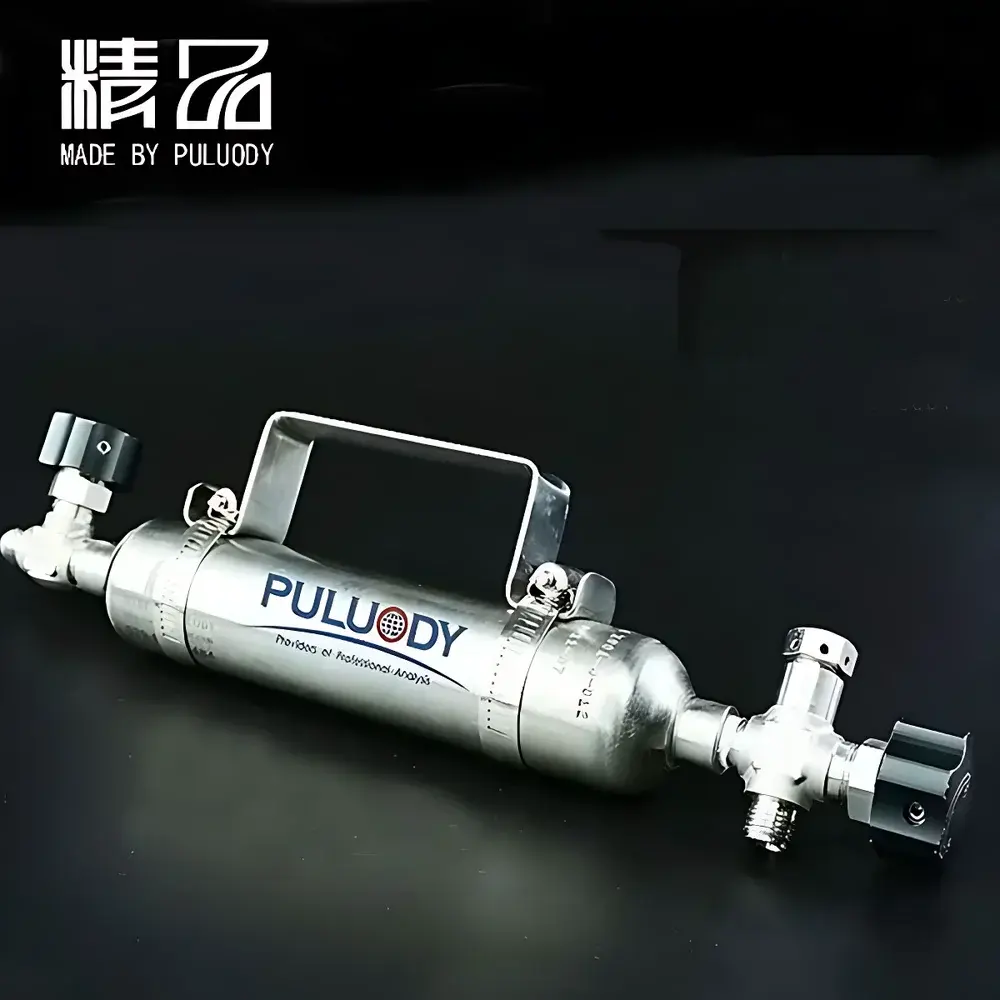
PULL PULL Series Liquefied Petroleum Gas (LPG) & Natural Gas Sampling Cylinders
| Origin | Shaanxi, China |
|---|---|
| Manufacturer Type | Authorized Distributor |
| Origin Category | Domestic (China) |
| Model | PULL |
| Price | USD 295 (FOB) |
| Working Pressure | 4–20 MPa |
| Burst Pressure | 7–38 MPa |
| Operating Temperature | −60 °C to +80 °C |
| Material | ASTM A213/A269 Grade 316L Stainless Steel |
| Volume Range | 100 mL to 5000 mL |
| Valve Configuration | Dual-end (single- and double-valve variants available) |
| Safety Features | Integrated rupture disc, explosion-proof needle valves |
| Optional Internal Coating | PTFE (per ASTM D1250 & ISO 4257) |
| Pressure Gauge Port | 1/4″ NPT, compatible with Class 1.6 analog or digital gauges |
| Accessories | Stainless steel 304 support stand, high-pressure metallic or nylon-reinforced polymer transfer hoses, push-to-connect quick couplings (ISO 8434-1 compliant) |
Overview
The PULL Series Liquefied Petroleum Gas (LPG) and Natural Gas Sampling Cylinders are engineered for high-integrity, pressure-retentive sampling of volatile hydrocarbon streams under demanding field and laboratory conditions. Designed in strict accordance with SH/T 0233–92 “Standard Test Method for Sampling Liquefied Petroleum Gases (LPG)” and SY/ZJ 1045 “Technical Specification for Sampling Equipment in Petrochemical Plants”, these cylinders operate on the principle of isobaric–isothermal phase containment—ensuring representative sample integrity during transfer, storage, and transport. Constructed from seamless, cold-drawn ASTM A269 Grade 316L stainless steel tubing, each cylinder undergoes full-body hydrostatic testing at 1.5× maximum working pressure and certified non-destructive examination (NDE) per ASME BPVC Section VIII, Div. 1. The dual-valve configuration enables controlled purging, dead-volume minimization, and direct connection to gas chromatography (GC), Fourier-transform infrared (FTIR), or compositional analyzers without phase segregation or adsorption artifacts.
Key Features
- Pressure-rated operation from 4 MPa to 20 MPa nominal working pressure, with burst resistance up to 38 MPa — validated per ISO 11119-2 for composite and metallic gas containers
- Full-temperature range compatibility: −60 °C to +80 °C, enabling cryogenic ethylene/propylene sampling and ambient LPG/NGL handling
- Electropolished internal surface finish (Ra ≤ 0.4 µm) standard; optional PTFE lining (per ASTM D1250 Annex A4) for trace-level sulfur, mercury, or oxygenate analysis where metal surface interaction must be eliminated
- Integrated safety architecture: ASME-certified rupture disc (set at 1.3× working pressure), dual-stage explosion-proof needle valves with PTFE-sealed stems, and 1/4″ NPT gauge port with calibrated pressure monitoring capability
- Modular accessory interface: Compatible with ISO 8434-1 push-to-connect quick couplings, 304 stainless steel braided high-pressure hoses (up to 40 MPa), and laboratory-grade support stands fabricated from passivated 304 stainless steel
Sample Compatibility & Compliance
These cylinders are validated for sampling and temporary storage of saturated and unsaturated light hydrocarbons—including ethylene, propylene, butadiene, liquefied natural gas (LNG) boil-off gas, compressed natural gas (CNG), and refinery-grade LPG—provided the medium exhibits no corrosive reactivity toward 316L stainless steel at specified T/P conditions. Compliance extends across multiple regulatory and methodological frameworks: SH/T 0233–92, SY/ZJ 1045, ASTM D1265 (Standard Practice for Sampling Liquefied Petroleum (LP) Gases), ASTM D1252 (Test Methods for Analysis of Liquefied Petroleum Gases), ISO 4257 (Petroleum products — Sampling of liquefied petroleum gases), and EN 15377 (Gas analysis — Sampling of gaseous fuels). All units ship with material test reports (MTRs) per EN 10204 3.1 and hydrostatic test certificates traceable to national standards.
Software & Data Management
While the PULL sampling cylinder is a passive mechanical device, its integration into auditable analytical workflows complies with data integrity requirements under FDA 21 CFR Part 11 and EU Annex 11. Each cylinder is serialized and assigned a unique asset ID, enabling linkage to laboratory information management systems (LIMS) via barcode or RFID tagging (optional add-on). When used with digital pressure transducers or smart gauges (e.g., WIKA CTH series), real-time pressure logging supports GLP/GMP-compliant chain-of-custody documentation. Calibration records for associated pressure instrumentation, hose integrity logs, and valve maintenance histories are maintained per ISO/IEC 17025:2017 clause 6.4.10.
Applications
- Upstream: Wellhead gas composition verification, flare gas auditing, and custody transfer sampling at LNG export terminals
- Midstream: Pipeline quality monitoring (H₂S, CO₂, water dew point), fractionator overhead sampling, and blend verification in NGL recovery units
- Downstream: Refinery FCCU feed characterization, alkylation unit feedstock screening, and petrochemical plant reactor inlet analysis
- Standards laboratories: Preparation of certified reference materials (CRMs) for GC calibration, proficiency testing schemes (e.g., ILAC P15), and round-robin interlaboratory studies
- Environmental compliance: Emission source testing per EPA Method 18 and ISO 10156 for flammable gas classification
FAQ
What pressure rating options are available for PULL sampling cylinders?
Standard configurations support 4 MPa, 16 MPa, and 20 MPa working pressures. Custom designs up to 30 MPa are available upon engineering review and ASME Code Case approval.
Can these cylinders be used for hydrogen or ammonia sampling?
Not without material verification: Hydrogen embrittlement risk requires ASTM A213 TP316L + HIC testing per NACE MR0175/ISO 15156; ammonia service demands ASTM A240 S32205 duplex or super-austenitic alternatives.
Is PTFE coating applied via spray, dip, or electrostatic process?
Coating is applied using vacuum-assisted plasma-polymerized PTFE deposition (per ASTM D7234), ensuring uniform 25–35 µm thickness, adhesion class 5 per ISO 2409, and minimal outgassing below 1×10⁻⁹ Torr.
Are calibration certificates included with pressure gauges?
Yes — all factory-installed analog gauges include UKAS-accredited calibration certificates (valid for 12 months); digital transducers ship with NIST-traceable calibration data sheets.
What is the recommended inspection interval for repeated use?
Per API RP 2553 and ISO 11119-2, visual inspection and leak testing required before each use; hydrostatic retest every 5 years or after any overpressure event exceeding 1.1× MAWP.





