York Instrument DataNet Wireless Data Acquisition System
| Brand | York Instrument |
|---|---|
| Origin | USA |
| Manufacturer Type | Manufacturer |
| Origin Category | Imported |
| Model | DataNet |
| Price | Upon Request |
| ADC Resolution | 16-bit |
| Input Channels | 4 analog/digital inputs per node |
| Wireless Protocol | Zigbee (IEEE 802.15.4) @ 2.4 GHz |
| Max RF Range (LoS) | 80 m (extendable to 800 m with repeaters) |
| Network Capacity | Up to 65,000 devices |
| Data Rate | 250 kbps |
| Security | 128-bit AES encryption |
| Memory | 59,000 samples per node |
| Sampling Interval | 1 s – 2 h (user-configurable) |
| Power | Rechargeable internal battery + external 12 VDC @ 2 A adapter |
| Operating Temperature | −20 °C to +50 °C |
| Certifications | CE, FCC |
| Compliance | RoHS, FCC Part 15, EN 300 328 |
Overview
The York Instrument DataNet Wireless Data Acquisition System is a modular, IEEE 802.15.4–compliant Zigbee-based telemetry platform engineered for high-reliability, low-maintenance monitoring of industrial and laboratory environments. Designed around a robust 16-bit analog-to-digital conversion architecture, DataNet acquires and transmits time-synchronized measurements from up to four heterogeneous sensor inputs per node—including current loops (4–20 mA), low-level voltage signals (0–1 V, 0–50 mV), pulse/frequency events, and multiple temperature sensor types (PT100, J/K/T thermocouples, NTC). Its mesh networking topology enables self-healing, multi-hop data routing—eliminating single points of failure and supporting scalable deployments across large physical footprints such as multi-story laboratories, warehouse complexes, or distributed manufacturing facilities. The system operates in the globally license-free 2.4 GHz ISM band and incorporates 128-bit AES encryption to ensure data integrity and confidentiality in regulated environments.
Key Features
- 16-bit resolution ADC with configurable sampling intervals from 1 second to 2 hours per channel
- Zigbee mesh network architecture: each node functions as both endpoint and repeater, enabling seamless range extension without infrastructure rewiring
- Support for up to 8 end-node devices and 16 repeaters per gateway; individual repeaters support up to 24 end nodes and 16 additional repeaters
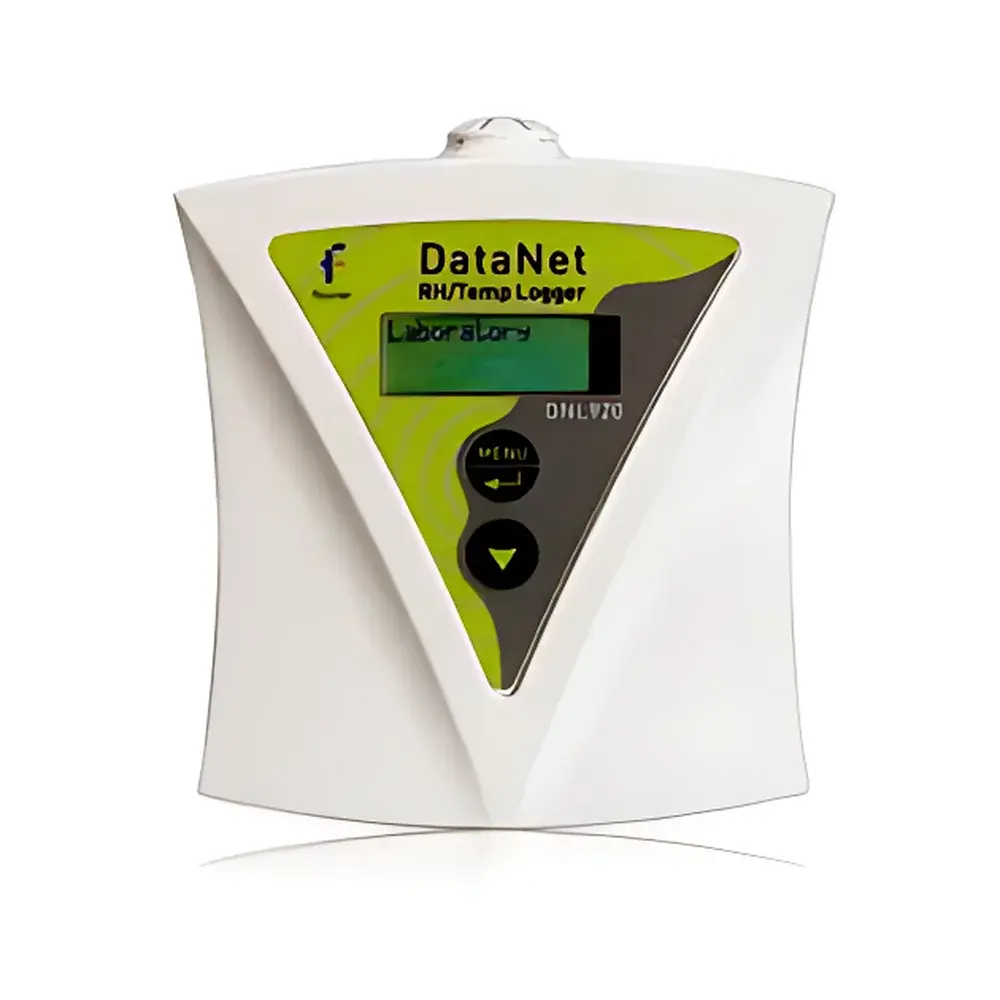
- Dual hardware variants: DNL910 (external PT100 input only) and DNL920 (integrated digital temperature/humidity sensor + same external input flexibility)
- Onboard 2-line LCD display (16 characters) with full keypad navigation for local configuration and real-time value verification
- Mini USB 2.0 interface for firmware updates, local data offload, and direct PC commissioning
- Integrated alarm output (open-collector, 50 mA/3 V DC max) with programmable thresholds for process interlock or supervisory signaling
- Comprehensive power management: rechargeable internal battery with onboard charger + optional 12 VDC @ 2 A external supply for continuous operation
Sample Compatibility & Compliance
DataNet supports standardized industrial sensor interfaces compliant with IEC 60584 (thermocouples), IEC 60751 (RTDs), and ISA-50.00.01 (analog signal transmission). Input specifications include 4–20 mA loop-powered inputs (±0.5 % accuracy, 0.47 µA resolution), millivolt-range inputs (0–50 mV, ±0.5 %, 3 µV resolution), and precision temperature measurement with cold-junction compensation (±0.3 °C typical for J/K/T thermocouples within −60 °C to +60 °C range). Humidity sensing (DNL920 only) meets ISO 16000-11 performance criteria (±3 % RH at 10–90 % RH). The system conforms to CE (EMC Directive 2014/30/EU, RED 2014/53/EU) and FCC Part 15 Subpart C requirements. All firmware and configuration workflows are designed to support GLP/GMP-aligned audit trails when used with validated software environments.
Software & Data Management
DataNet is managed via Windows-native configuration and visualization software supporting real-time telemetry dashboards, historical trend analysis, and export to CSV, Excel, or MATLAB-compatible formats. The application enables full remote calibration of all analog channels—including user-defined linearization tables for non-standard sensors—and supports dynamic sensor definition (e.g., custom scaling, engineering unit mapping, alarm setpoints). Data logging occurs locally on each node’s non-volatile memory (59,000 samples capacity) while simultaneously streaming to the central gateway. Software features include synchronized timestamping (NTP-compatible), automatic gap-filling for intermittent RF links, and role-based access control for multi-user environments. Optional integration with OPC UA servers allows interoperability with SCADA, MES, and cloud-based IIoT platforms—facilitating compliance with FDA 21 CFR Part 11 when deployed with electronic signature and audit-log modules.
Applications
- Continuous environmental monitoring in GxP-compliant laboratories (temperature, humidity, differential pressure)
- Thermal profiling of HVAC systems, cleanrooms, and cold-chain storage areas
- Process validation and equipment qualification (IQ/OQ/PQ) per ASTM E2874 and ISO 14644
- Energy consumption tracking via pulse-counting inputs interfaced with utility meters
- Remote condition monitoring of rotating machinery using vibration or temperature sensors
- Multi-point thermal mapping in pharmaceutical stability chambers and bioreactor suites
- Legacy system retrofitting where trenching or conduit installation is cost-prohibitive or operationally disruptive
FAQ
What wireless standard does DataNet use, and is it interoperable with existing Zigbee infrastructure?
DataNet implements the IEEE 802.15.4–2006 PHY/MAC layer with Zigbee PRO stack (ZDO/ZCL), but operates on a proprietary profile optimized for deterministic industrial telemetry. It is not interoperable with consumer-grade Zigbee smart-home devices.
Can DataNet operate in environments with high RF interference, such as near Wi-Fi routers or industrial drives?
Yes—the system employs adaptive channel selection, CSMA/CA collision avoidance, and 16 orthogonal channels in the 2.4 GHz band. Field tests demonstrate stable operation at co-location distances ≥1 m from 802.11n access points.
Is firmware update capability available over-the-air (OTA)?
No—firmware updates require physical USB connection to prevent unauthorized modification in regulated settings. This design aligns with IEC 62443-3-3 SL2 requirements for secure device lifecycle management.
Does the system support time synchronization across nodes for phase-critical measurements?
Yes—gateway-initiated time sync ensures sub-second alignment across all nodes in the mesh, sufficient for thermal ramp-rate analysis and event correlation across distributed assets.
Are calibration certificates traceable to NIST or other national metrology institutes provided?
Factory calibration reports (including as-found/as-left data) are supplied with each shipment. NIST-traceable calibration services are available through York Instrument’s ISO/IEC 17025-accredited calibration lab upon request.