
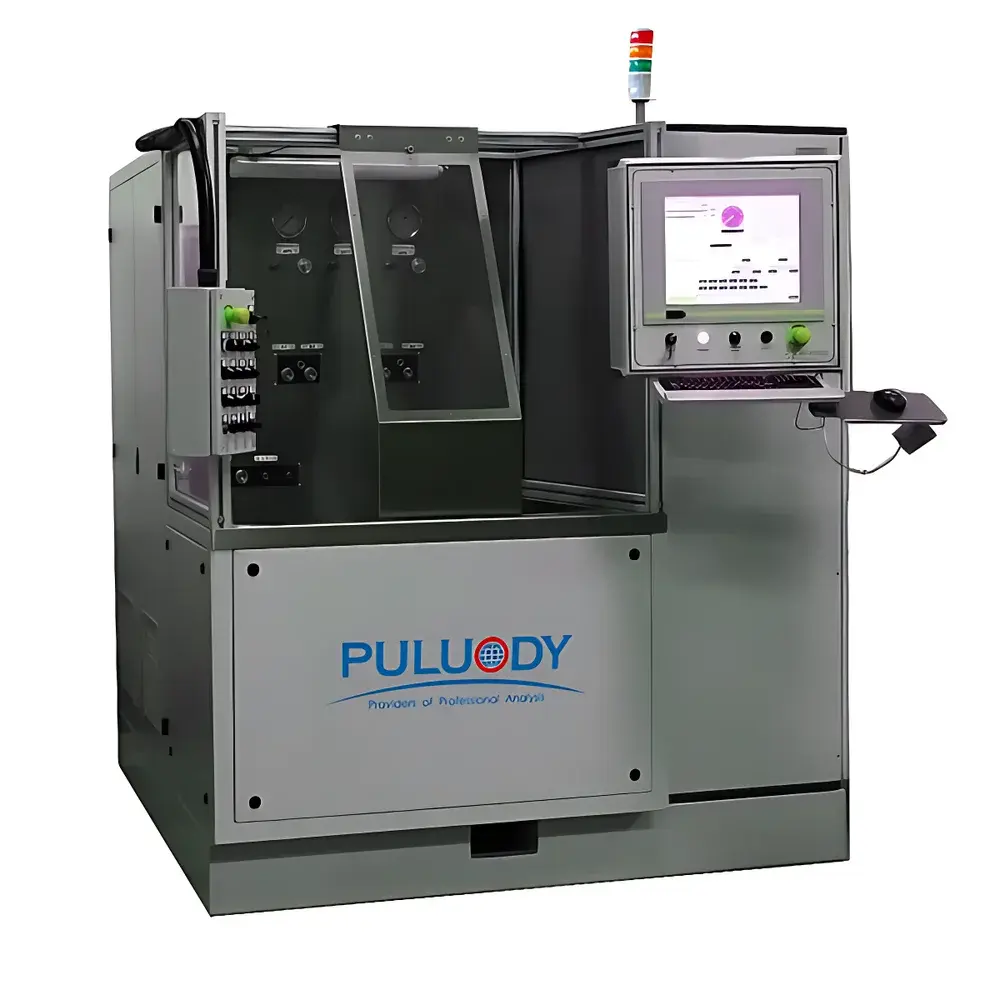
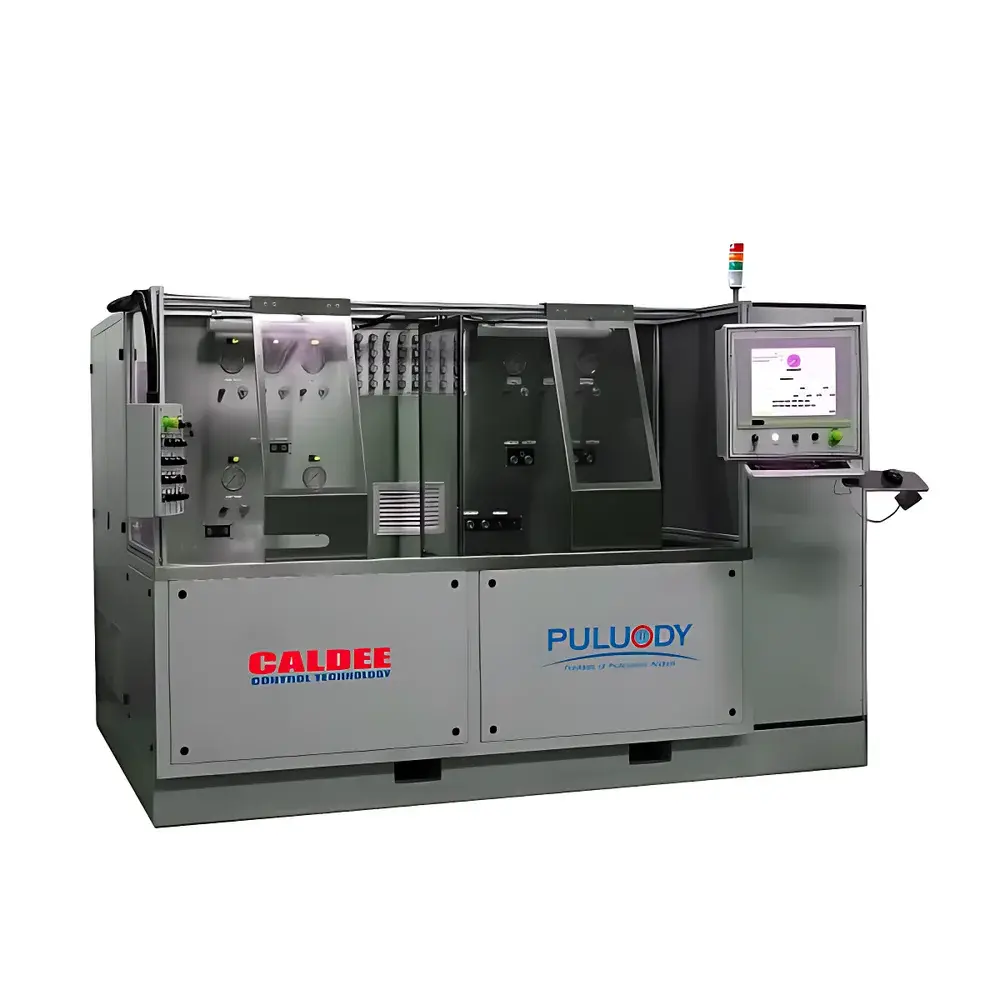
PULUODY CCACS1.0 Aerospace Component Cleanliness Control System
| Brand | PULUODY |
|---|---|
| Origin | Shaanxi, China |
| Manufacturer Type | Authorized Distributor |
| Country of Origin | China |
| Model | CCACS1.0 |
| Instrument Type | Optical Particle Counter |
| Detection Principle | Light Obscuration (LO) |
| Laser Sensor | 7th-Generation Dual-Laser Narrow-Beam Detector |
| Channel Count | 1000 adjustable channels |
| Size Range | 0.1 µm (c) to 100 µm (c), customizable bins (e.g., 4–128 bins) |
| Resolution | >95% |
| Accuracy | ±3% typical |
| Coincidence Limit | 10,000 particles/mL (5% coincidence error) |
| Sample Flow Rate | 5–1500 mL/min |
| Viscosity Range | Offline 0–99 mm²/s |
| Temperature Range | Fluid 0–80 °C |
| Sampling Precision | <±1% |
| Output Interfaces | RS232, RS485, USB, LAN, 4–20 mA analog, MODBUS protocol |
| Calibration Standards | JJG 1061, NIST-traceable latex spheres, GBW reference materials |
| Compliance | GB/T 11446.9, GJB 420B-2006, HB 6639/6649, QJ 2850/3024, MIL-STD-1246C, SAE AS4059F, NAVAIR 01-1A-17, ROCT 17216-2001 |
Overview
The PULUODY CCACS1.0 Aerospace Component Cleanliness Control System is a fully integrated, real-time optical particle counting and contamination management platform engineered for mission-critical fluid cleanliness assurance in aerospace manufacturing, maintenance, and overhaul environments. Built upon the internationally recognized light obscuration (LO) principle—where particles suspended in a liquid stream pass through a focused laser beam, generating pulse signals proportional to their cross-sectional area—the system delivers quantitative, traceable, and repeatable particle size distribution data across 1000 high-resolution detection channels. Unlike conventional single-channel or low-bin counters, the CCACS1.0 supports configurable multi-bin analysis (e.g., 4, 16, 64, or 128 user-defined size ranges), enabling compliance with over 510 global cleanliness standards—including military, civil aviation, spaceflight, and industrial specifications. Its architecture integrates fluid handling, closed-loop cleaning, real-time monitoring, and automated reporting into a single validated workflow, eliminating manual intervention and minimizing operator-induced variability.
Key Features
- 7th-generation dual-laser narrow-beam sensor with enhanced signal-to-noise ratio, improved thermal stability, and sub-micron resolution down to 0.1 µm (c)
- 1000-channel high-fidelity particle sizing engine supporting simultaneous multi-standard evaluation (e.g., ISO 4406, NAS 1638, SAE AS4059F Class, GJB 420B Level)
- Modular hydraulic circuit design with precision metering pump, pressure-regulated flow control (5–1500 mL/min), and temperature-stabilized sample path (0–80 °C fluid)
- Industrial-grade embedded controller based on Advantech military-spec IPC hardware, featuring redundant watchdog timers, EMI-hardened I/O, and extended operational lifetime
- Full compliance with regulatory data integrity requirements: audit trail, electronic signatures, user role-based access control, and 21 CFR Part 11–ready software architecture
- Configurable analog (4–20 mA) and digital (MODBUS RTU over RS485, TCP/IP via LAN) interfaces for seamless integration into MES, SCADA, and Smart Factory ecosystems
Sample Compatibility & Compliance
The CCACS1.0 is validated for use with hydraulic fluids (MIL-H-5606, MIL-PRF-83282, Skydrol), aviation fuels (JP-5, Jet A-1), lubricants, coolants, deicing fluids, and ultra-pure process liquids (e.g., electronic-grade water per GB/T 11446.9). It meets the physical and metrological requirements of national and international cleanliness standards including GJB 420B-2006 (China military hydraulic fluid classification), HB 6639/6649 (aircraft hydraulic system acceptance), QJ 2850 (spacecraft foreign object debris prevention), MIL-STD-1246C (product cleanliness verification), and SAE AS4059F (aerospace fluid contamination grading). Calibration traceability is maintained through certified GBW reference materials and optional third-party certification from the National Defense Science & Technology Commission’s Grade-I Particle Metrology Station (No. 116) or Xi’an Zhongte Metrology & Testing Institute.
Software & Data Management
CCACS1.0 runs the proprietary CCACS1.0 Analysis & Control Software Suite—a modular, GLP-compliant application built on a deterministic real-time kernel. The platform unifies seven functional modules: pre-filter, fine filter, final filter, cleaning cycle management, particle counting, calibration, and standardization. All operations—including method setup, threshold definition, pass/fail logic, alarm configuration (visual + audible), and report generation—are executed via intuitive touchscreen interface or external keyboard. Raw data (particle counts per channel, timestamp, flow rate, temperature) are stored locally (≥20,000 test records) and exportable to CSV, PDF, or XML formats. Audit trails record every user action, parameter change, and calibration event with immutable timestamps—fully aligned with FDA 21 CFR Part 11 and ISO/IEC 17025 documentation requirements.
Applications
- Final cleanliness verification of aircraft hydraulic actuators, fuel nozzles, and servo valves prior to installation
- In-process monitoring of component cleaning baths and rinse cycles in MRO facilities
- Validation of filtration efficiency for coalescers, depth filters, and membrane systems in ground support equipment
- Quantitative assessment of wear debris generation during bench testing of turbine oil systems
- Supporting root-cause analysis in contamination-related field failures under GJB 3058 and NAVAIR 01-1A-17 protocols
- Automated generation of ISO Cleanliness Codes and SAE AS4059F Particle Count Reports for OEM documentation packages
FAQ
Does the CCACS1.0 support both offline and online (in-line) measurement configurations?
Yes—it operates in offline mode using calibrated syringe or bottle sampling, and can be adapted for in-line installation with custom flow cells, pressure housings, and bypass manifolds meeting ASME B31.1 and MIL-STD-1300 requirements.
Can the system be reconfigured for non-aerospace applications such as pharmaceutical water systems or semiconductor slurry monitoring?
Absolutely. With appropriate wetted material selection (e.g., 316L SS, sapphire optics, EPDM-free seals) and software profile loading, it complies with USP , ISO 8573-4, and SEMI F57 for ultrapure fluid applications.
What documentation is provided for regulatory audits?
Each unit ships with Factory Acceptance Test (FAT) report, IQ/OQ documentation templates, calibration certificate (traceable to GBW/NIST), and a full set of software validation protocols (including boundary testing, failure mode simulation, and cybersecurity hardening logs).
Is remote diagnostics and firmware update capability available?
Yes—via secure TLS-enabled LAN connection or optional cellular gateway; all updates undergo cryptographic signature verification and require dual-role authorization before deployment.
Related Products



