
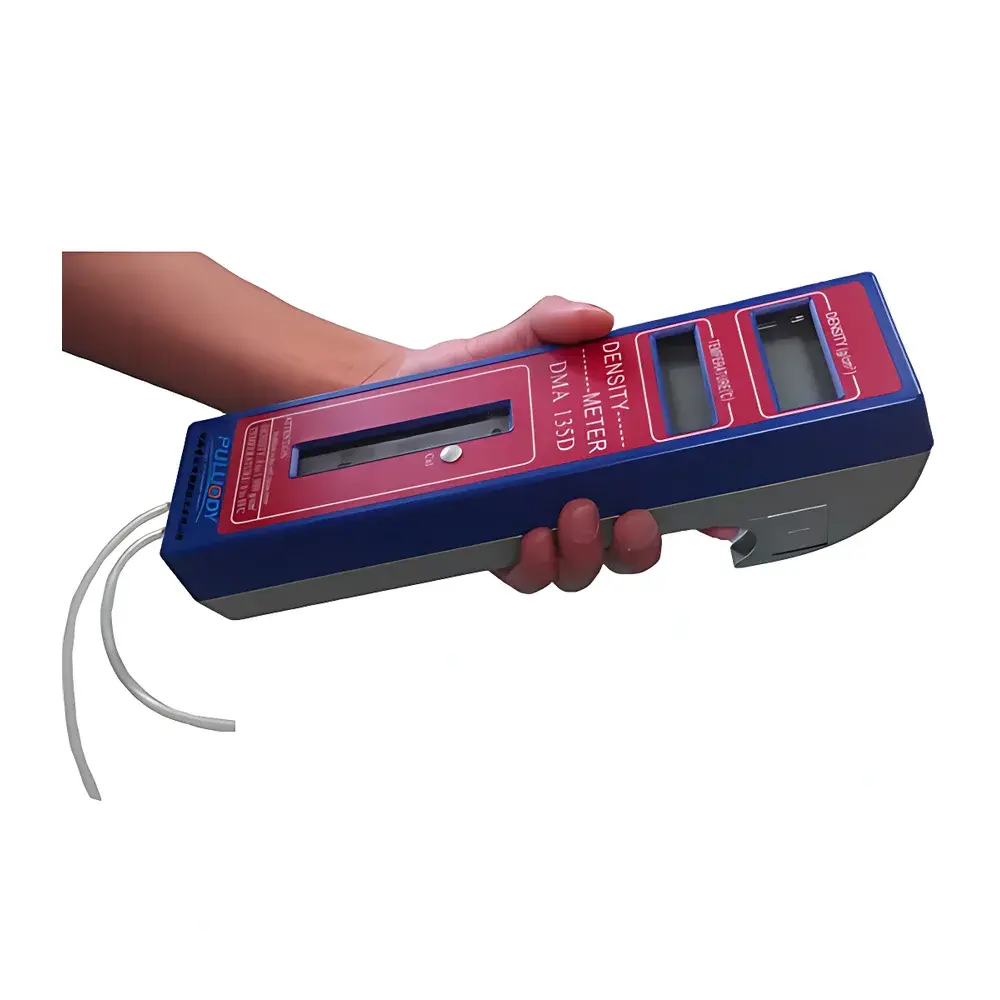
PULUODY DMA-135D Portable Oscillating U-Tube Digital Densimeter
| Brand | PULUODY |
|---|---|
| Origin | Shaanxi, China |
| Model | DMA-135D |
| Instrument Type | Portable Oscillating U-Tube Densimeter |
| Sample Type | Liquids |
| Density Range | 0.001–1.999 g/cm³ |
| Density Accuracy | ±0.01 g/cm³ |
| Temperature Range | 0–50 °C |
| Repeatability | ±0.01 g/cm³ |
| Resolution | 0.001 g/cm³ |
| Minimum Sample Volume | 10 mL |
| Compliance Standards | GB/T 29617–2013, GB/T 2013–2010, SH/T 0604–2000, SN/T 2383–2009, ASTM D4052–11, ASTM D5002–13, ASTM D3505–12e1, ISO 12185:1996, IP 559–2008 |
Overview
The PULUODY DMA-135D Portable Oscillating U-Tube Digital Densimeter is an engineered solution for rapid, high-reproducibility density determination of liquid samples in field and laboratory environments. It operates on the well-established oscillating U-tube principle: a precisely fabricated dual-U quartz tube—selected for its exceptional thermal stability and elastic consistency—is electromagnetically excited into resonance. When filled with a liquid sample, the resonant frequency of the tube shifts proportionally to the mass of the contained fluid. Since volume remains constant under controlled conditions, this frequency shift correlates directly with density via a calibrated physical relationship (ρ ∝ 1/f²). The instrument integrates real-time temperature measurement (PT1000 sensor) and automatic temperature compensation to ensure metrological integrity across the full operational range (0–50 °C). Designed for compliance with international standard test methods—including ASTM D4052, ISO 12185, and GB/T 2013—the DMA-135D delivers traceable, GLP-ready results without requiring external thermostatic baths or volumetric glassware.
Key Features
- Quartz-based dual-U oscillation cell with low thermal expansion coefficient and high mechanical Q-factor for stable, long-term calibration retention
- Integrated PT1000 temperature sensor with ±0.1 °C accuracy and automatic density correction per ISO 12185 Annex B
- High-resolution digital display (0.001 g/cm³) with direct readout of density, relative density (d20/20), and API gravity (calculated per ASTM D1250)
- Low sample consumption (10 mL minimum) minimizes reagent waste and reduces contamination risk during sequential analysis
- Self-contained alkaline battery power (9 V) enabling >12 hours of continuous operation—ideal for refinery perimeter testing, tank farm audits, and mobile QC labs
- On-device calibration capability using certified reference standards (e.g., air/water or NIST-traceable hydrocarbon mixtures)
- Ruggedized ABS housing with IP54-rated ingress protection for dust and splash resistance in industrial environments
Sample Compatibility & Compliance
The DMA-135D is validated for use with non-viscous to moderately viscous liquids (kinematic viscosity < 100 mm²/s at 20 °C), including petroleum distillates (gasoline, diesel, kerosene), lubricants, organic solvents, aqueous electrolytes, pharmaceutical excipients, food-grade oils, and cleaning formulations. It excludes highly volatile, corrosive (e.g., concentrated HF/HNO₃), or particulate-laden suspensions unless pre-filtered through 5 µm membrane filters. Regulatory alignment includes full support for ASTM D4052 data reporting structures, USP density requirements for liquid dosage forms, and ISO/IEC 17025 documentation workflows. Measurement uncertainty is quantified per GUM (JCGM 100:2008) and verified against certified reference materials (CRMs) such as NIST SRM 1828 (water) and SRM 2778 (crude oil simulants).
Software & Data Management
While the DMA-135D operates as a standalone instrument, its RS-232 interface enables bidirectional communication with LIMS or QA/QC databases. Exported data packets include timestamp, ambient temperature, sample ID, raw frequency count, compensated density value, and operator ID—structured to meet FDA 21 CFR Part 11 audit trail requirements when paired with compliant host software. Internal memory stores up to 200 measurement records with metadata tagging. Calibration logs—including date, standard used, deviation from nominal value, and technician signature—are retained for GLP/GMP internal audits. Firmware updates are delivered via secure USB-to-serial adapter, with version history and cryptographic checksums provided in release notes.
Applications
This densimeter serves critical quality control functions across multiple regulated sectors: In upstream and downstream petroleum operations, it verifies crude assay consistency, monitors blending accuracy in additive packages, and validates custody transfer compliance per API MPMS Chapter 11.5. In chemical manufacturing, it supports concentration verification of caustic solutions, glycol antifreeze blends, and surfactant formulations. Within pharmaceutical production, it confirms bulk solvent identity (e.g., ethanol USP grade) and detects adulteration in glycerin or propylene glycol monographs. Food & beverage laboratories apply it for alcohol content estimation (via density-alcohol tables per OIML R 22), vegetable oil authenticity screening, and syrup Brix correlation. Academic and research users leverage its portability for in-situ environmental water density profiling and polymer solution characterization.
FAQ
What standards does the DMA-135D comply with for petroleum density testing?
It conforms to ASTM D4052, ASTM D5002, SH/T 0604, and ISO 12185 for oscillating U-tube methodology, supporting API gravity calculation per ASTM D1250.
Can the instrument measure samples above 50 °C?
No—the built-in temperature sensor and quartz cell design are rated for 0–50 °C; external thermostatted sample conditioning is required for elevated-temperature measurements.
Is user calibration traceable to national metrology institutes?
Yes—calibration with NIST-, PTB-, or NIM-certified density standards (e.g., water, n-decane, or certified hydrocarbon mixtures) establishes full traceability per ISO/IEC 17025 Clause 6.6.
How is data integrity maintained during battery-powered operation?
All measurements include embedded timestamps and temperature-compensation coefficients; non-volatile memory retains records even during power loss.
Does the device require periodic recalibration by an accredited lab?
Field verification using two-point calibration (air + water or air + reference fluid) is recommended before each shift; full recalibration by an ISO/IEC 17025-accredited provider is advised annually or after mechanical shock.



