
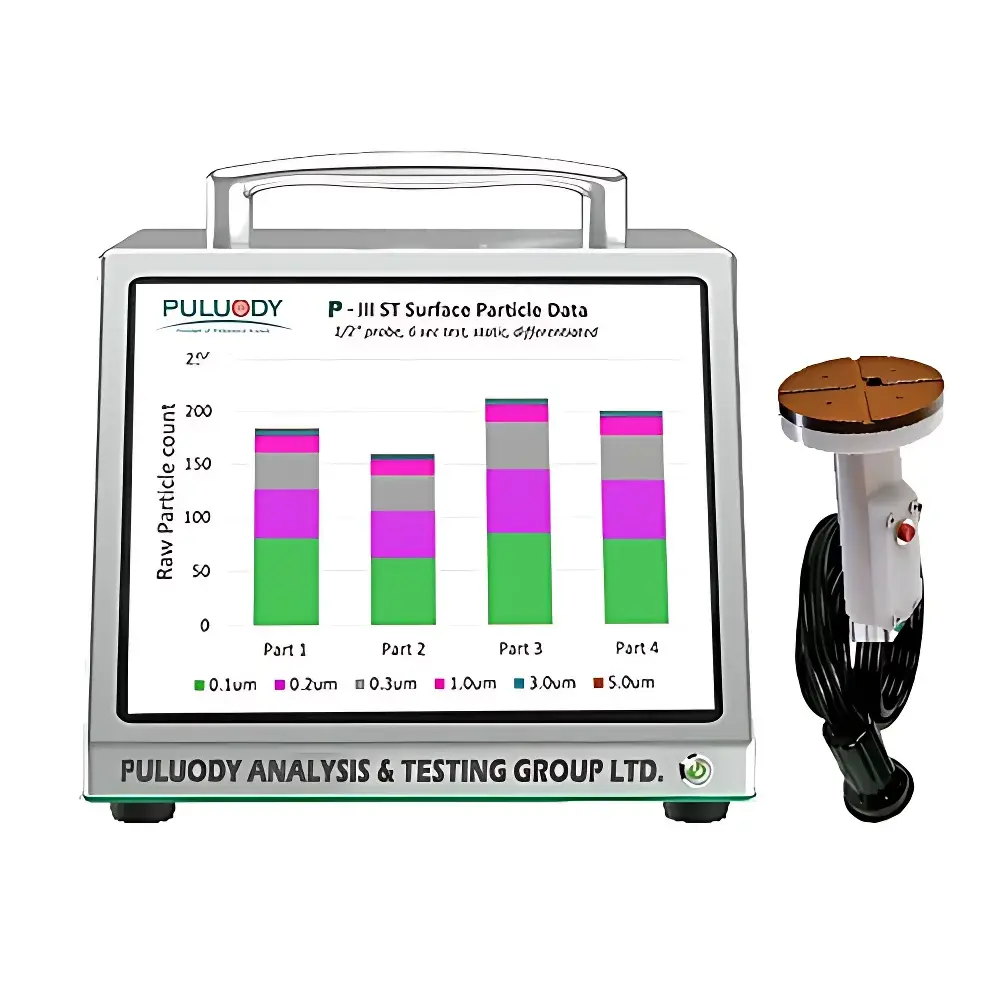
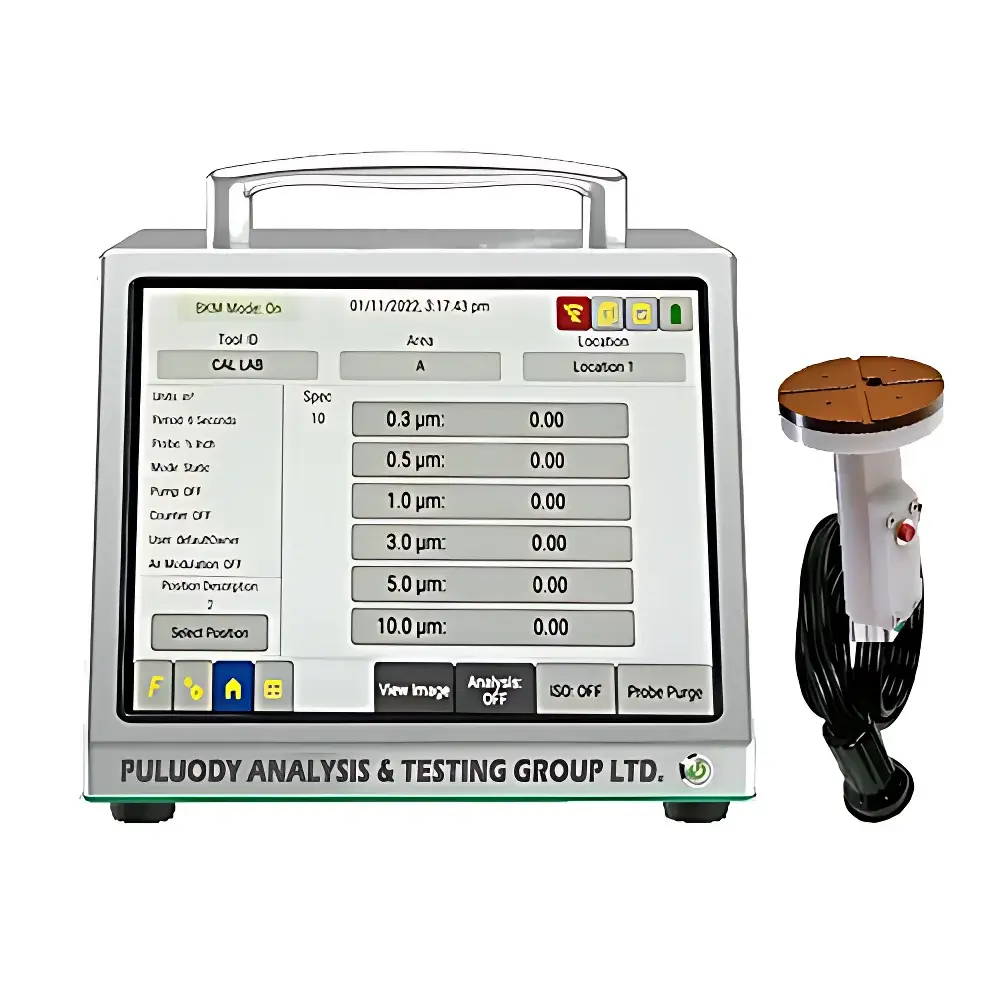
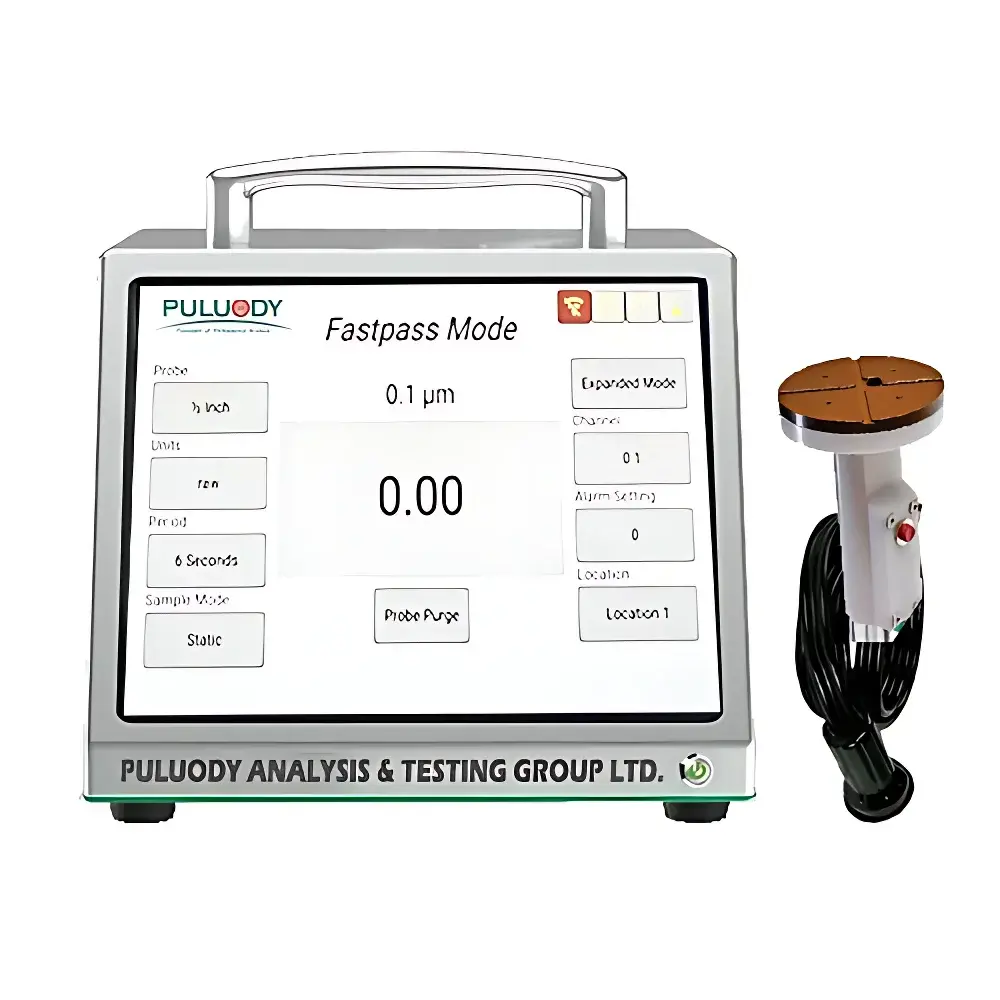
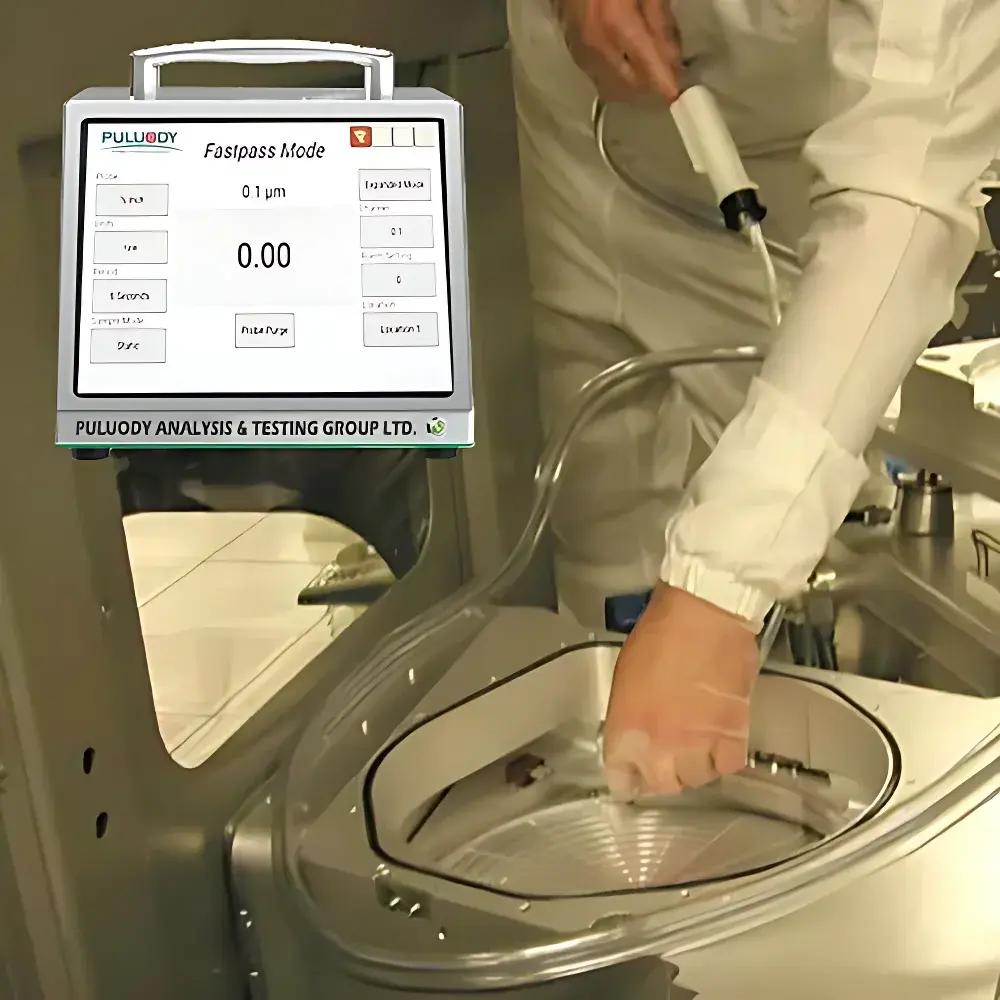
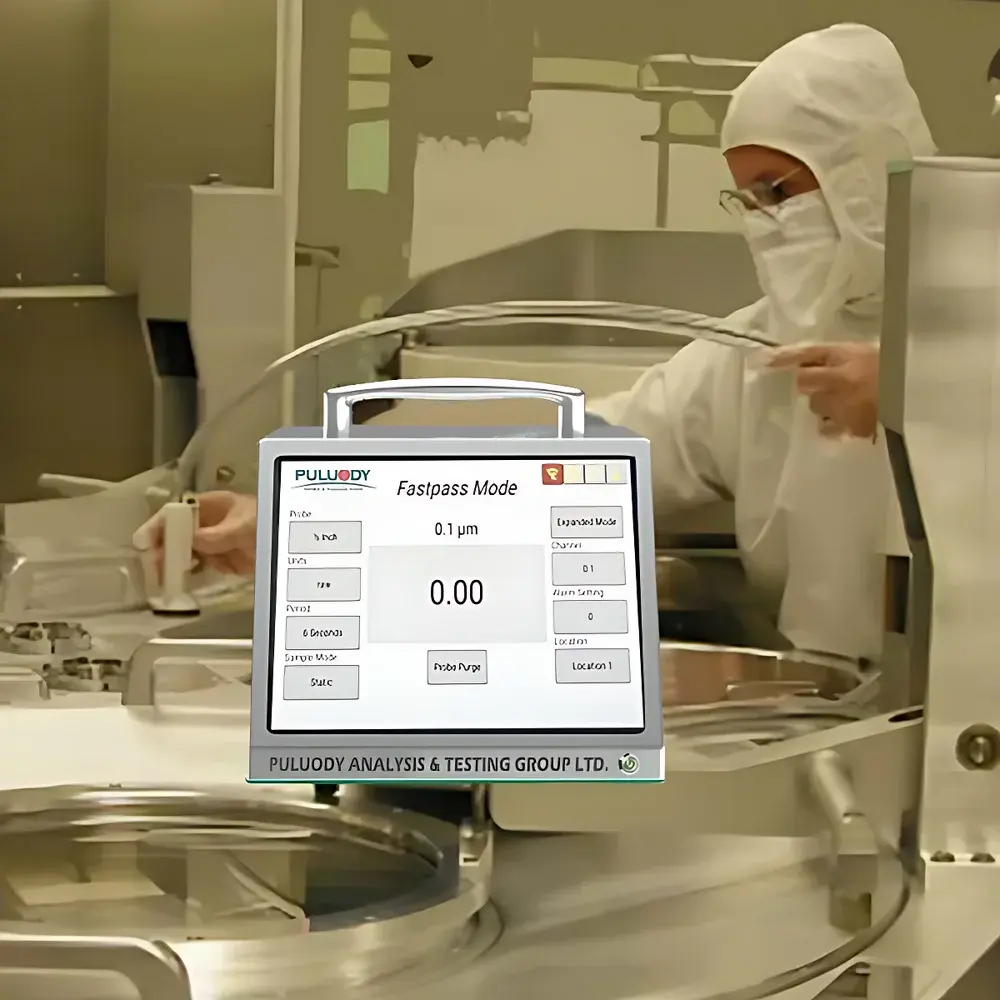
PULUODY P-III Surface Micro-Particle Counter
| Brand | PULUODY |
|---|---|
| Model | P-III |
| Instrument Type | Optical Surface Particle Counter |
| Detection Principle | Light Scattering (Laser-Based) |
| Particle Size Channels | Configurable across 6 channel sets (A–F), ranging from 0.1 µm to 25.0 µm |
| Size Accuracy | ≤ ±30% |
| Concentration Accuracy | ≤ ±30% |
| Repeatability | ≤ ±10% FS |
| Coincidence Error | ≤ 5% |
| Flow Rate Options | 2.83 L/min or 28.3 L/min |
| Sampling Duration | 3–60 s (user-selectable) |
| Operating Temperature | −40 °C to +120 °C |
| Environmental Operating Range | 5–45 °C, ≤90% RH (non-condensing) |
| Power Supply | AC 100–240 V, 50/60 Hz |
| Compliance | ISO 21501-4, JIS B 9921, ISO 14644-1, ISO 14644-9 |
| Data Interface | RS232, RS485, LAN, USB |
| Audit Trail & User Access Control | Yes |
| Detection Modes | Count, Mass, Net Efficiency |
| Alarm Output | Customizable count/mass thresholds |
| Storage | Real-time and scheduled (unlimited capacity) |
| Optional Accessories | Straight probe (2″), 90° angled probe, multifunctional surface probe (UK4400301) |
Overview
The PULUODY P-III Surface Micro-Particle Counter is an optical particle counter engineered for quantitative, non-contact surface contamination assessment in high-cleanliness environments. It operates on the principle of laser light scattering—where particles deposited on or suspended near a surface scatter incident laser light in proportion to their size and refractive index. The instrument captures scattered photons via high-sensitivity photodetectors and classifies particles into user-defined size bins using calibrated pulse-height analysis. Unlike airborne particle counters, the P-III integrates specialized surface-sampling probes—including straight, 90°-angled, and multifunctional contactless probes—to enable direct measurement of particulate load on critical surfaces such as silicon wafers, optical substrates, stainless-steel chamber walls, and medical device housings. Its design conforms to ISO 14644-9, the international standard governing surface particle monitoring in cleanrooms and controlled environments, making it suitable for qualification, routine surveillance, and root-cause investigation of surface contamination events.
Key Features
- 7-inch high-resolution capacitive touchscreen interface with real-time visualization of particle counts, size distribution histograms, and trend overlays—enabling intuitive operation without external PCs.
- Dual hot-swappable battery system ensures uninterrupted operation during extended production shifts or facility audits; battery replacement requires zero instrument downtime.
- Configurable multi-channel detection architecture supporting six distinct size binning schemes (A–F), enabling application-specific calibration—e.g., semiconductor wafer inspection (0.1–5.0 µm) or pharmaceutical packaging validation (0.5–25.0 µm).
- Reduced self-cleaning time by up to 50% compared to legacy surface monitors—achieved through optimized airflow dynamics and adaptive background subtraction algorithms—thereby shortening preventive maintenance intervals and increasing equipment uptime.
- Integrated audit trail functionality compliant with FDA 21 CFR Part 11 requirements, including electronic signatures, role-based access control, and immutable timestamped records for all configuration changes, calibrations, and test results.
- Flexible sampling protocols: programmable durations (3–60 s), repeatable cycle modes, and dual-mode reporting (numerical count per unit area, mass-equivalent concentration) support both statistical process control (SPC) and regulatory submission workflows.
Sample Compatibility & Compliance
The P-III supports direct surface interrogation of flat, curved, or recessed substrates using three certified probe types: a 2″ straight probe for open-plan surfaces, a 90° angled probe for confined geometries (e.g., vacuum chamber ports), and the multifunctional UK4400301 probe for hybrid air-surface sampling. All probes maintain laminar, low-turbulence flow at nominal rates of 2.83 L/min or 28.3 L/min—validated per ISO 21501-4 for counting efficiency and sizing accuracy. The instrument meets JIS B 9921 for optical particle counter performance verification and is traceably calibrated against NIST-traceable polystyrene latex (PSL) standards. Its firmware and data management architecture satisfy GLP/GMP documentation requirements, including full electronic record retention, change control logs, and exportable CSV/PDF reports compatible with LIMS integration.
Software & Data Management
The embedded operating system supports local data storage with unlimited capacity and configurable auto-save intervals (real-time or scheduled). Raw particle event logs—including timestamp, channel assignment, pulse amplitude, and environmental metadata (temperature, humidity)—are retained in binary format and convertible to ASCII for third-party analysis. Communication interfaces include RS232 (for legacy PLC integration), RS485 (multi-drop network capability), Ethernet (TCP/IP for remote monitoring), and USB (for report export or firmware updates). Optional software packages provide advanced analytics: overlay comparison of historical surface maps, SPC charting (X-bar/R, CUSUM), and automated deviation flagging against ISO 14644-1 class limits. All software modules undergo periodic security patching and are validated per IEC 62304 for medical-grade software lifecycle management.
Applications
- Semiconductor fabrication: Wafer surface cleanliness verification pre- and post-lithography, etch, and deposition steps; tool chamber qualification per SEMI E10 guidelines.
- Flat-panel display manufacturing: Inspection of TFT array glass, color filter substrates, and touch sensor films for sub-micron defect excursions.
- Medical device assembly: Monitoring of Class 7/8 cleanroom workbenches, isolator gloves, and final-packaging surfaces per ISO 13485 and AAMI TIR12.
- Aerospace component finishing: Quantification of metallic particulate residue on turbine blade coatings and composite layup tools.
- Pharmaceutical primary packaging: Validation of vial stopper washing efficacy and isolator glove integrity testing under Annex 1 (2022) requirements.
FAQ
What calibration standards are used for the P-III?
The P-III is factory-calibrated using NIST-traceable polystyrene latex (PSL) spheres and verified per ISO 21501-4 Annex D. Field recalibration kits—including reference aerosols and surface challenge standards—are available under PULUODY’s Certified Calibration Program.
Can the P-III measure particles below 0.1 µm?
No. The optical detection limit is 0.1 µm under optimal signal-to-noise conditions. Sub-100 nm particles require electron microscopy or condensation particle counter (CPC)-based techniques.
Is the instrument suitable for hazardous area use?
The base P-III is rated for general industrial environments (IP54). Intrinsically safe variants with ATEX/IECEx certification are available upon request and require custom probe and housing configurations.
How does the P-III handle particle coincidence at high concentrations?
Coincidence error is actively managed via flow-rate optimization, pulse-pair resolution algorithms, and real-time coincidence correction factors derived from ISO 21501-4 Annex F—ensuring ≤5% error up to 2×10⁶ particles/m³.
Does the system support 21 CFR Part 11 compliance out-of-the-box?
Yes. Role-based user authentication, electronic signature capture, audit trail generation, and data immutability are enabled by default and validated during IQ/OQ protocol execution.



