
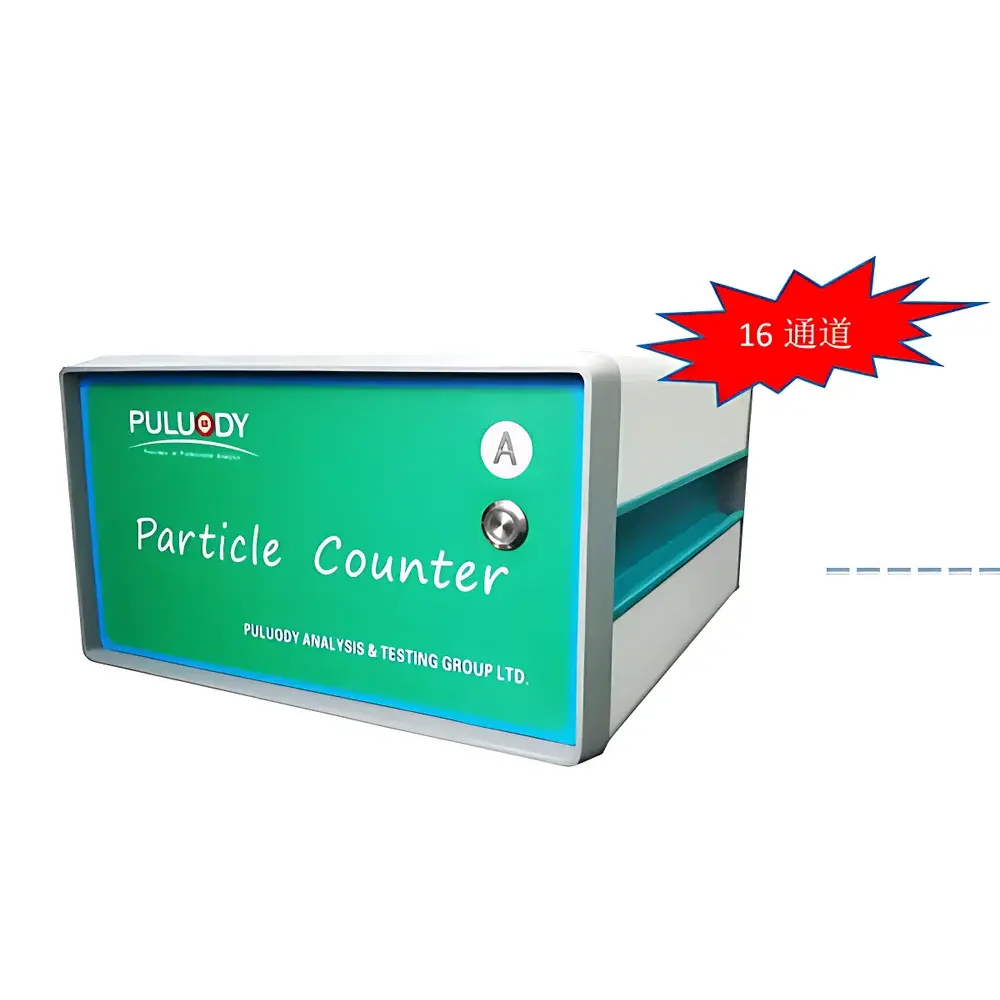
PULUODY OPC-16 Channel Online Particle Counter
| Brand | PULUODY |
|---|---|
| Origin | Shaanxi, China |
| Manufacturer Type | Authorized Distributor |
| Product Category | Domestic |
| Model | OPC-16 Channel |
| Instrument Type | Optical Particle Counter |
| Detection Principle | Dual-Laser Narrow-Beam Light Scattering (7th Generation) |
| Measurement Range | 1–150 µm |
| Number of Channels | 16 |
| Calibration Standards Supported | ISO 4406, NAS 1638, SAE AS4059, ISO 11171, MIL-STD-1246C, GJB 420B, GOST 17216, GB/T 14039, DL/T 432, JB/T 9737, GB/T 18854 |
| Pressure Rating | 0–1.0 MPa (standard), up to 31.5 MPa (with integrated pressure reducer) |
| Flow Rate | 15–500 mL/min |
| Fluid Temperature Range | −10 °C to +80 °C |
| Viscosity Limit | ≤500 cSt (online mode) |
| Output Interfaces | RS232, RS485, 4–20 mA, 0–5 V (customizable) |
| Power Supply | 9–30 VDC |
| Reporting | Particles per mL + ISO/NAS/GJB contamination code |
| Compliance | Supports GLP/GMP audit trails, ASTM D6786, ISO 11500, IP 564/565 |
Overview
The PULUODY OPC-16 Channel Online Particle Counter is an industrial-grade optical particle counter engineered for continuous, real-time monitoring of particulate contamination in hydraulic fluids, lubricants, turbine oils, and ultra-pure process liquids. It operates on the principle of dual-laser narrow-beam light scattering—PULUODY’s seventh-generation sensing architecture—delivering high reproducibility and minimal signal drift across extended operational cycles. Unlike benchtop or portable counters, the OPC-16 is designed for permanent integration into fluid circulation loops, enabling uninterrupted sampling at line pressure (up to 31.5 MPa with optional pressure reduction module) and flow rates from 15 to 500 mL/min. Its 16 independent detection channels provide granular size distribution resolution across the 1–150 µm range, supporting simultaneous compliance reporting against multiple international standards—including ISO 4406:2022, NAS 1638:2020, GJB 420B–2015, and GB/T 14039–2002—without requiring manual recalibration or software switching.
Key Features
- 16-channel optical detection system with dual-laser excitation for enhanced signal-to-noise ratio and reduced coincidence error
- Integrated pressure management: standard operation up to 1.0 MPa; extended capability to 31.5 MPa via built-in pressure-reducing valve assembly
- Wide dynamic viscosity tolerance (0–500 cSt), validated for use with mineral oils, synthetic esters, phosphate esters, and aqueous solutions
- Ruggedized stainless-steel housing rated for IP65 environmental protection; operational temperature range of −10 °C to +80 °C
- Multi-protocol digital and analog outputs: RS232, RS485 (Modbus RTU), 4–20 mA, and 0–5 V—with configurable alarm thresholds and status flags
- Onboard memory stores >10,000 test records with timestamp, flow rate, temperature, and pressure metadata
- Field-calibratable design compliant with ISO 21501-4 and ISO 11171 reference methods; traceable calibration certificates available upon request
Sample Compatibility & Compliance
The OPC-16 is validated for direct inline measurement of mineral oils, hydraulic fluids (HL, HM, HVLP), aviation turbine fuels (Jet A-1, JP-8), transformer oils, coolant emulsions, and deionized water used in semiconductor rinsing. It meets the physical and metrological requirements of ISO 11500 (hydraulic fluid contamination measurement), ASTM D6786 (particle counting in lubricating oils), and IEC 60296 (transformer oil cleanliness). For regulated environments—including aerospace MRO facilities, power generation plants, and naval maintenance depots—the instrument supports configuration for 21 CFR Part 11-compliant data logging when paired with PULUODY’s certified PC-based software suite. All reported contamination codes (e.g., ISO 4406 [x/y/z], NAS 1638 Class) are derived directly from raw channel counts using standardized binning algorithms defined in ISO 4402 and ISO 11171 Annex A.
Software & Data Management
The OPC-16 ships with PULUODY ParticleView™ Lite—a Windows-based desktop application supporting real-time visualization, historical trend analysis, and automated report generation in PDF, CSV, and XML formats. The software implements full audit trail functionality: every parameter change, calibration event, or user login is time-stamped, user-identified, and non-erasable—meeting GLP and GMP documentation requirements. Optional cloud connectivity enables remote diagnostics and firmware updates via secure TLS 1.2 tunnels. Data export modules support integration with SCADA systems (via OPC UA), CMMS platforms (Maximo, SAP PM), and enterprise LIMS environments through configurable RESTful API endpoints.
Applications
- Condition-based monitoring of hydraulic systems in mobile equipment (excavators, cranes, offshore drilling rigs)
- Real-time wear debris tracking in gearboxes, servo valves, and electro-hydraulic actuators
- Filter performance validation per ISO 16889 and ISO 19438 in filter test benches
- Contamination control during turbine oil reclamation and offline filtration campaigns
- Acceptance testing of new oil batches prior to commissioning (per ISO 4406 Class limits)
- Monitoring of purity-critical fluids in marine propulsion systems, nuclear coolant loops, and wind turbine pitch control hydraulics
FAQ
Does the OPC-16 require annual third-party calibration to maintain compliance?
Yes. While the unit includes internal verification routines and field-adjustable gain compensation, ISO/IEC 17025-accredited calibration—traceable to NIST or UKAS-certified reference materials—is recommended annually for applications governed by ISO 55001, MIL-STD-1246C, or GJB 420B.
Can the instrument operate continuously under high-pressure pulsation conditions?
Yes. The flow cell and optical head are mechanically decoupled and mounted on vibration-damping isolators; pressure transients up to 5 Hz at ±10% amplitude do not affect counting stability or sizing accuracy.
Is the 16-channel configuration fixed, or can channel thresholds be redefined?
Thresholds are programmable within the 1–150 µm range using ParticleView™ Lite. Users may define custom bins aligned with specific wear particle categories (e.g., 5–15 µm cutting wear, 25–50 µm fatigue spalls) or regulatory grade boundaries.
What mechanical interfaces are supported for pipeline integration?
Standard options include ISO 228-1 G½” and ISO 228-1 G¾” threaded ports; flanged (DIN 2501) and sanitary clamp (ISO 2852) adapters are available as factory-configured options.
How is data integrity ensured during power interruption or network failure?
All measurements are buffered in non-volatile flash memory. Upon recovery, the device resumes logging without data loss and timestamps all recovered entries with “power cycle” flags for traceability.



