
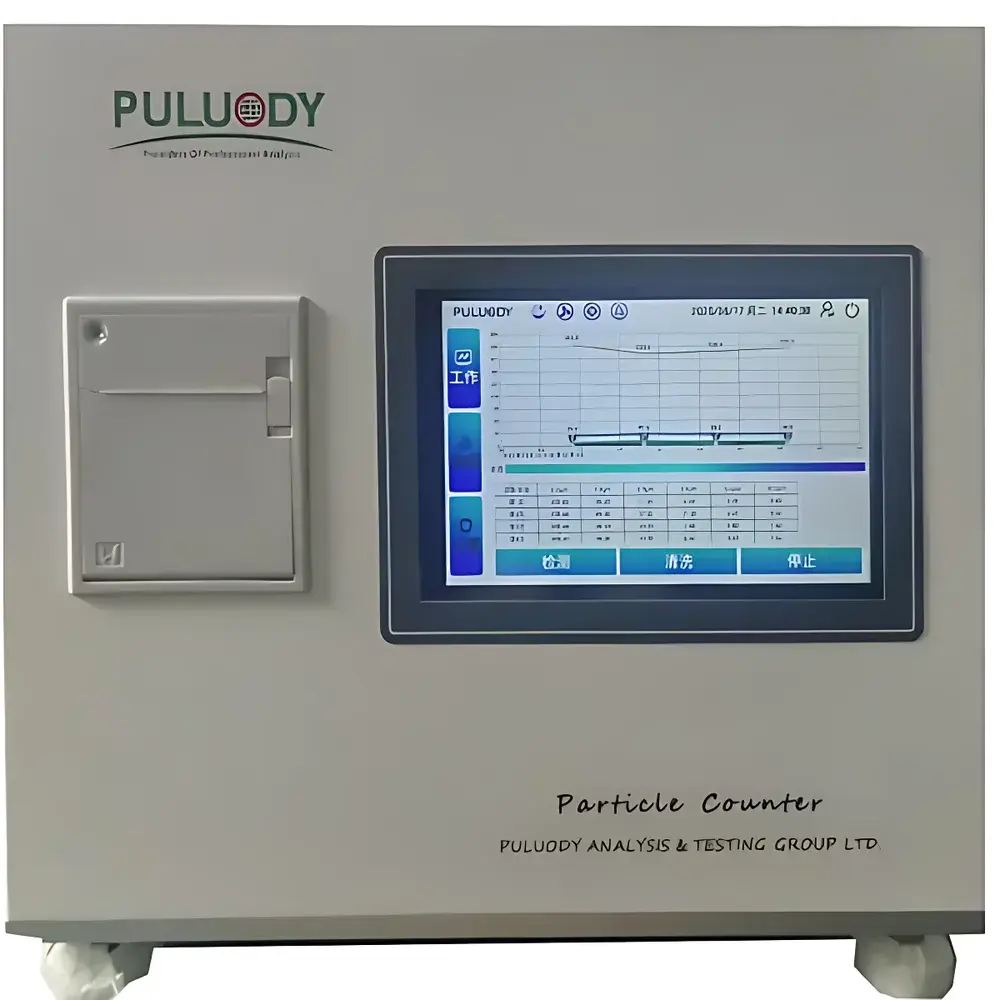
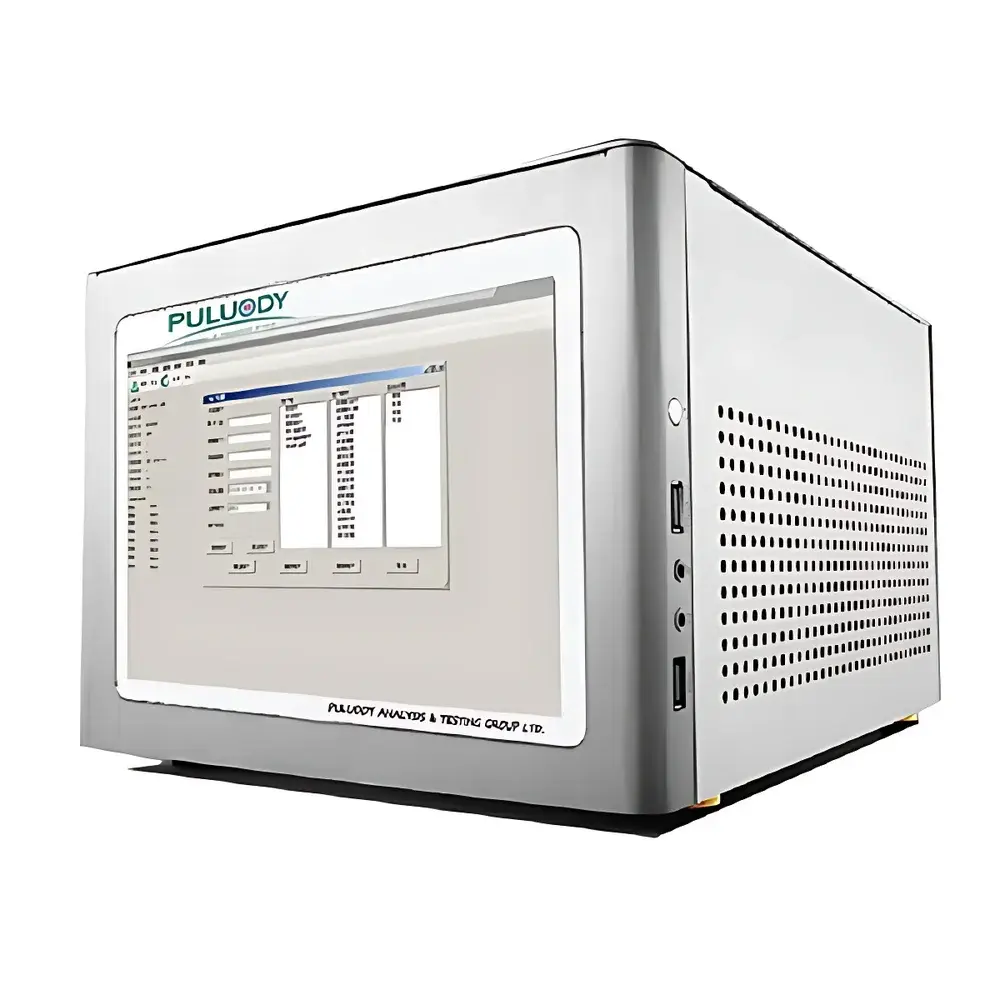
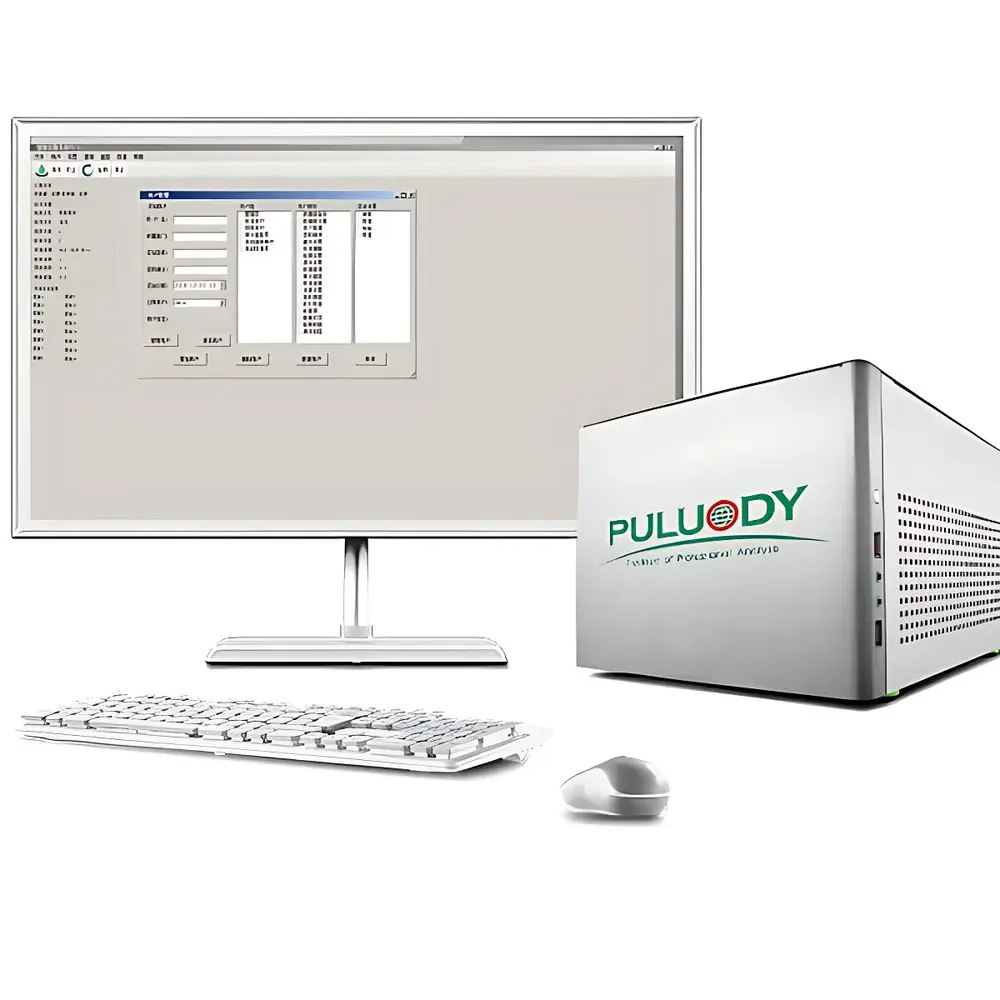
PULUODY OPC-1800 Optical Particle Counter for Packaged Drinking Water
| Brand | PULUODY |
|---|---|
| Model | OPC-1800 |
| Instrument Type | Optical Particle Counter (Light Obscuration Principle) |
| Detection Range | 1–450 µm |
| Channel Count | 1000 adjustable size channels |
| Calibration Standards | JJG 1061, ISO 11171, USP <788>, USP <789>, EP 2.9.19, JP 6.06, GB/T 11446.9-2013, ISO 21510, NAS1638, ISO 4406 |
| Sampling Accuracy | <±1% |
| Precision | <±3% typical |
| Coincidence Limit | 10,000 particles/mL (5% coincidence error) |
| Resolution | <10% (per latex sphere calibration per JJG 1061) |
| Sample Flow Rate | 5–60 mL/min |
| Rinse Flow Rate | 5–500 mL/min |
| Fluid Temperature Range | 0–80 °C |
| Operating Environment | −15–50 °C |
| Interface | RS232, RS485-to-USB, USB, MODBUS RTU |
| Data Storage | ≥20,000 test records (expandable via USB drive) |
| Software | P6.4 Integrated & PC Edition |
| Control | Industrial PC or Embedded IPC |
| Detection Principle | Seventh-generation dual-laser narrow-beam light obscuration |
| Sensor | High-stability optical sensing module with temperature-compensated photodetector array |
| Compliance Support | Fully configurable to USP, EP, JP, BP, IP, WHO, ChP, ISO, ASTM, and military standards (e.g., MIL-STD-1246, GJB/T 420A/B) |
Overview
The PULUODY OPC-1800 Optical Particle Counter is a high-precision, laboratory-grade instrument engineered for quantitative analysis of insoluble particulate contamination in packaged drinking water and other low-viscosity aqueous solutions. It operates on the internationally standardized light obscuration (LO) principle—also known as the optical blocking or photoelectric extinction method—in accordance with ISO 21510, USP , USP , EP 2.9.19, and GB/T 11446.9-2013. The system employs a seventh-generation dual-laser narrow-beam detection architecture, delivering exceptional signal-to-noise ratio and minimizing false counts from refractive index mismatches or air bubble interference. With a validated detection range of 1–450 µm and 1000 programmable size channels, the OPC-1800 supports granular resolution across critical regulatory thresholds—including sub-2 µm, 2–5 µm, 5–10 µm, and >25 µm bins—enabling full compliance with pharmacopoeial and industrial particle contamination limits.
Key Features
- 1000-channel high-resolution particle sizing with user-definable bin boundaries (e.g., 1–10 µm, 4–70 µm(c), or 0.1 µm(c) custom thresholds)
- Dual-laser narrow-beam optical sensor optimized for low-conductivity, low-turbidity aqueous matrices including purified water, WFI, and bottled drinking water
- Integrated precision metering pump with flow accuracy <±1% and volumetric repeatability ≤±3% (typical)
- Full traceability via NIST-traceable calibration using certified polystyrene latex (PSL) spheres per JJG 1061 and ISO 11171
- Embedded industrial PC or optional external PC control with P6.4 analytical software suite supporting automated report generation, statistical trend analysis, and audit-ready data export
- Comprehensive interface support: RS232, RS485-to-USB, native USB, MODBUS RTU, and 4–20 mA analog output for integration into SCADA or LIMS environments
- Temperature-controlled fluid path (0–80 °C) and ambient operation range (−15–50 °C) suitable for both laboratory and mobile deployment
- Onboard color touchscreen HMI with intuitive icon-driven workflow for ISO/USP-compliant test execution without PC dependency
Sample Compatibility & Compliance
The OPC-1800 is validated for use with a broad spectrum of aqueous liquids requiring particulate purity verification: packaged drinking water, sterile water for injection (WFI), purified water (PW), oral solutions, parenteral preparations, dialysis fluids, electronic-grade water, ultrapure water (UPW), and beverage formulations. Its optical design eliminates solvent compatibility limitations common in membrane-based or Coulter counter systems. Regulatory alignment includes full configurability for pharmacopoeial testing protocols—USP and , EP 2.9.19, JP 6.06, BP Appendix XVII, ChP 2020 General Chapter 0903, WHO TRS 992 Annex 5—and industrial standards such as ISO 4406 (fluid cleanliness), NAS1638 (aerospace hydraulics), and MIL-STD-1246 (spacecraft contamination control). Optional certification reports are available from national metrology institutes, including the National Institute of Metrology (NIM) Northwest Center and the Defense Science & Technology Commission’s Level-1 Particle Metrology Station No. 116.
Software & Data Management
The P6.4 software platform provides full 21 CFR Part 11-compliant functionality, including electronic signatures, role-based access control, immutable audit trails, and automatic timestamped metadata logging (operator ID, sample ID, calibration status, environmental conditions). Test results are stored locally in encrypted binary format and exportable to CSV, PDF, or XML for LIMS ingestion. The system supports customizable reporting templates aligned with ISO/IEC 17025 requirements and enables batch-level statistical process control (SPC) charts (X̄–R, CUSUM). All raw scatter pulse data is retained for retrospective re-analysis, ensuring full data integrity throughout the instrument lifecycle.
Applications
- Quality control of bottled and sachet-packaged drinking water per GB 19298 and FDA 21 CFR Part 129
- Final filtration validation and integrity testing in pharmaceutical water systems
- In-process monitoring of UPW distribution loops in semiconductor fabs
- Contamination assessment of dialysate and IV admixtures under USP
- Supplier qualification and incoming inspection of excipients and solvents
- Root cause analysis of filter breakthrough events in bioprocessing skids
- Regulatory submission support for ANDA, NDA, and MA dossier packages
FAQ
Does the OPC-1800 comply with USP and for particulate matter testing?
Yes—the instrument meets all hardware, calibration, and procedural requirements specified in USP (Particulate Matter in Injections) and (Particulate Matter in Ophthalmic Solutions), including flow rate control, sensor resolution, and calibration traceability.
Can it be used for ultrapure water (UPW) analysis in semiconductor manufacturing?
Yes—its 1 µm lower detection limit, sub-3% precision, and compatibility with low-conductivity (<1 µS/cm) matrices make it suitable for UPW monitoring per SEMI F63 and ISO 14644-1 Class 1 cleanroom specifications.
Is third-party calibration certification available?
Yes—certified calibration reports issued by China’s National Institute of Metrology (NIM) or the Defense科工委 Particle Metrology Station No. 116 can be provided upon request.
What sample volume is required per test?
Standard test volume is 5–25 mL, programmable in 0.1 mL increments; minimum detectable concentration is 1 particle/mL at 10 mL sample volume.
Does the system support automated pass/fail grading against ISO 4406 or NAS1638 codes?
Yes—P6.4 software automatically assigns fluid cleanliness codes per selected standard and generates compliant summary reports with grade assignment logic embedded per clause.



