
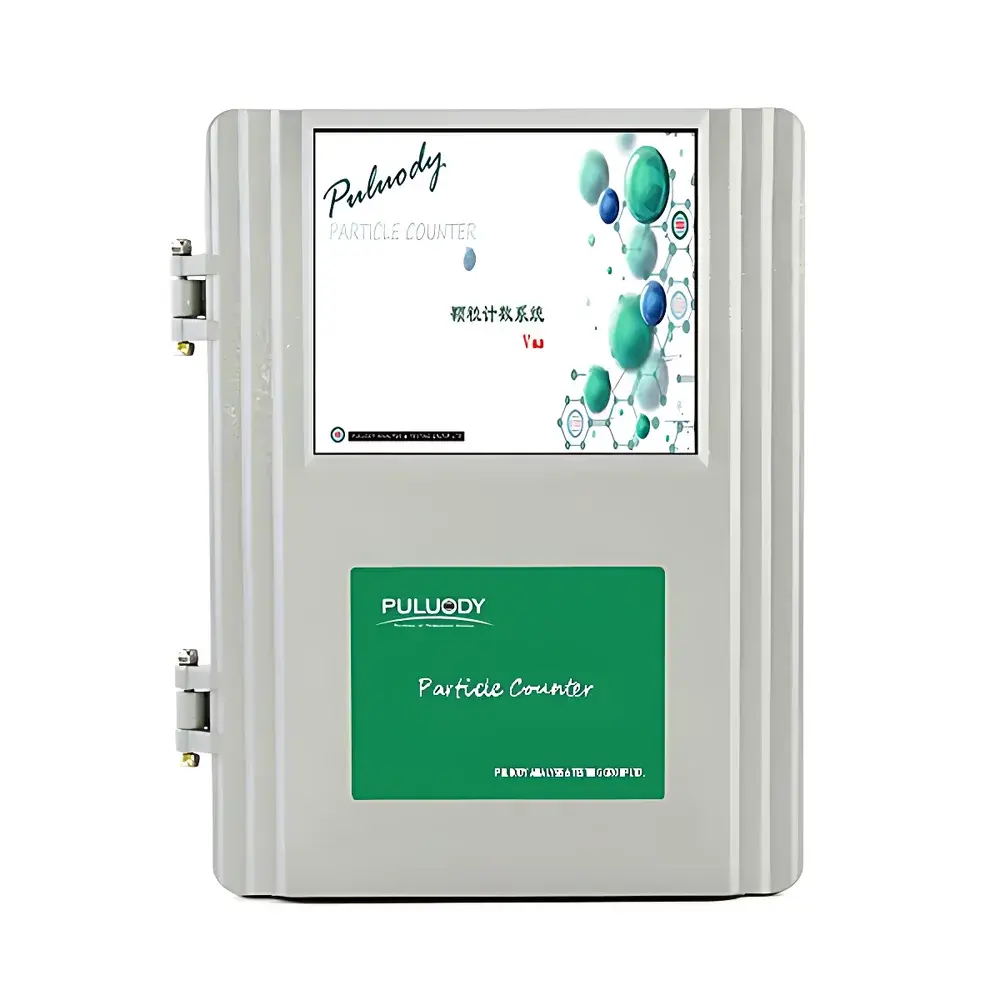
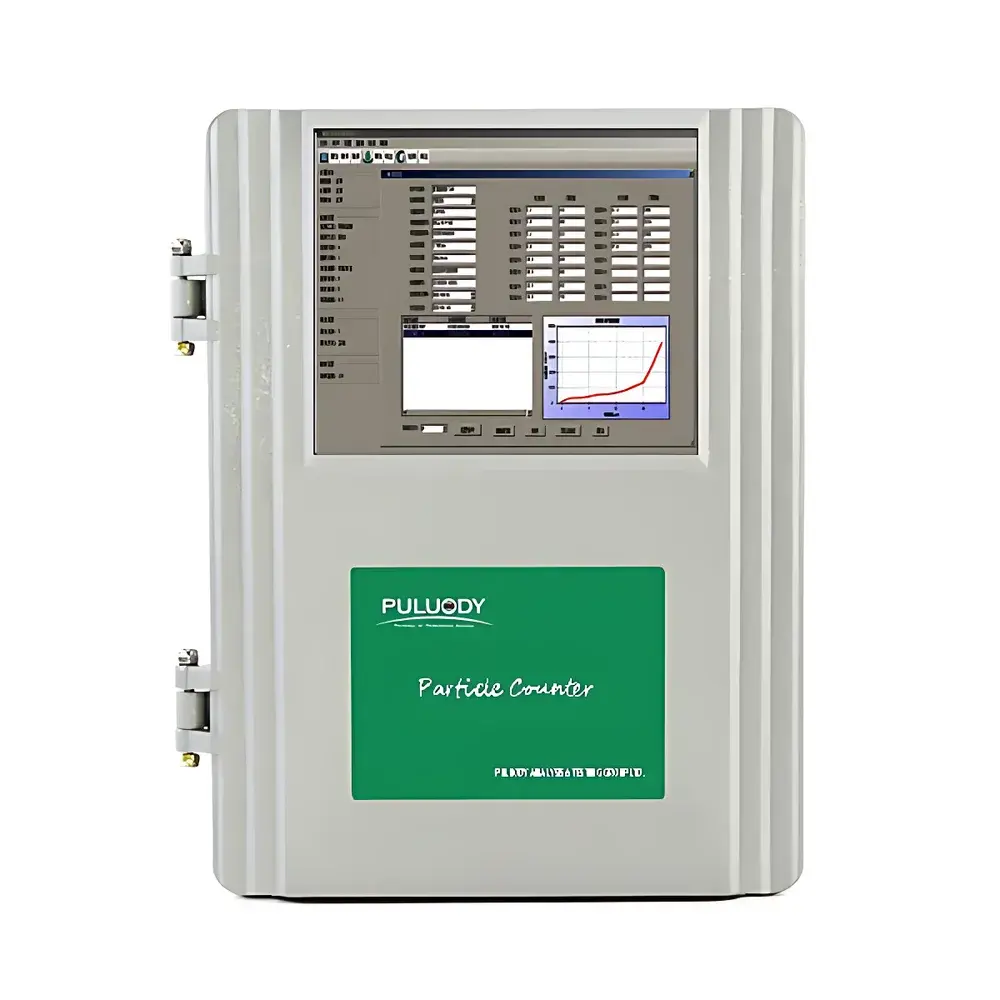
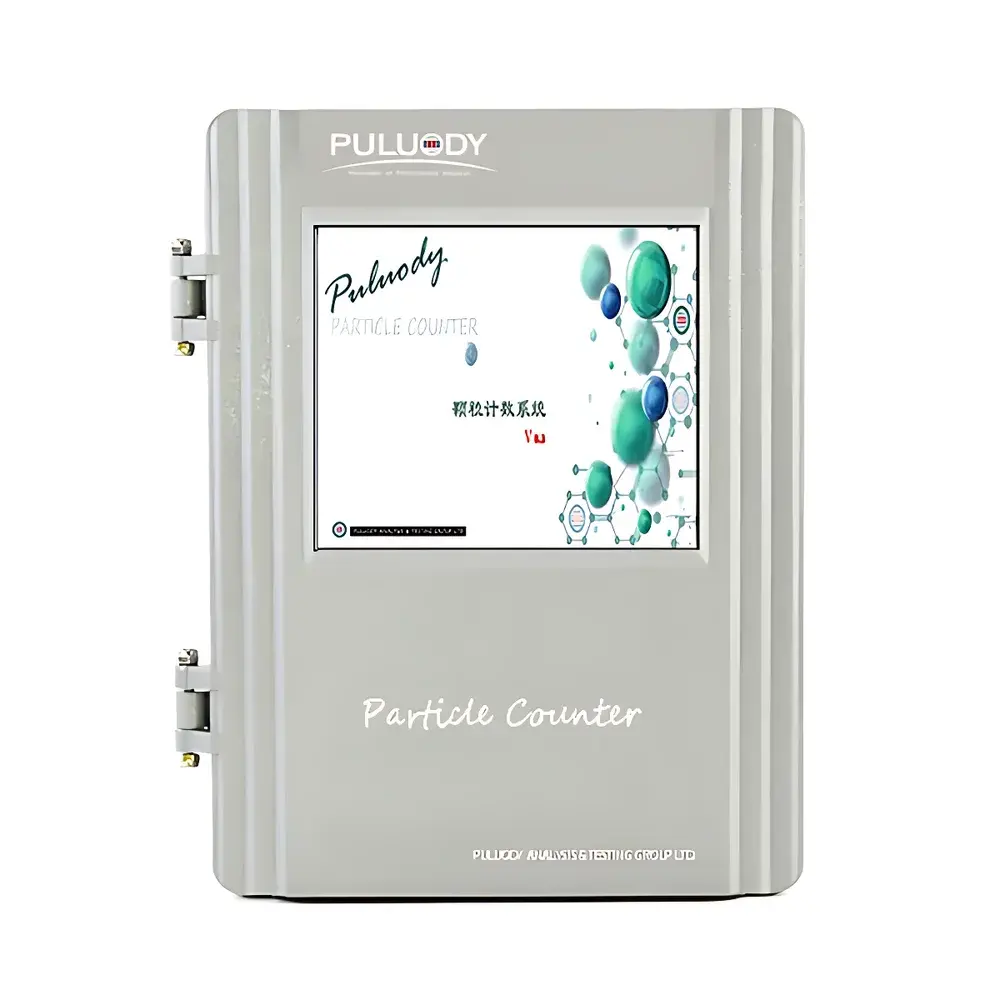
PULUODY OPC-2300D Online Waterborne Particle Counter
| Brand | PULUODY |
|---|---|
| Origin | Shaanxi, China |
| Manufacturer Type | Authorized Distributor |
| Region of Origin | Domestic (China) |
| Model | OPC-2300D |
| Instrument Type | Optical Particle Counter |
| Detection Principle | Light Obscuration (LO) with Dual-Laser Narrow-Beam Technology |
| Sensor Range | 2–750 µm (configurable up to 1000 µm) |
| Size Channels | Up to 1000 user-defined bins (e.g., 8/16/32 standard channels) |
| Resolution | 0.1 µm |
| Counting Accuracy | < ±3% (typical) |
| Coincidence Error | ≤5% at 999,999 particles/mL |
| Maximum Concentration | 9,999,999 particles/mL |
| Sampling Interval | 5 s – 9 h |
| Pressure Rating | 0–0.6 MPa (standard), 0–31.5 MPa (with pressure-reducing valve) |
| Flow Rate | 6–500 mL/min |
| Fluid Temperature Range | −10 °C to +80 °C |
| Analog Output | 4–20 mA |
| Digital Interface | RS232 / RS485 |
| Data Storage | Unlimited (onboard + external export) |
| Calibration Standards | NIST-traceable latex spheres, AC fine test dust, MTD |
| Compliance Support | ISO 4406, ISO 11171, NAS 1638, ASTM D6786, USP <788>, EP 2.9.19 |
| Power Supply | 9–30 VDC or 220 VAC |
| Alarm Functions | Particle count threshold, sensor health diagnostics |
Overview
The PULUODY OPC-2300D Online Waterborne Particle Counter is an industrial-grade optical particle counter engineered for continuous, real-time monitoring of suspended particulate contamination in aqueous process streams. Based on the eighth-generation dual-laser narrow-beam light obscuration (LO) detection architecture licensed from PULUODY Analytical Testing Group UK, the OPC-2300D delivers high reproducibility and long-term stability in demanding operational environments. Unlike laboratory-based offline analyzers, this system is designed for permanent installation in pressurized water circuits — including municipal drinking water distribution networks, membrane filtration skids, pharmaceutical water-for-injection (WFI) loops, beverage bottling lines, and industrial cleaning-in-place (CIP) systems. Its core function is to quantify particle concentration per milliliter across user-selectable size thresholds (e.g., ≥2 µm, ≥5 µm, ≥10 µm, ≥25 µm), enabling dynamic assessment of filter integrity, upstream contamination ingress, and system wear debris accumulation. The instrument operates under ISO 4406 and ASTM D6786-compliant counting protocols and supports configurable reporting formats aligned with hydraulic fluid cleanliness standards — adapted for aqueous media through validated hydrodynamic calibration.
Key Features
- Dual-laser narrow-beam optical sensing architecture ensures minimal signal drift and enhanced discrimination of sub-micron to coarse particles (2–750 µm, extendable to 1000 µm)
- Configurable multi-channel sizing: 1000-bin resolution with arbitrary binning (8/16/32 standard channels); 0.1 µm minimum size resolution
- Robust process interface: Stainless steel wetted parts; pressure-rated housing (0–31.5 MPa with integrated pressure-reducing valve); operating temperature range −10 °C to +80 °C
- Flexible integration: 4–20 mA analog output for PLC/DCS connectivity; RS232 and RS485 serial interfaces supporting Modbus RTU protocol
- On-device intelligence: Built-in LCD display with membrane keypad; real-time particle count, size distribution histogram, and ISO 4406 code generation
- Continuous self-diagnostics: Automatic sensor health monitoring, flow validation, and optical path integrity verification
- Modular mechanical design: Available in both integrated inline and remote-sensor configurations with customizable tubing connections (VCR, Swagelok, DIN, or ANSI flange)
Sample Compatibility & Compliance
The OPC-2300D is validated for use with low-conductivity, non-corrosive aqueous fluids including purified water (PW), water-for-injection (WFI), ultrapure water (UPW), potable water, wastewater effluent, and food-grade process water. It complies with international regulatory frameworks governing particle control in critical applications: USP and for pharmaceutical water quality; EP 2.9.19 for injectable solutions; ISO 8573-4 for compressed air-associated water condensate; and ISO 21501-4 for light-scattering particle characterization. Calibration traceability is maintained via NIST-certified polystyrene latex (PSL) microspheres, ISO MTD (medium test dust), and AC fine test dust. The device supports audit-ready data logging compliant with FDA 21 CFR Part 11 requirements when paired with validated software — including electronic signatures, immutable timestamps, and operator-access-controlled configuration changes.
Software & Data Management
The OPC-2300D ships with embedded firmware and optional PC-based analysis software (PULUODY ParticleView™ v5.x). Data is stored locally in non-volatile memory with unlimited capacity and can be exported via USB or network transfer in CSV, PDF, or XML formats. The software enables trend analysis of particle counts over time, overlay of multiple size thresholds, automatic generation of ISO 4406 or NAS 1638 codes, and alarm-triggered snapshot capture. All measurement events include metadata: timestamp, flow rate, temperature, pressure, sensor status, and calibration history. For enterprise integration, RESTful API and OPC UA support allow bidirectional communication with MES, SCADA, and LIMS platforms. Audit trails record all parameter modifications, user logins, and calibration activities — satisfying GLP and GMP documentation requirements.
Applications
- Real-time integrity testing of ultrafiltration (UF), nanofiltration (NF), and reverse osmosis (RO) membranes in municipal and industrial water treatment plants
- Monitoring microbial challenge indicators (e.g., spore surrogates) and detecting breakthrough events in sterile barrier systems
- Quantifying particulate shedding from pump seals, valve seats, and pipe welds in hygienic process lines
- Validating cleaning efficacy during CIP cycles in dairy, brewing, and biopharmaceutical facilities
- Assessing filter performance decay and scheduling predictive maintenance based on cumulative particle load
- Supporting risk-based water system qualification per ICH Q5C and Annex 1 (EU GMP)
FAQ
What particle size ranges can the OPC-2300D measure?
The standard configuration covers 2–750 µm with 0.1 µm resolution; extended options support 5–1000 µm. Users may define up to 1000 discrete size bins or select industry-standard groupings (e.g., ISO 4406’s 4 µm(c), 6 µm(c), 14 µm(c)).
Is the instrument suitable for high-pressure boiler feedwater systems?
Yes — with the optional pressure-reducing valve assembly, it operates continuously at up to 31.5 MPa (4570 psi), making it compatible with high-pressure steam generation and nuclear coolant loop monitoring.
How is calibration verified in situ?
Field calibration verification uses traceable PSL suspensions injected via a dedicated calibration port; automated alignment routines confirm laser focus and photodetector response without disassembly.
Can the OPC-2300D integrate with existing plant DCS systems?
Yes — 4–20 mA analog outputs map to primary particle count channels; Modbus RTU over RS485 enables full register-level access to raw histograms, alarms, and diagnostic flags.
Does the device meet cybersecurity requirements for Industry 4.0 deployments?
Firmware includes TLS 1.2 encryption for remote configuration, role-based access control (RBAC), and secure boot authentication — certified to IEC 62443-4-2 SL2 compliance upon request.



