
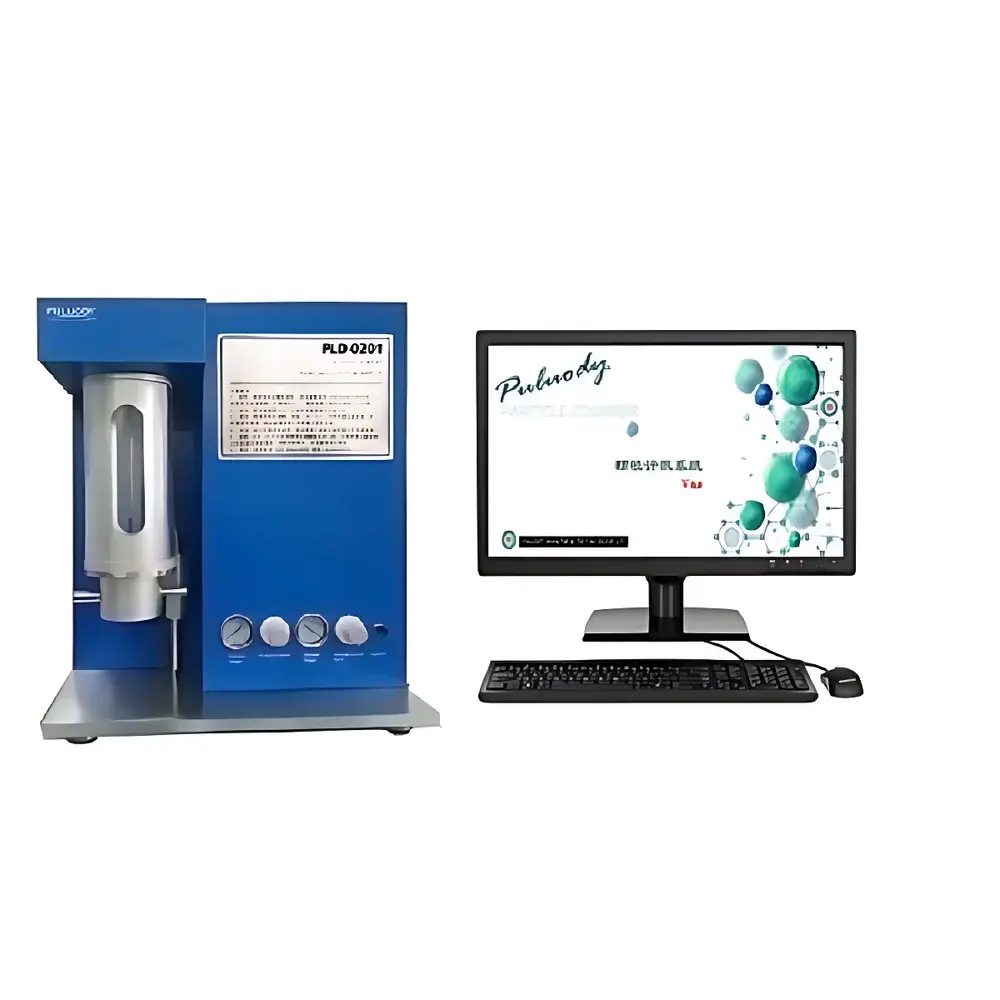
PULUODY PLD-0201 8th-Generation Dual-Laser Optical Particle Counter
| Brand | PULUODY |
|---|---|
| Origin | Shaanxi, China |
| Manufacturer Type | OEM Manufacturer |
| Instrument Type | Optical Particle Counter |
| Model | PLD-0201 |
| Detection Principle | Light Obscuration (LO) with Dual-Laser Narrow-Beam Technology |
| Measurement Range | 0.01 µm – 1000 µm (configurable sensor modules) |
| Channel Resolution | Up to 1000 user-definable size channels |
| Sensitivity | 1 µm (per ISO 4402) or 4 µm(c) (per ISO 11171 / GB/T 18854) |
| Sample Flow Control | Dual-mode precision piston pump + ultra-precise electromagnetic flow regulation |
| Viscosity Handling | ≤ 450 mm²/s |
| Sample Volume Accuracy | ±1% |
| Flow Rate | 5–60 mL/min (test), 10–100 mL/min (cleaning) |
| Pressure Range | −0.08 to 0.8 MPa (integrated positive/negative pressure pretreatment) |
| Operating Temperature | Ambient to 65 °C (sample), 0–50 °C (ambient) |
| Data Storage | 3000 tests onboard |
| Compliance Standards | ISO 11171, ISO 4402, ISO 4406, NAS 1638, GB/T 14039, GB/T 18854, JJG/T 066, DL/T 432, GJB 380, GJB 420A/B, MIL-STD-1246, ASTM D6786, USP <788> & <789> (via optional configuration) |
| Software Platform | PULL 8.1 Multi-Language Analysis Suite (English, Chinese, Japanese, Korean, German, French, Spanish, Russian, Arabic, Portuguese) |
| Output Interface | RS232, integrated thermal printer, capacitive touchscreen (7″ color LCD), dual-input (touch + keypad), iPad-compatible data acquisition module |
Overview
The PULUODY PLD-0201 is an 8th-generation dual-laser optical particle counter engineered for high-fidelity, trace-level particulate contamination monitoring in both organic and aqueous liquid systems. It operates on the internationally standardized light obscuration (LO) principle—where particles suspended in a laminar fluid stream pass through two spatially separated, collimated laser beams, generating discrete voltage pulses proportional to their cross-sectional area. This dual-beam architecture significantly enhances signal-to-noise ratio, reduces coincidence error (<5% at 10,000 particles/mL), and enables real-time discrimination of transient artifacts (e.g., air bubbles, agglomerates) via pulse shape analysis. Designed specifically for mission-critical fluid integrity applications—including hydraulic oils, turbine oils, insulating transformer oils, aviation fuels, ultrapure water, and polymer solutions—the PLD-0201 meets the metrological rigor required by aerospace, power generation, semiconductor manufacturing, and pharmaceutical cleanroom operations. Its modular sensor architecture supports configurable detection ranges from 0.01 µm (nanoscale colloids) to 1000 µm (macro-debris), with up to 1000 programmable size thresholds per measurement cycle.
Key Features
- Dual-laser narrow-beam optical detection system (8th-generation PULUODY proprietary design) delivering improved long-term stability (>12 months calibration interval), reduced thermal drift, and enhanced resolution at sub-micron thresholds.
- Integrated sample pretreatment station with independent positive-pressure, negative-pressure, magnetic stirring, and vacuum degassing functions—enabling reliable analysis of viscous fluids (up to 450 mm²/s), aerated samples, and heterogeneous suspensions without manual prefiltration or dilution.
- Electromagnetically regulated dual-flow control: precision metering piston pump ensures volumetric accuracy better than ±1%, while closed-loop electromagnetic flow modulation maintains constant velocity across variable viscosity and backpressure conditions.
- 1000-channel granulometric profiling with fully customizable binning—supporting simultaneous compliance reporting against multiple international standards (e.g., ISO 4406:2021, NAS 1638:2022, GJB 420B:2020) within a single run.
- Embedded industrial-grade controller with 7-inch capacitive touchscreen interface, bilingual (English/Chinese) menu navigation, and dual-input mode (touch + physical keypad) for gloved-hand operation in controlled environments.
- Onboard thermal printer and RS232 serial interface—enabling standalone operation or seamless integration into LIMS, MES, or SCADA platforms without external computing hardware.
Sample Compatibility & Compliance
The PLD-0201 accommodates a broad spectrum of liquid matrices: hydrocarbon-based lubricants (mineral, synthetic, bio-based), water-glycol and phosphate-ester hydraulic fluids, deionized and ultrapure water (UPW), aqueous coolants, pharmaceutical injectables (per USP and when configured with 0.1–5 µm optimized optics), and aggressive solvents (e.g., acetone, THF, IPA). Its sensor modules are certified traceable to NIST-traceable reference materials (GBW series), and calibration adheres strictly to ISO 11171:2010 (for calibration particle sizing) and ISO 4402:1991 (for sensitivity verification). The instrument satisfies GLP/GMP documentation requirements through full audit trail logging—including operator ID, timestamped calibration events, parameter changes, and raw pulse data archives. Optional validation packages include formal IQ/OQ documentation, as well as third-party certification reports issued by the Aviation Industry Particle Counting Metrology Station (Xi’an) or Northwest National Metrology Center (CNAS-accredited).
Software & Data Management
PULL 8.1 is a deterministic, multi-language analysis platform compliant with FDA 21 CFR Part 11 (electronic signatures, audit trails, role-based access control). It decouples calibration routines from routine testing—allowing concurrent execution without interference—while preserving raw pulse waveform integrity for retrospective reanalysis. Each test record stores not only particle counts per channel but also statistical descriptors (D10/D50/D90, skewness, kurtosis), histogram overlays, cumulative distribution curves, and automated ISO 4406 or NAS 1638 code assignment. Data export supports CSV, PDF, XML, and proprietary .PLD binary formats. Local storage retains 3000 complete test histories with metadata (operator, date, method, sensor ID); network-connected PCs enable unlimited archival, trend analysis, and SPC charting. Remote firmware updates and method library synchronization are supported over secure HTTPS.
Applications
This instrument serves as a primary contamination control tool across regulated and industrial sectors. In aerospace maintenance depots, it verifies hydraulic fluid cleanliness prior to component installation per MIL-STD-1246C Level 100. Power plants deploy it for continuous monitoring of turbine oil per DL/T 1096 and ISO 8573-4. Semiconductor fabs use its nanoscale module (0.01–0.2 µm) to qualify UPW used in wafer rinsing baths. Pharmaceutical manufacturers apply it for subvisible particle enumeration in parenteral formulations under USP . Additionally, it supports R&D workflows such as wear debris analysis in tribology labs, catalyst suspension homogeneity assessment, and nanoparticle dispersion stability studies in battery electrolyte development.
FAQ
Does the PLD-0201 support regulatory-compliant calibration traceability?
Yes—calibration is performed using ISO 11171-certified ACFTD and MTD reference materials, with documentation traceable to national metrology institutes (NIM, NIM-NWMC) and optionally accredited by CNAS.
Can the system analyze high-viscosity oils without dilution?
Yes—its integrated positive/negative pressure pretreatment and precision piston pump allow direct analysis of oils up to 450 mm²/s at 40 °C without solvent addition or heating.
Is software validation support available for GxP environments?
Yes—PULL 8.1 includes Part 11-compliant features (electronic signatures, audit trails, 21-day auto-backup), and IQ/OQ protocols are provided upon request.
What particle counting standards are preloaded in the firmware?
Over 510 configurations are embedded—including ISO 4406:2021, NAS 1638:2022, GJB 420B:2020, DL/T 432:2018, and USP , with field-upgradable templates for emerging standards.
How is sensor cross-sensitivity to air bubbles mitigated?
Dual-laser time-of-flight discrimination combined with pulse width analysis distinguishes true particulates from gaseous cavities, reducing false positives by >92% versus single-beam systems.



