
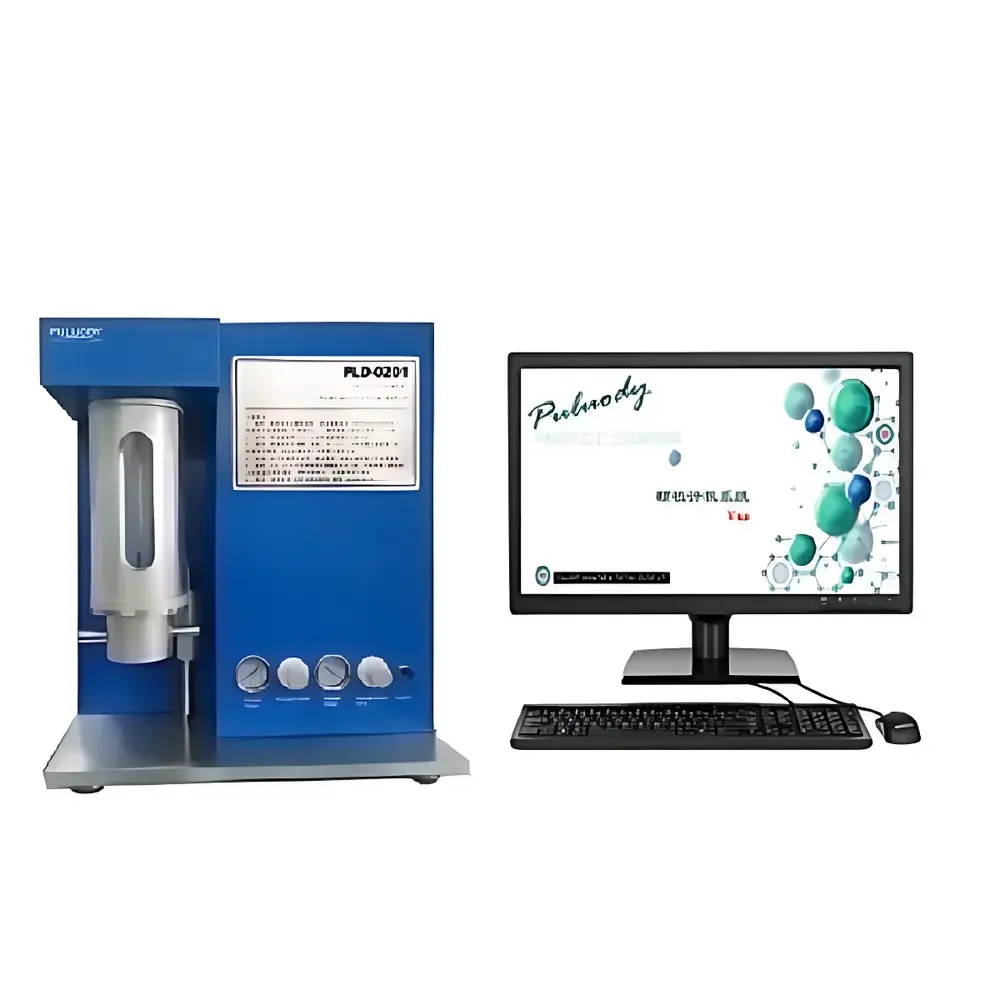
PULUODY PLD-0201 Optical Oil Particle Counter
| Brand | PULUODY |
|---|---|
| Origin | Shaanxi, China |
| Manufacturer Type | Direct Manufacturer |
| Instrument Type | Optical Particle Counter |
| Model | PLD-0201 (Serial: 02010086) |
| Detection Principle | Light Obscuration (LO) |
| Measurement Range | 0.01 µm to 1000 µm (sensor-dependent) |
| Channel Capacity | Up to 1000 user-configurable size channels |
| Sensitivity | 1 µm (per ISO 4402) or 4 µm(c) (per ISO 11171 / GB/T 18854) |
| Sample Viscosity Limit | ≤450 mm²/s |
| Flow Control | Dual-mode precision piston pump + ultra-precise electromagnetic flow regulation |
| Sampling Volume Accuracy | ±1% |
| Flow Rate | 5–60 mL/min (test), 10–100 mL/min (rinse) |
| Pressure Range | −0.08 to 0.8 MPa |
| Operating Temperature | Ambient to 65 °C |
| Data Storage | 3000 tests onboard |
| Compliance Standards | ISO 11171, ISO 4406, ISO 4402, NAS 1638, GB/T 14039, GB/T 18854, JJG/T 066, GJB 420A/B, DL/T 432, DL/T 1096, MIL-STD-1246, ASTM D6786 |
| Software Platform | PULL 8.1 multi-language analytical suite (English, Chinese, Japanese, Korean, etc.) |
| Output Interface | RS232, integrated thermal printer, touchscreen GUI, iPad-compatible data acquisition |
| Calibration Support | ACFTD & MTD traceable calibration |
Overview
The PULUODY PLD-0201 Optical Oil Particle Counter is an industrial-grade, dual-laser narrow-beam light obscuration (LO) instrument engineered for high-precision quantification of solid particulate contamination in liquid media—primarily lubricating oils, hydraulic fluids, turbine oils, insulating oils, and aqueous solutions. Its core measurement principle relies on the transient attenuation of collimated laser light as particles pass through a precisely defined sensing zone, generating voltage pulses proportional to particle cross-sectional area. This method conforms rigorously to ISO 11171 (calibration), ISO 4406 (contamination coding), and NAS 1638 (grading), ensuring metrological traceability and interlaboratory comparability. Designed for continuous operation in QC labs, field service units, and OEM maintenance centers, the PLD-0201 integrates fluid conditioning, optical detection, real-time signal processing, and standardized reporting into a single robust architecture—eliminating manual sample preparation while maintaining compliance with GLP, GMP, and FDA 21 CFR Part 11 data integrity requirements.
Key Features
- Dual-eighth-generation narrow-beam laser sensors delivering enhanced signal-to-noise ratio, long-term photodetector stability (>10,000 hours MTBF), and sub-micron resolution down to 0.01 µm.
- 1000 fully programmable detection channels enabling simultaneous multi-standard evaluation (e.g., ISO 4406, NAS 1638, GJB 420B) without hardware reconfiguration.
- Integrated pre-conditioning chamber with independent positive/negative pressure control, magnetic stirring, and vacuum-assisted degassing—enabling reliable analysis of viscous, aerated, or sediment-prone samples (up to 450 mm²/s).
- Precision dual-flow control system: electro-mechanical piston pump for volumetric accuracy (±1%) and electromagnetic valve array for pulse-free, laminar flow regulation across 5–60 mL/min test range.
- Self-cleaning fluidic path with automated rinse cycle, minimizing carryover and reducing operator intervention between samples.
- Industrial-grade 10.1-inch capacitive touchscreen HMI with bilingual (English/Chinese) menu navigation, keyboard-and-touch dual input, and real-time histogram visualization.
Sample Compatibility & Compliance
The PLD-0201 supports broad-spectrum liquid matrices including mineral- and synthetic-based lubricants, phosphate ester hydraulic fluids, water-glycol systems, transformer oil, jet fuel, glycol coolants, and ultrapure water (UPW). It accommodates both organic and inorganic suspensions without chemical modification or filtration pretreatment. Regulatory alignment includes full support for ISO 4406:2017 (code generation), ISO 11171:2010 (calibration protocol), NAS 1638 Class reporting, and military specifications such as MIL-STD-1246C and GJB 420B. Calibration traceability is maintained via NIST-traceable ACFTD and MTD reference materials; optional third-party verification is available through the AVIC Aviation Industry Particle Metrology Center or the Northwest National Metrology Center (NWNM), accredited under CNAS ILAC-MRA. All firmware and software operations comply with audit trail requirements per 21 CFR Part 11 Annex 11 and EU GMP Annex 11.
Software & Data Management
PULL 8.1 analytical software serves as the embedded and PC-deployable platform—offering ten localized language interfaces and modular functionality. The system separates calibration routines from routine testing workflows to prevent parameter interference during live analysis. Onboard storage retains 3,000 complete test records with timestamped metadata (operator ID, sample ID, environmental conditions, sensor status). Data export supports CSV, PDF, and XML formats compatible with LIMS integration. iPad-based remote monitoring enables real-time acquisition and cloud-synced backup. All raw pulse data—including threshold-crossing events, dwell time, and amplitude histograms—is preserved for retrospective reanalysis. Audit logs record every user action, configuration change, and calibration event with immutable timestamps—fully satisfying GLP documentation requirements.
Applications
This instrument is deployed across critical infrastructure sectors where fluid cleanliness directly impacts system reliability and service life. In aerospace maintenance, it validates hydraulic fluid integrity prior to aircraft deployment per MIL-STD-1246C. Power generation facilities use it for real-time turbine oil monitoring to preempt bearing wear and varnish formation. Wind turbine OEMs apply it to gear oil trending per IEC 60422. Semiconductor fabs employ its sub-100 nm capability for UPW qualification against SEMI F57. Additional applications include R&D validation of filtration efficiency, accelerated wear testing of hydraulic components, corrosion inhibitor performance assessment, and regulatory submission support for ISO 8573-4 compressed air particulate audits.
FAQ
Does the PLD-0201 require sample dilution or filtration before analysis?
No—its integrated degassing, stirring, and pressure-controlled aspiration eliminates the need for off-line pretreatment for most oils up to 450 mm²/s viscosity.
Can the instrument generate ISO 4406 codes automatically?
Yes—real-time calculation and display of ISO 4406:2017 codes (e.g., 18/16/13) are embedded in firmware and report templates.
Is third-party calibration certification available?
Yes—certified calibration reports issued by the AVIC Particle Metrology Center or NWNM National Metrology Center can be procured upon request.
What is the minimum detectable particle size with standard configuration?
The base A-sensor configuration detects particles ≥1 µm (ISO 4402 compliant); optional nanoscale sensors extend down to 0.01 µm.
How does the system ensure flow rate accuracy across varying viscosities?
Dual-stage flow regulation combines closed-loop piston displacement control with adaptive electromagnetic valve modulation to maintain ±1% volumetric precision regardless of fluid rheology.
Related Products



