
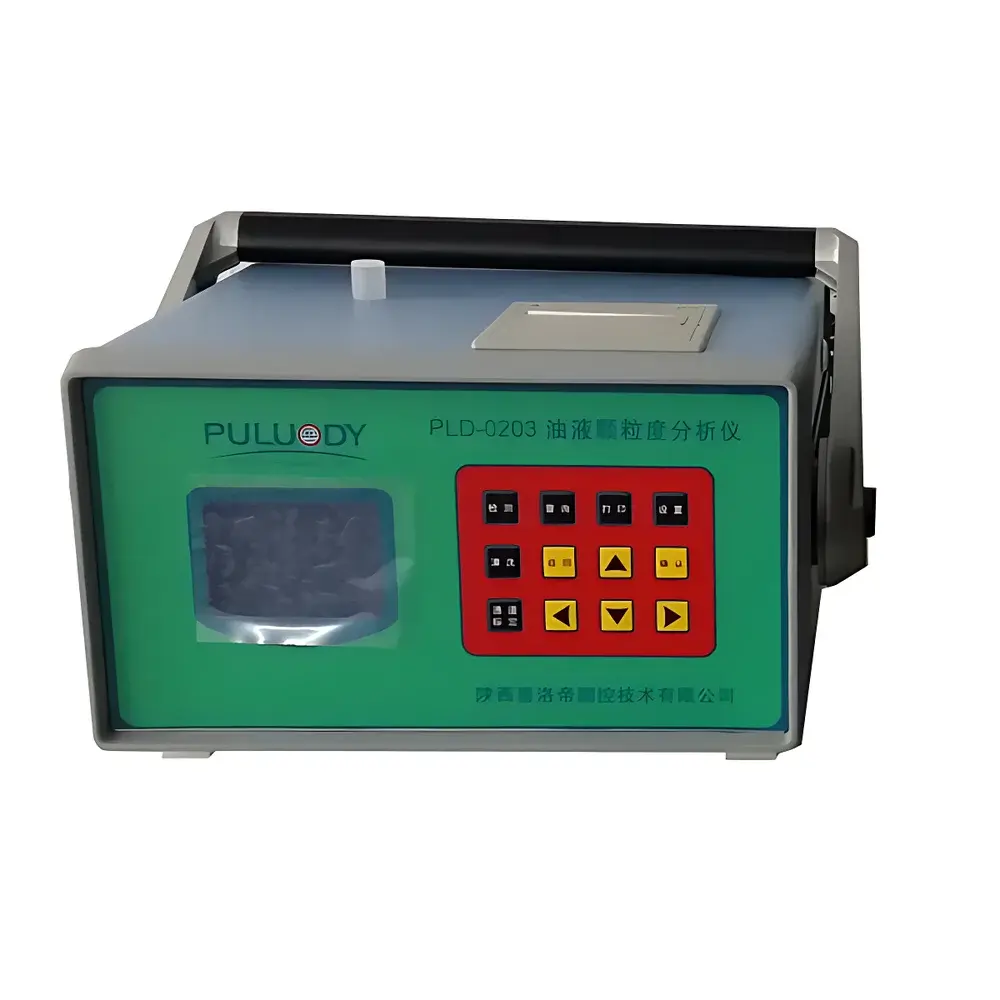
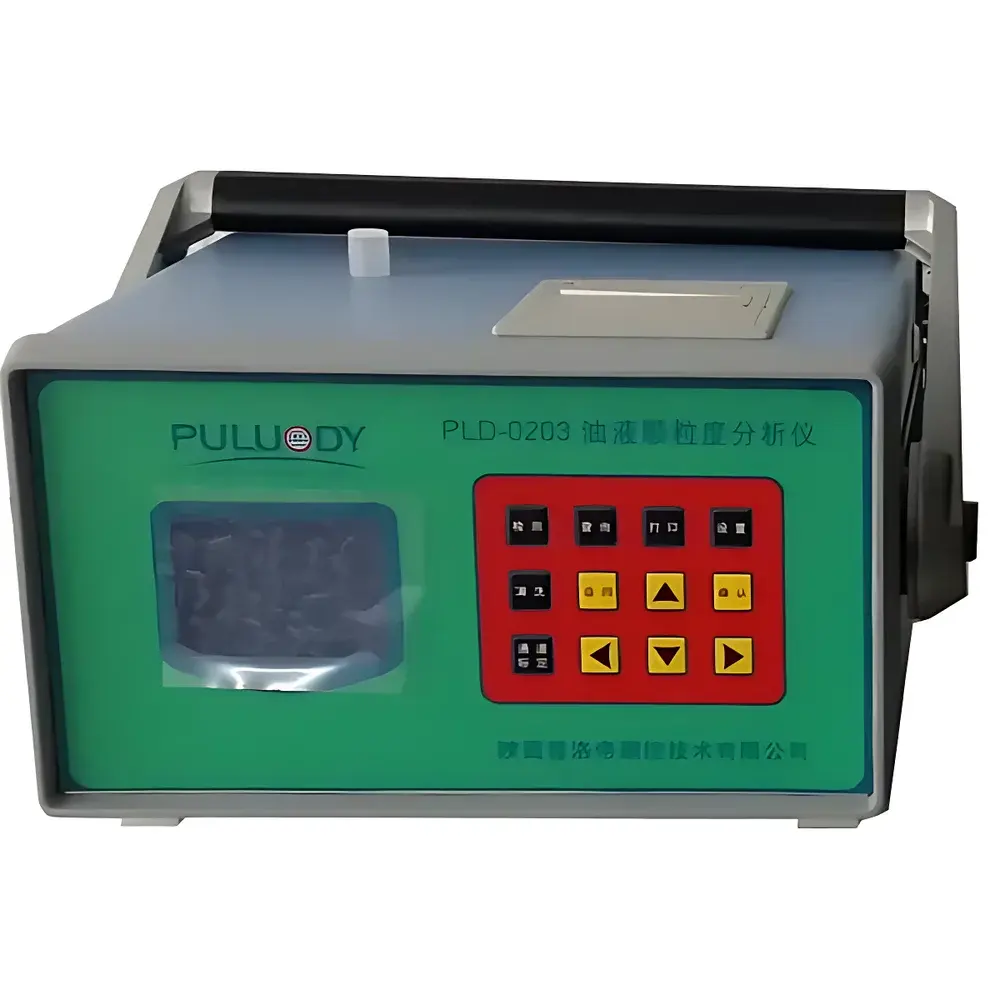
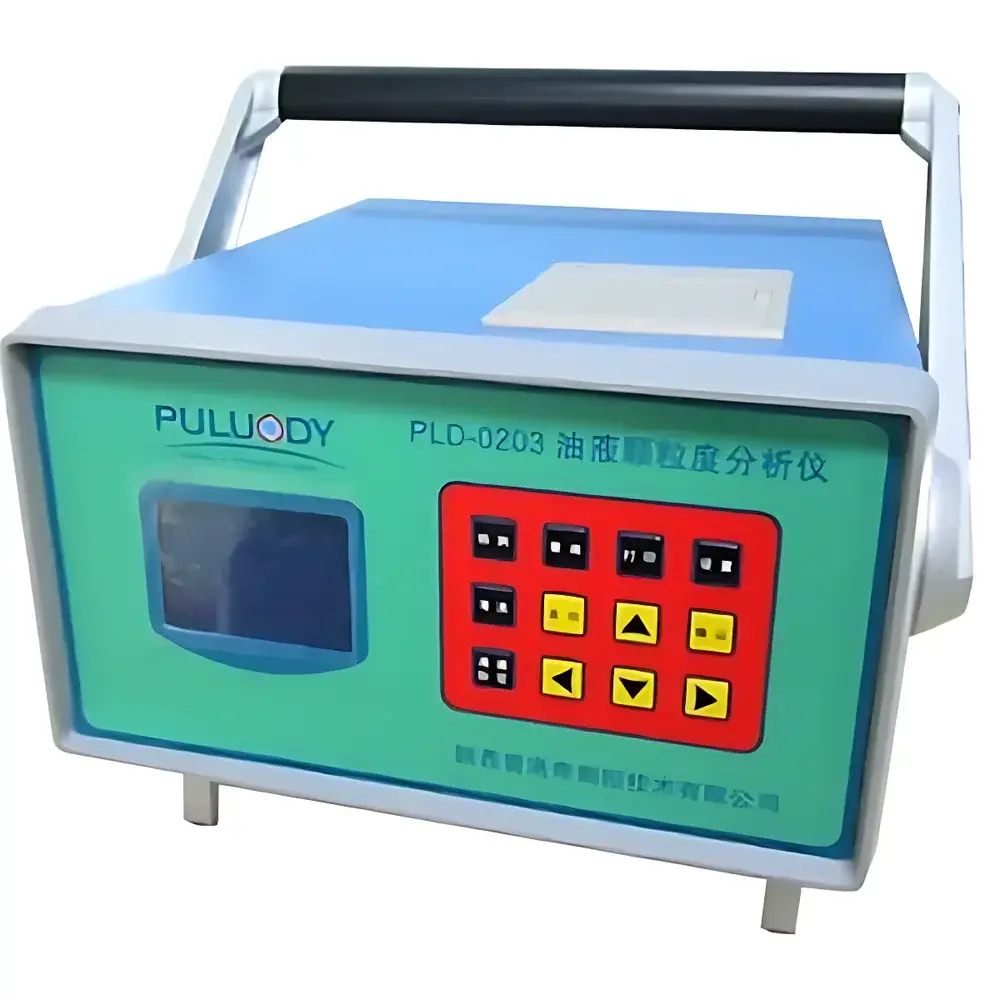
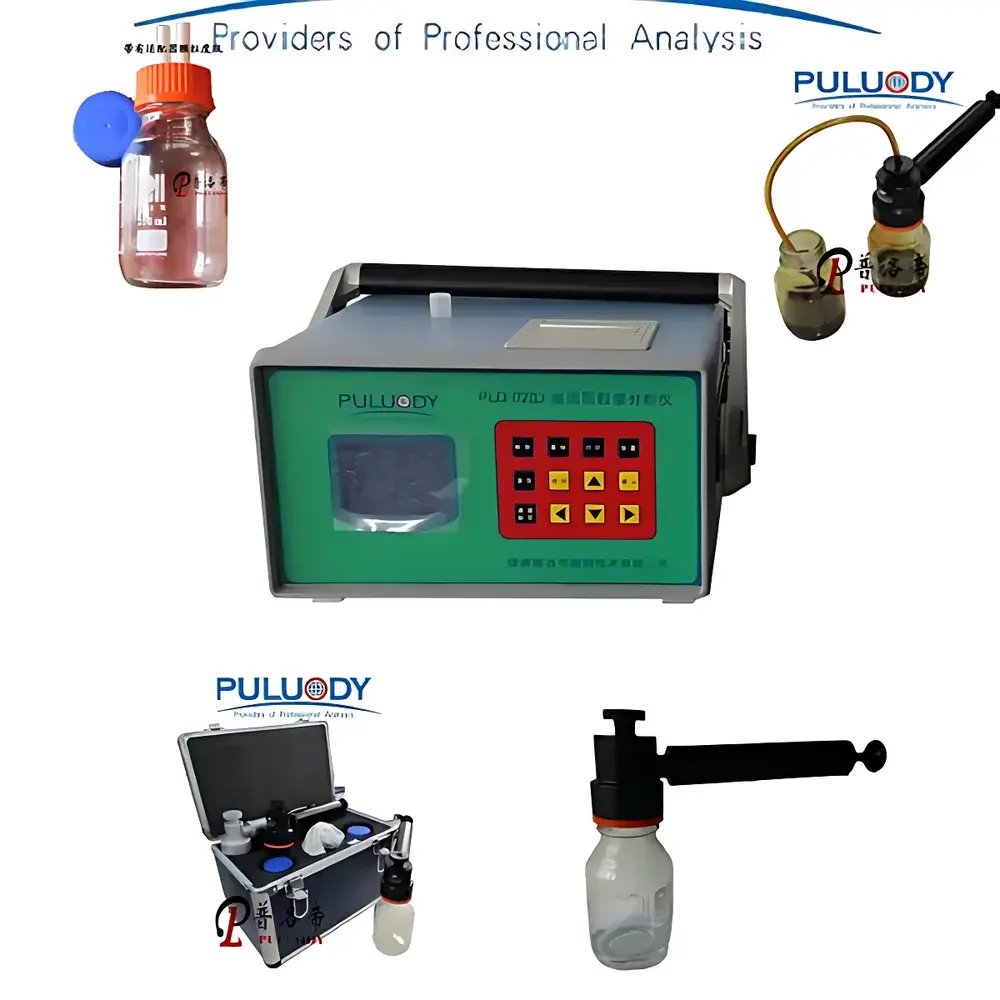
PULUODY PLD-0203 Oil Particle Counter — Laboratory & Online Dual-Mode System
| Brand | PULUODY |
|---|---|
| Origin | Shaanxi, China |
| Instrument Type | Optical Particle Counter |
| Laser Sensor Generation | 7th-generation dual-laser narrow-beam detector |
| Measurement Principle | Light Blockage (LO) & Light Scattering (LS) |
| Calibration Standards | ISO 11171, ISO 4402, ASTM F658-87 (PSL), GB/T 18854, JJG 1061 |
| Compliance | ISO 4406:1999/2017, NAS 1638, SAE AS4059F, GJB 420B, DL/T 432, GJB 380, ISO 11500 |
| Particle Size Range | 0.03 µm – 3000 µm (configurable sensor modules) |
| Channel Count | Up to 1000 resolution channels |
| Sensitivity | 1 µm (per ISO 4402) or 4 µm(c) (per ISO 11171 / GB/T 18854) |
| Coincidence Limit | ≤5% at 10,000 particles/mL |
| Resolution | ≥90% @ 60 mL/min |
| Volumetric Accuracy | ±1% |
| Flow Rate (Sampling) | 5–60 mL/min |
| Flow Rate (Cleaning) | 5–150 mL/min |
| Max. Online Pressure | 0–31.5 MPa (with pressure regulator) |
| Viscosity Range | Offline ≤99 mm²/s |
| Operating Temperature | Ambient to 65°C |
| Power Supply | 220 VAC, 50 Hz, <80 W |
Overview
The PULUODY PLD-0203 Oil Particle Counter is a dual-mode optical particle counting system engineered for rigorous particulate contamination analysis in both laboratory and continuous online monitoring environments. It implements two complementary detection principles—light blockage (LO) and light scattering (LS)—to deliver high-fidelity quantification of insoluble particulate matter across an exceptionally broad size range (0.03 µm to 3000 µm), configurable via interchangeable sensor modules. Designed under the technical oversight of PULUODY Analytical Testing Group (UK), the instrument meets the metrological requirements of international fluid cleanliness standards including ISO 4406, NAS 1638, SAE AS4059F, and GJB 420B. Its architecture supports traceable calibration per ISO 11171 (MTD/ISO), ISO 4402 (ACFTD), ASTM F658-87 (PSL latex spheres), and GB/T 18854, ensuring alignment with GLP/GMP validation frameworks and regulatory audit readiness (e.g., FDA 21 CFR Part 11–compliant data integrity when integrated with validated software configurations).
Key Features
- Modular sensor architecture with up to 13 selectable optical detection units (e.g., 0.03–0.10 µm, 0.1–1.0 µm, 2–750 µm), each optimized for specific size bands and fluid matrices
- 7th-generation dual-laser narrow-beam detector enabling simultaneous LO/LS signal acquisition for improved sizing accuracy and reduced misclassification of agglomerates or translucent particles
- Integrated industrial-grade control platform: optional embedded IPC or external industrial PC, supporting deterministic real-time sampling control and synchronized data logging
- Full-range volumetric precision: programmable sample volume (1–200 mL) with ±1% volumetric accuracy and automated priming/purging cycles
- Online deployment capability: rated for continuous operation at pressures up to 31.5 MPa (with integrated pressure regulation) and viscosities up to 500 mm²/s
- Self-cleaning fluidic pathway with programmable cleaning flow rates (5–150 mL/min) and post-analysis rinse sequence verification
- Multi-standard compliance engine: automatic grade assignment per ISO 4406, NAS 1638, or custom user-defined thresholds without manual recalculation
Sample Compatibility & Compliance
The PLD-0203 accommodates diverse fluid chemistries without pre-filtration or dilution, including aviation turbine fuels (Jet A-1, JP-5), phosphate ester hydraulic fluids (e.g., Skydrol®), synthetic lubricants, transformer oil, turbine oil, gear oils, and aggressive media such as high-acidity or high-alkalinity process liquids. It has been verified for use with ultrapure water (UPW), pharmaceutical-grade injectables, and semiconductor process chemicals. All sensor modules are calibrated per ISO 11171 using NIST-traceable MTD aerosol and ISO 4402 ACFTD suspensions; optional PSL sphere calibration (ASTM F658-87) is available for sub-micron validation. The system complies with national military metrology requirements (GJB 420B, DL/T 432) and civilian certification protocols administered by the Northwest National Metrology Center and the Commission of Science, Technology and Industry for National Defense (COSITND) Level-1 Particle Metrology Station.
Software & Data Management
The instrument operates with P6.4 Analysis Software (integrated and PC versions), providing full audit trail functionality—including operator ID, timestamped method parameters, raw pulse data, and calibration history—to satisfy 21 CFR Part 11 electronic record requirements. Data output includes differential and cumulative particle counts per ISO-defined size bins, histogram distribution plots, temporal trend charts, and direct export to CSV, PDF, or XML formats. Built-in thermal printer enables on-site hardcopy reporting. Communication interfaces include RS232, RS485, USB, and MODBUS RTU; analog outputs (4–20 mA, 0–5 V) support integration into SCADA and DCS platforms. Cloud connectivity via PULUODY Oil Monitoring Cloud enables remote diagnostics, fleet-wide contamination trending, and predictive maintenance analytics.
Applications
The PLD-0203 serves critical contamination control functions across aerospace (hydraulic system health monitoring, fuel cleanliness verification per MIL-STD-3005), power generation (turbine oil condition assessment per ASTM D6786), defense logistics (wear debris analysis in armored vehicle transmissions), semiconductor manufacturing (UPW and chemical delivery system qualification), and pharmaceutical production (particulate testing of parenteral solutions per USP ). It is routinely deployed for R&D wear testing, filter efficiency validation (per ISO 16889), hydraulic component qualification (per ISO 10770-1), and routine QC in lubricant blending facilities. Its adaptability to corrosive, high-viscosity, and thermally sensitive fluids makes it suitable for offshore drilling mud analysis, wind turbine gearbox oil surveillance, and electric vehicle battery coolant monitoring.
FAQ
Does the PLD-0203 require sample filtration or dilution prior to analysis?
No—samples are introduced directly without pretreatment, preserving native particle morphology and concentration integrity.
Can the instrument be validated for GxP-regulated environments?
Yes—when operated with P6.4 software configured for 21 CFR Part 11 compliance (user authentication, electronic signatures, immutable audit trails), it supports IQ/OQ/PQ documentation packages.
What is the maximum allowable fluid temperature during online operation?
The inline sensor module supports continuous operation from ambient temperature up to 65°C; higher temperatures require external heat exchanger integration.
How is sensor calibration maintained over time?
Calibration is verified using certified reference materials (ISO 11171 MTD, PSL spheres); drift correction routines are embedded in firmware and triggered automatically during scheduled maintenance intervals.
Is remote firmware update supported?
Yes—secure OTA updates are delivered via the PULUODY Oil Monitoring Cloud platform, with version rollback capability and change-log documentation.



