
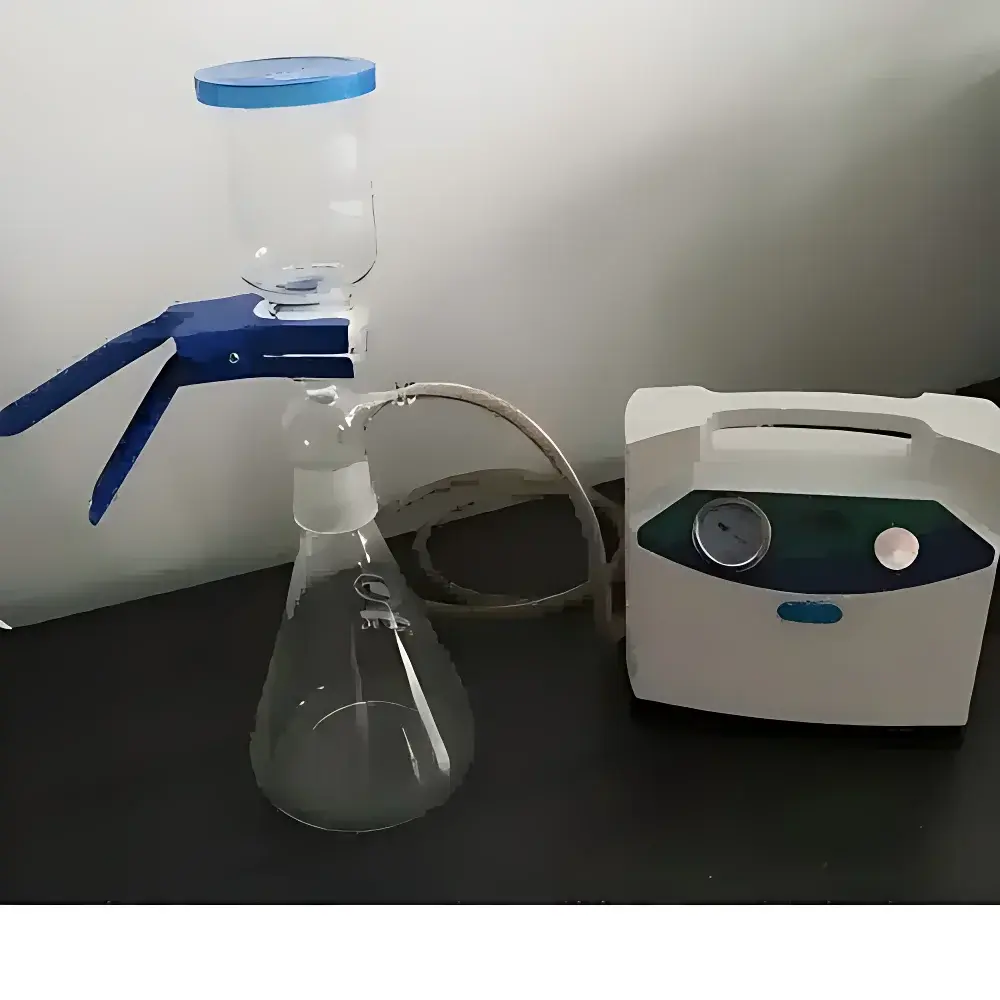
PULUODY PLD-11901 Portable Suspended Solids Analyzer
| Brand | PULUODY |
|---|---|
| Origin | Shaanxi, China |
| Model | PLD-11901 |
| Instrument Type | Portable Suspended Solids Analyzer |
| Detection Principle | Gravimetric Filtration (0.45 µm membrane) |
| Filtration Membrane | Glass fiber or quantitative filter paper (φ50 mm or φ60 mm, pore size 0.45 µm) |
| Drying Temperature | 104 ± 1 °C |
| Weighing Accuracy | ≥ 0.1 mg |
| Vacuum Pressure Range | 20–80 kPa |
| Maximum Vacuum | ≥ 80 kPa |
| Airflow Rate | ≥ 20 L/min |
| Noise Level | ≤ 60 dB(A) |
| Power Supply | AC 220 V ± 10%, 50 Hz |
| Detection Range | 2–1000 mg/L (practical optimal range: 5–100 mg suspended solids per sample) |
| Sample Volume | 100 mL (adjustable based on expected concentration) |
| Compliance Basis | ASTM D5907, ISO 11923, EPA Method 160.2, GB/T 11901–1989 |
Overview
The PULUODY PLD-11901 Portable Suspended Solids Analyzer is a field-deployable gravimetric instrumentation system engineered for precise quantification of total suspended solids (TSS) in aqueous matrices. It implements the standardized filtration–drying–weighing methodology defined in major regulatory and consensus standards—including ASTM D5907 (Standard Test Method for Total Suspended Solids in Water), ISO 11923 (Water Quality — Determination of Suspended Solids by Filtration Through Glass-Fibre Filters), and EPA Method 160.2 (Suspended Solids). The instrument integrates a vacuum-assisted filtration module with a built-in high-stability vacuum pump, enabling rapid, reproducible sample processing without reliance on external laboratory infrastructure. Its design conforms to the fundamental definition of TSS: particulate matter retained on a 0.45 µm pore-size filter membrane after filtration, followed by drying at 103–105 °C to constant mass. This principle ensures traceability to national and international reference methods, making the PLD-11901 suitable for compliance monitoring, wastewater treatment plant operations, environmental impact assessments, and regulatory reporting under ISO/IEC 17025-accredited laboratories.
Key Features
- Integrated dual-mode vacuum control: digitally adjustable pressure range (20–80 kPa) with real-time stabilization, minimizing membrane rupture risk during high-turbidity sampling
- Optimized filtration manifold compatible with standard φ50 mm and φ60 mm glass-fiber or quantitative filter membranes (0.45 µm pore size), ensuring interchangeability with certified lab consumables
- Low-noise operation (≤60 dB(A)) and compact ergonomic housing, facilitating extended use in mobile labs, field stations, and on-site industrial audits
- Thermally stable drying interface—designed to interface seamlessly with externally calibrated ovens operating at 104 ± 1 °C—supporting strict adherence to thermal conditioning requirements per ISO 11923
- Robust mechanical architecture with corrosion-resistant fluid pathways and sealed pump chamber, rated for continuous duty in humid or chemically aggressive ambient conditions
- No internal reagent consumption; operation relies solely on distilled/deionized water for membrane pre-wetting and sample rinsing—reducing operational cost and chemical handling hazards
Sample Compatibility & Compliance
The PLD-11901 is validated for use across diverse water matrices, including surface water, groundwater, domestic wastewater, and industrial effluents—with documented performance for samples containing non-settleable colloids, fine silt, algal fragments, and biologically derived particulates. It excludes floating debris, submerged macro-particulates, and immiscible hydrocarbons per standard TSS definitions (e.g., US EPA 40 CFR Part 136). All procedural steps—from bottle cleaning (polyethylene or borosilicate glass, triple-rinsed with sample matrix) to cold storage at 4 °C (≤7 days, no preservatives)—align with GLP-aligned sample integrity protocols. The system supports full audit readiness: raw weight data from analytical balances (≥0.1 mg resolution) can be manually logged into LIMS-compatible spreadsheets, and all filtration events are timestamped via operator documentation per ISO/IEC 17025 clause 7.7 (result reporting). While the analyzer itself does not generate electronic records, its workflow is fully compatible with 21 CFR Part 11-compliant data capture systems when integrated with validated balance interfaces and secure electronic notebooks.
Software & Data Management
The PLD-11901 operates as a hardware-only platform with no embedded firmware or proprietary software—ensuring long-term interoperability and eliminating vendor lock-in. All measurement data (initial membrane mass, post-filtration mass, drying cycles, sample volume) are recorded manually or entered into laboratory information management systems (LIMS) using standardized templates compliant with ISO/IEC 17025 Annex A.3 (data control). Users may employ Excel-based calculation tools pre-validated against ASTM D5907 Annex A1 to derive final TSS concentrations (mg/L) using the formula: TSS = [(A − B) × 1000] / V, where A = dried filter + residue mass (g), B = tare filter mass (g), and V = sample volume (L). The absence of onboard electronics simplifies IQ/OQ validation and reduces cybersecurity exposure—critical for GMP-regulated environmental monitoring programs.
Applications
- Wastewater treatment plant (WWTP) process control: monitoring influent, activated sludge, secondary clarifier effluent, and disinfection outfalls
- Regulatory compliance testing for discharge permits (e.g., NPDES, EU Urban Wastewater Treatment Directive)
- Environmental site assessments (ESAs) and sediment transport studies in riverine and lacustrine systems
- Industrial pretreatment verification for food processing, pulp/paper, textile, and pharmaceutical manufacturing facilities
- Educational laboratories requiring ANSI/ISO-aligned TSS methodology training for undergraduate and graduate environmental science curricula
- Field-based rapid screening during emergency response (e.g., post-spill turbidity surge evaluation, stormwater runoff characterization)
FAQ
What filtration membrane specifications are required?
Glass-fiber filters (e.g., Whatman GF/C or equivalent) or ashless quantitative filter paper (pore size 0.45 µm, diameter φ50 mm or φ60 mm) must be used. Membranes must be pre-dried, cooled in a desiccator, and tared to constant mass (±0.2 mg) prior to filtration.
Can the PLD-11901 be used for saline or high-TDS water?
Yes—provided dissolved salts do not precipitate during drying. For brackish or seawater samples, confirm absence of crystalline salt deposition on the filter post-drying; if present, consider parallel conductivity or gravimetric TDS analysis to deconvolve contributions.
Is calibration required before each use?
No instrumental calibration is needed. However, daily verification of vacuum stability (±5 kPa at setpoint) and periodic validation of balance accuracy (using NIST-traceable weights) are essential per ISO/IEC 17025 clause 6.4.
How is method detection limit (MDL) determined for this system?
MDL is analyte- and procedure-dependent. Based on replicate analyses of low-concentration blanks (n ≥ 7), the practical MDL is 2 mg/L when using 100 mL sample volume and ≥0.1 mg balance resolution—consistent with EPA guidance for gravimetric TSS methods.
Does the unit include a drying oven?
No—the PLD-11901 includes only the filtration and vacuum subsystem. A separate, externally validated oven (103–105 °C, ±1 °C uniformity) and desiccator are required per standard methodology.
Related Products







