
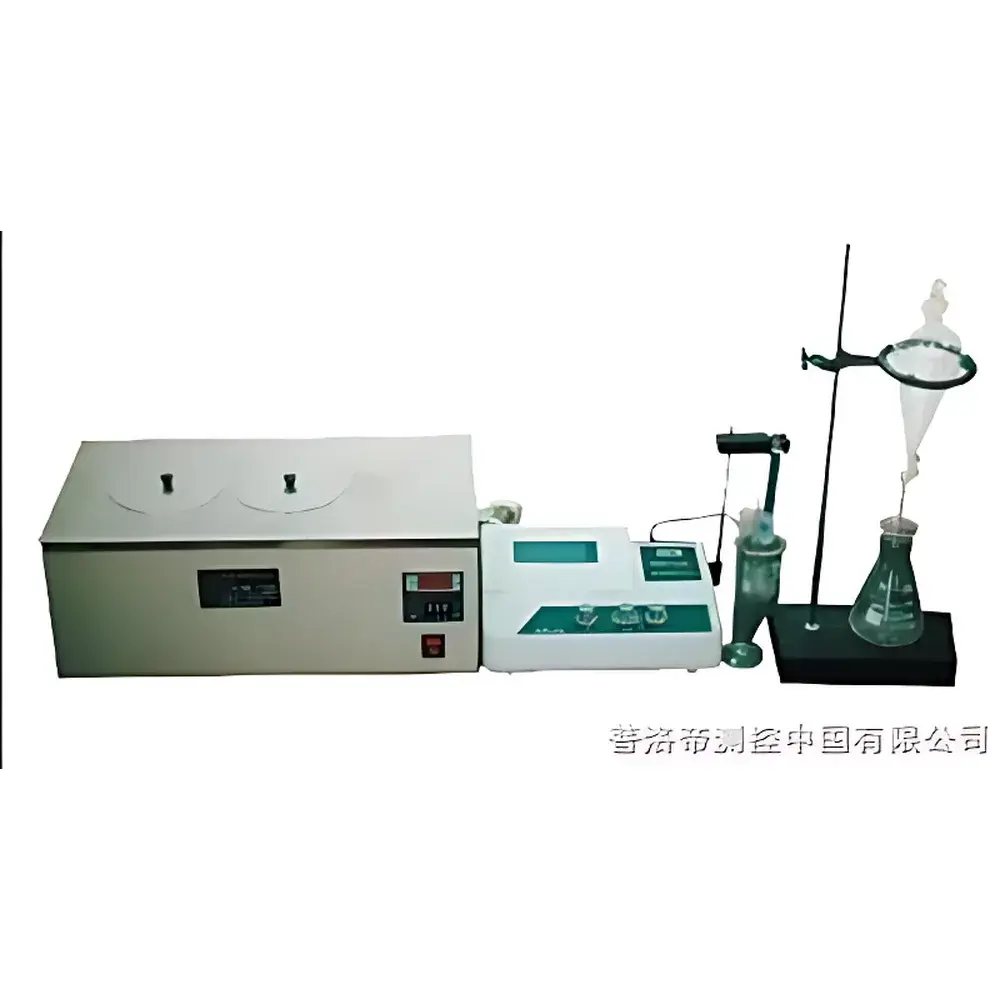
PULUODY PLD-259A Water-Soluble Acid and Alkali Tester
| Brand | PULUODY |
|---|---|
| Model | PLD-259A |
| Origin | Shaanxi, China |
| Manufacturer Type | Original Equipment Manufacturer (OEM) |
| Product Category | Domestic |
| Rated Power | 500 W |
| Operating Voltage | 220 V AC, 50 Hz |
| Temperature Control Range | TR+10 °C to 100 °C |
| Temperature Display Accuracy | ±0.2 °C |
| Separatory Funnel Capacity | 250 mL |
| Graduated Cylinders | 50 mL and 100 mL |
| Test Tube Diameter Compatibility | φ15–20 mm |
| pH Measurement Range | 0.00–14.00 |
| pH Accuracy | ±0.1 pH |
| mV Range | ±1999 mV |
| mV Accuracy | ±10 mV |
Overview
The PULUODY PLD-259A Water-Soluble Acid and Alkali Tester is a dedicated electrochemical analytical instrument engineered for standardized extraction and quantitative assessment of water-soluble acidic and alkaline components in petroleum-based fluids and related hydrocarbon derivatives. It operates in strict compliance with GB/T 259–1988, the Chinese national standard equivalent in scope and methodology to ASTM D974 (Standard Test Method for Neutralization Number of Petroleum Products by Potentiometric Titration) and ISO 3675 for acid number determination in crude oil and refined products. The system integrates two functionally interdependent modules: a precision temperature-controlled water bath extraction unit and a calibrated benchtop pH/mV meter. The extraction process follows a defined aqueous partitioning protocol—where sample is agitated with distilled water under controlled thermal conditions (TR+10 °C to 100 °C), followed by phase separation using a 250 mL separatory funnel. The resulting aqueous extract is then subjected to potentiometric measurement to determine pH or redox potential, enabling classification of acidity/alkalinity per standardized thresholds.
Key Features
- Integrated dual-module architecture: independent water bath heating system and digital pH/mV meter, each calibrated and validated for traceable metrology.
- Stainless steel inner chamber and cold-rolled steel outer housing ensure long-term corrosion resistance and structural integrity during repeated exposure to acidic/alkaline aqueous extracts.
- Digital temperature controller with ±0.2 °C display accuracy and stable setpoint maintenance across the full operating range (TR+10 °C to 100 °C), minimizing thermal drift during extended extraction cycles.
- Dual-range electrochemical sensor interface supporting both pH (0.00–14.00, ±0.1 pH) and mV (±1999 mV, ±10 mV) measurements, suitable for endpoint detection in semi-quantitative acid-base screening.
- Modular glassware configuration—including 250 mL separatory funnel, 50 mL and 100 mL graduated cylinders, and φ15–20 mm test tubes—designed for reproducible manual liquid–liquid separation and transfer per GB/T 259–1988 procedural requirements.
- Adjustable electrode stand with vertical extension mechanism ensures consistent immersion depth and mechanical stability for repeatable electrode positioning during measurement.
Sample Compatibility & Compliance
The PLD-259A is validated for use with liquid petroleum products (e.g., gasoline, diesel, kerosene), petroleum additives, lubricating greases, paraffin waxes, and wax-containing fractions. Its design conforms to the physical and chemical constraints outlined in GB/T 259–1988, including specified agitation time, water-to-sample ratio, and phase separation dwell period. While not certified to IEC 61000-4 electromagnetic compatibility standards or UL/CSA safety listings, the instrument meets general industrial laboratory electrical safety requirements for Class I equipment operating at 220 V AC, 50 Hz. It supports GLP-aligned documentation when used with external lab notebooks or LIMS-integrated data capture workflows.
Software & Data Management
The PLD-259A is a hardware-only platform with no embedded firmware or proprietary software. All measurements are displayed on local LED or LCD screens (pH/mV meter and temperature controller), and raw data must be manually recorded. For regulatory environments requiring audit trails—such as those governed by FDA 21 CFR Part 11 or ISO/IEC 17025—the instrument is intended for use in conjunction with validated electronic lab notebooks (ELNs) or chromatography data systems (CDS) capable of timestamped entry and user authentication. No automated data export (e.g., USB, RS-232, or Ethernet) is provided; optional third-party analog-to-digital interfaces may be integrated for analog output logging.
Applications
- Routine quality control testing of refinery intermediates and finished fuels for residual acidic contaminants introduced during catalytic cracking or hydrotreating.
- Stability assessment of lubricant formulations during accelerated oxidation trials, where formation of low-molecular-weight organic acids signals base stock degradation.
- Verification of neutralization efficacy in post-treatment washing steps for wax purification processes.
- Educational laboratory instruction in petroleum chemistry, emphasizing standardized wet-chemistry protocols for polar compound extraction and electrochemical characterization.
- Pre-screening tool prior to formal titrimetric acid number (TAN) analysis per ASTM D664 or D974, reducing unnecessary reagent consumption in high-throughput labs.
FAQ
Does the PLD-259A comply with ASTM or ISO standards?
It is designed to implement procedures aligned with GB/T 259–1988, which shares methodological equivalence with ASTM D974 and ISO 3675 for qualitative and semi-quantitative water-soluble acid/alkali detection—but it is not certified to those standards.
Can the pH/mV meter be recalibrated in-house?
Yes, the meter supports manual calibration using standard NIST-traceable buffer solutions (pH 4.01, 7.00, 10.01) and redox standards (e.g., quinhydrone, Zn/ZnSO₄), per manufacturer’s calibration protocol.
Is the water bath compatible with non-aqueous solvents?
No—only distilled or deionized water is permitted as the heat-transfer medium. Organic solvents pose fire, volatility, and material compatibility risks.
What maintenance is required for long-term accuracy?
Routine cleaning of glassware with non-ionic detergent, periodic verification of temperature sensor drift using a certified reference thermometer, and annual electrode hydration and slope verification are recommended.
Can this instrument be used for quantitative acid number (TAN) reporting?
No—it provides qualitative or semi-quantitative classification only. Quantitative TAN requires potentiometric titration with standardized KOH solution and volumetric endpoint detection per ASTM D664 or D974.





