
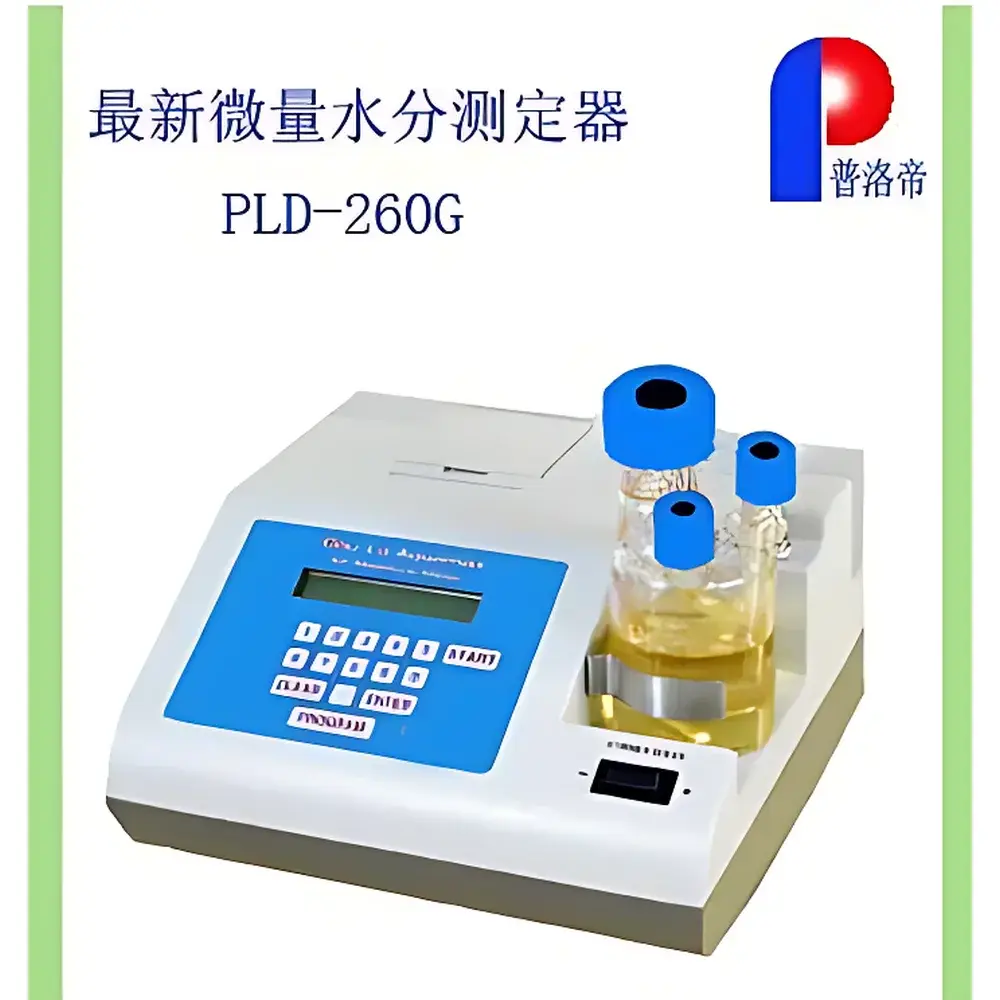
PULUODY PLD-260G Karl Fischer Coulometric Moisture Analyzer
| Brand | PULUODY |
|---|---|
| Origin | Shaanxi, China |
| Manufacturer Type | Direct Manufacturer |
| Model | PLD-260G |
| Measurement Principle | Coulometric Karl Fischer Titration |
| Measurement Range | 1 µg – 500 mg H₂O |
| Sensitivity | 0.1 µg |
| Accuracy | ±5% ±1 µg |
| Electrode System | Dual Platinum Indicator Electrodes |
| Titration Cell Volume | 150 mL |
| Stirring Method | Magnetic Stirring |
| Control System | PULL T 8.0 Embedded Test Platform |
| Analysis Time per Sample | 2–4 min |
| Endpoint Detection | Real-time Current Monitoring with Audio-Visual Alert |
| Display | 20×2 Character LCD (Date, Time, Electrolysis Rate, µg H₂O) |
| Printer Output | 16-Character Thermal Printer |
| Power Supply | 220 V ±10%, 50 Hz ±0.5 Hz |
| Power Consumption | 40 W |
| Operating Temperature | 10–40 °C |
| Relative Humidity | ≤70% RH |
| Compliance Standards | GB/T 7600, GB/T 11133, GB/T 6283, SH/T 0207, SH/T 0246, SH/T 0255 |
Overview
The PULUODY PLD-260G Karl Fischer Coulometric Moisture Analyzer is an embedded, microprocessor-controlled analytical instrument engineered for high-precision quantification of trace water content in diverse sample matrices. It operates on the fundamental electrochemical principle of coulometric Karl Fischer titration—where iodine is generated *in situ* via controlled electrolysis of iodide ions in the reagent, and stoichiometrically reacts with water according to the Karlsruhe reaction (I₂ + SO₂ + H₂O + 3RN + CH₃OH → 2RN·HI + RN·HSO₄CH₃). The instrument precisely measures the total charge passed during electrolysis, enabling direct calculation of water mass (1 coulomb ≡ 3.73 µg H₂O), eliminating the need for volumetric standardization. Designed for laboratories requiring reproducible sub-microgram detection, the PLD-260G delivers robust performance across liquid, solid, and gaseous samples—particularly where low moisture levels (<100 ppm) demand metrological rigor.
Key Features
- Coulometric detection mode with 0.1 µg absolute sensitivity—optimized for samples containing ≤100 ppm water.
- Dual platinum indicator electrodes for real-time, high-fidelity endpoint discrimination based on current threshold crossing.
- Integrated PULL T 8.0 control platform enabling fully automated sequence execution: cell conditioning, blank compensation, baseline stabilization, titration, endpoint confirmation, and result calculation.
- Self-calibrating baseline correction algorithm minimizes drift-induced error during extended operation or ambient humidity fluctuations.
- Magnetic stirring system ensures homogeneous reagent-sample interaction and rapid diffusion-limited reaction kinetics.
- Onboard 20×2 character LCD provides simultaneous display of date/time, electrolysis rate (µA), cumulative water mass (µg), and status flags—no external PC required for routine operation.
- Thermal printer outputs timestamped reports including method ID, sample ID, measured µg H₂O, calculated %/ppm, and operator annotation fields—supporting audit-ready documentation.
Sample Compatibility & Compliance
The PLD-260G accommodates a broad spectrum of sample types without modification: hygroscopic liquids (e.g., solvents, fuels, pharmaceutical excipients), viscous oils (transformer oil, lubricants), powders (catalysts, APIs), and gas-phase streams (via optional gas sampling module with permeation dryer). Its measurement protocol conforms to six Chinese national standards directly aligned with international practice: GB/T 7600 (in-service transformer oil), GB/T 11133 (liquid petroleum products), GB/T 6283 (general chemical products), SH/T 0207 (insulating oils), SH/T 0246 (light distillates), and SH/T 0255 (additive-containing lubricants). While not pre-certified to ISO 12937 or ASTM D6304, its coulometric architecture and documented repeatability (RSD < 2% at 10 µg level, n=6) meet the technical requirements for GLP-compliant moisture testing in QC environments.
Software & Data Management
The embedded PULL T 8.0 firmware implements deterministic state-machine logic for unattended batch analysis. All operational parameters—including cell volume, reagent titer (if used in hybrid mode), blank subtraction window, and endpoint current threshold—are stored in non-volatile memory with write-protection. Each measurement record contains immutable metadata: start time, duration, total charge (C), calculated water mass (µg), and system diagnostic flags (e.g., electrode impedance, stirrer RPM validation). Printed output satisfies minimum ALCOA+ criteria for attributable, legible, contemporaneous, original, and accurate records. For regulated environments, raw data export via RS-232 enables integration into LIMS or validated electronic lab notebooks; full 21 CFR Part 11 compliance requires supplemental access controls and electronic signature modules deployed at the enterprise level.
Applications
- Petrochemical QA: Quantifying water in jet fuel (ASTM D6304-equivalent), transformer oil (IEC 60814), and LNG feedstocks where ppm-level moisture induces corrosion or freezing.
- Pharmaceutical manufacturing: Release testing of lyophilized intermediates, active pharmaceutical ingredients (APIs), and excipients per USP and EP 2.5.12.
- Electronics materials: Verification of moisture in solder pastes, encapsulants, and semiconductor-grade solvents where hydrolysis degrades dielectric integrity.
- Food & beverage R&D: Stability assessment of low-moisture confectionery, powdered dairy, and functional ingredients prone to Maillard browning.
- Academic research: Kinetic studies of hydration/dehydration equilibria in MOFs, zeolites, and polymer electrolytes under controlled atmospheres.
FAQ
What sample types require special handling for accurate coulometric analysis?
Highly acidic, basic, or carbonyl-containing samples (e.g., aldehydes, ketones) may interfere with the KF reaction. Use aldehyde/ketone-compatible reagents and validate recovery with certified reference materials.
Can the PLD-260G measure water in gases?
Yes—when paired with the optional gas sampling kit (PULUODY GSK-260), which integrates a calibrated mass flow controller, Nafion® dryer, and heated transfer line to deliver representative aliquots to the titration cell.
How often must the titration cell be cleaned or reconditioned?
Under normal use (≤10 samples/day), perform daily solvent rinse and weekly cathode chamber cleaning with dry methanol. Replace generator electrode annually or after 500 kC total charge.
Is method validation support available?
PULUODY provides IQ/OQ documentation templates and application notes for common matrices (oil, ethanol, DMF); full PQ must be executed per user’s SOP using in-house reference standards.
Does the instrument support remote diagnostics or firmware updates?
Firmware upgrades are performed via USB interface using PULL T Studio desktop utility; remote troubleshooting requires user-initiated screen sharing with authorized service engineers.






