
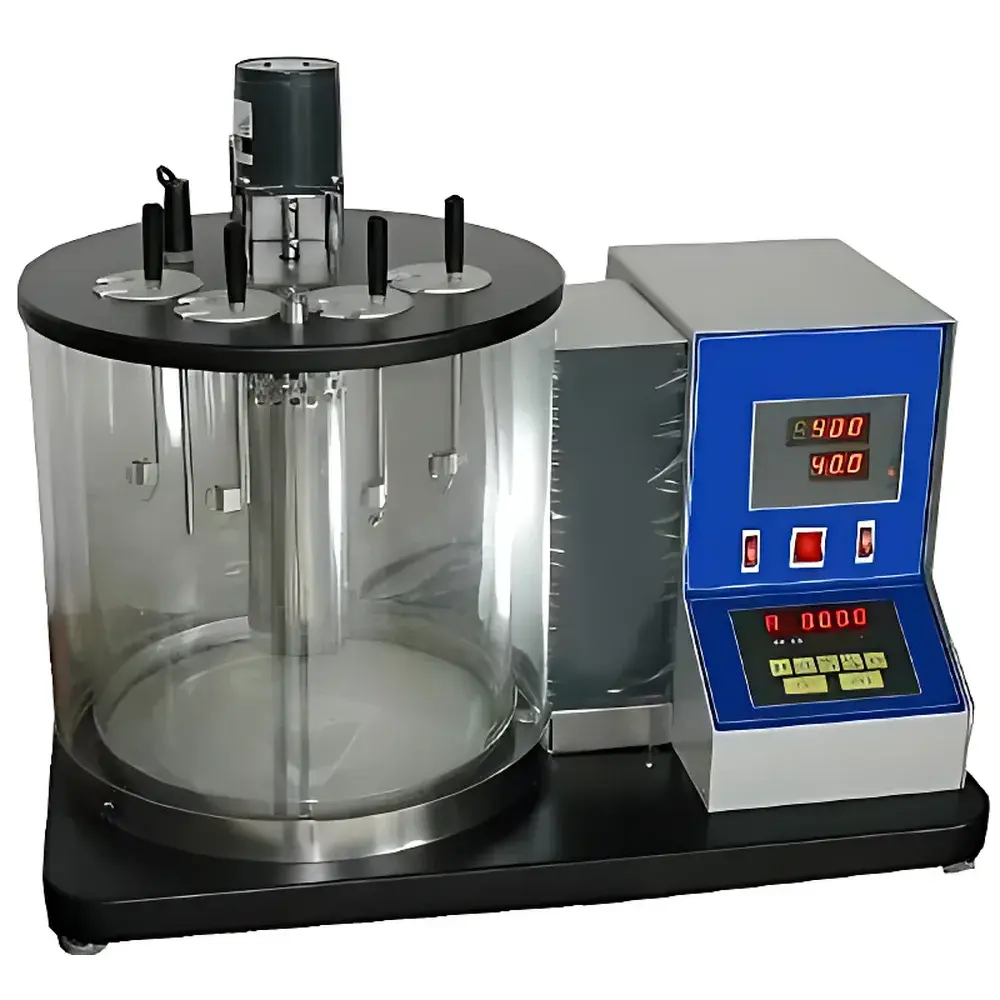
PULUODY PLD-265B Kinematic Viscosity Tester for Petroleum Liquids
| Brand | PULUODY |
|---|---|
| Model | PLD-265B |
| Origin | Shaanxi, China |
| Manufacturer Type | Direct Manufacturer |
| Power Input | <1850 W |
| Supply Voltage | AC 220 V ±10%, 50 Hz |
| Main Heating Power | 1000 W |
| Auxiliary Heating Power | 800 W |
| Temperature Control Range | Ambient to 100 °C |
| Temperature Stability | ±0.1 °C |
| Capillary Type | Ubbelohde (Ostwald-type) viscometer |
| Number of Capillary Holders | 4 |
| Conformance | GB/T 265–1988 (equivalent to ASTM D445 and ISO 3104) |
Overview
The PULUODY PLD-265B Kinematic Viscosity Tester is a precision laboratory instrument engineered for the standardized determination of kinematic viscosity in Newtonian liquid petroleum products—including base oils, lubricants, fuel oils, and hydraulic fluids—according to GB/T 265–1988. This standard aligns with internationally recognized methodologies specified in ASTM D445 and ISO 3104, both of which define capillary viscometry as the reference technique for kinematic viscosity measurement. The instrument operates on the principle of gravity-driven flow through a calibrated glass capillary (Ubbelohde/Ostwald type), where kinematic viscosity (ν) is calculated from the efflux time (t) and the capillary constant (C), using the relation ν = C × t. Designed for routine QC/QA labs in refineries, lubricant formulation centers, and third-party testing facilities, the PLD-265B delivers high reproducibility under controlled thermal conditions essential for compliance-driven reporting.
Key Features
- Double-walled transparent borosilicate glass bath enables unobstructed, multi-angle visual monitoring of capillary flow—critical for detecting bubble formation, meniscus anomalies, or flow interruption.
- Digital PID temperature controller with dual-display interface: simultaneously shows setpoint and real-time bath temperature, facilitating rapid calibration verification and drift compensation.
- Independent main and auxiliary heating circuits (1000 W + 800 W) ensure rapid thermal equilibration across the full 0–100 °C range while maintaining ±0.1 °C stability—meeting the stringent thermal uniformity requirements of ASTM D445 Annex A1.
- Four precision-machined capillary holders incorporate three-axis micrometer-adjustable leveling screws, enabling rapid vertical alignment of each viscometer without tools—minimizing operator-induced tilt error, a primary source of measurement bias in capillary methods.
- Modular bath design supports interchangeability of capillary types (e.g., Cannon-Fenske, Ubbelohde) within the same unit, provided they conform to ISO 3104 dimensional tolerances and calibration traceability protocols.
Sample Compatibility & Compliance
The PLD-265B is validated for use with transparent, homogeneous, Newtonian liquids having kinematic viscosities ranging from approximately 1 mm²/s to 10⁶ mm²/s (cSt), depending on selected capillary dimensions and test temperature (commonly 40 °C and 100 °C per ASTM D445). It excludes non-Newtonian, suspended-phase, or highly volatile samples unless pre-conditioned per ISO 17025 method validation guidelines. All operational parameters—including bath temperature uniformity, timing accuracy (<0.1 s resolution), and capillary geometry verification—are documented to support GLP-compliant audit trails. The system architecture permits integration into LIMS environments via RS-232/USB serial output for timestamped efflux data export.
Software & Data Management
While the PLD-265B operates as a standalone benchtop instrument, its digital temperature controller supports optional firmware upgrades enabling ASCII-based serial data streaming (efflux time, bath temperature, operator ID, timestamp) to external PCs. When paired with validated laboratory software (e.g., LabSolutions, Empower, or custom Python-based scripts), raw efflux data can be automatically linked to certified capillary constants, temperature-corrected using ASTM D341 interpolation, and formatted into reports compliant with ISO/IEC 17025 clause 7.8. Audit logs—covering parameter changes, calibration events, and user logins—are retained locally for ≥90 days, satisfying basic FDA 21 CFR Part 11 record-keeping expectations when deployed in regulated manufacturing settings.
Applications
- Quality control of finished lubricants against OEM specifications (e.g., SAE J300, API categories).
- Batch release testing of base stocks per ASTM D2006 and D2593.
- Viscosity index (VI) calculation using dual-temperature measurements (40 °C and 100 °C) per ASTM D2270.
- Research and development of synthetic ester formulations, bio-lubricants, and low-SAPS engine oils.
- Third-party certification testing for ISO 8573-1 compressed air system lubricant analysis.
FAQ
What standards does the PLD-265B comply with?
It is designed and verified to meet GB/T 265–1988, with technical equivalence to ASTM D445 and ISO 3104 for kinematic viscosity measurement.
Can it be used for non-Newtonian fluids such as greases or polymer-thickened oils?
No—capillary viscometry requires Newtonian behavior; such samples must be evaluated using rotational rheometry (e.g., ASTM D2983 or ISO 6743-9 Annex B).
Is temperature calibration traceable to national standards?
Yes—users are advised to perform annual verification using NIST-traceable PT100 probes or certified liquid-in-glass thermometers per ISO/IEC 17025 Section 6.4.
How many samples can be processed simultaneously?
Up to four capillaries may be mounted and thermally equilibrated concurrently; however, sequential timing is required per ASTM D445 Section 8.2 to avoid bath disturbance.
Does the unit include capillary viscometers?
No—capillaries must be procured separately and certified per ISO 3104 Annex A; each requires individual calibration constant determination.





