
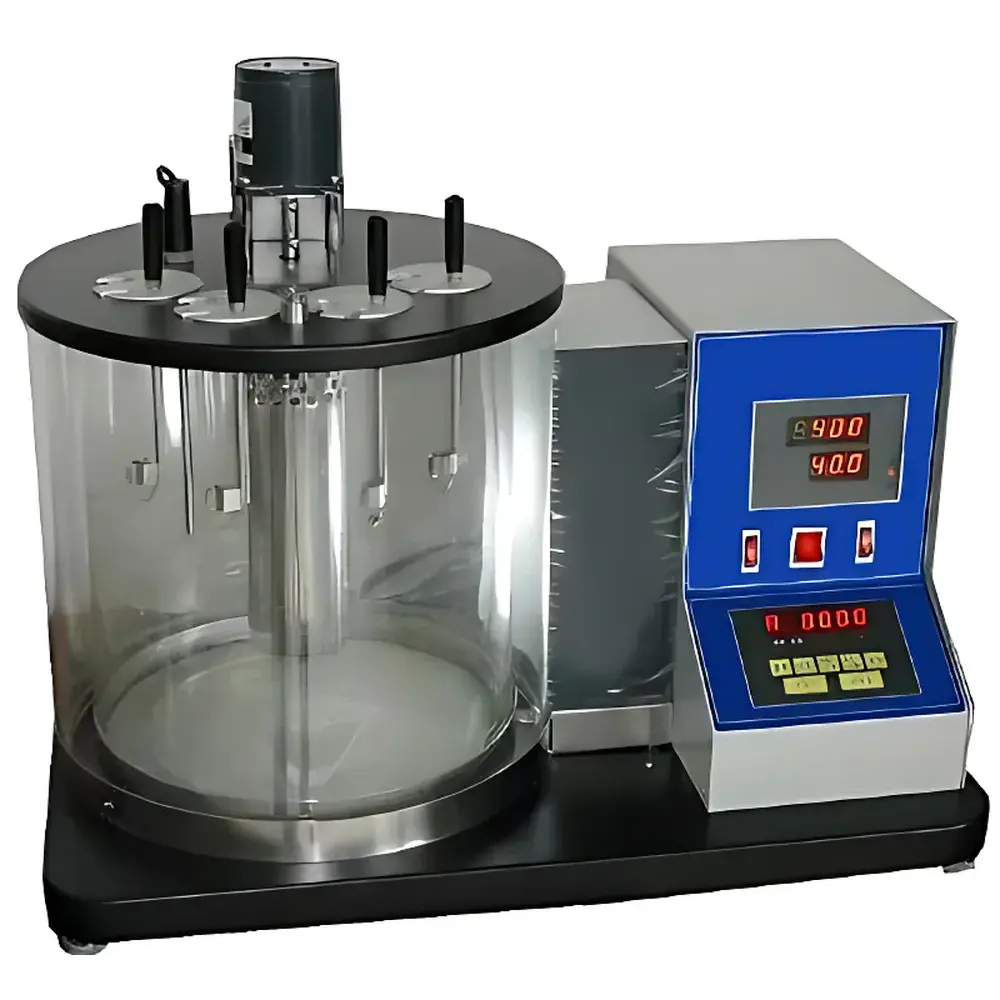
PULUODY PLD-265I Low-Temperature Kinematic Viscosity Tester
| Brand | PULUODY |
|---|---|
| Origin | Shaanxi, China |
| Manufacturer Type | Direct Manufacturer |
| Country of Origin | China |
| Model | PLD-265I |
| Power Supply | 220 V ±10%, 50 Hz |
| Heating Power | 1.8 kW |
| Stirring Motor | 15 W, 1400 rpm |
| Illumination | 9 W energy-saving fluorescent lamp |
| Temperature Control | Microcontroller-based digital display controller |
| Temperature Range | −38 °C to ambient |
| Temperature Stability | ±0.1 °C |
| Test Positions | 2 |
| Ambient Operating Conditions | 5–35 °C, <85% RH |
Overview
The PULUODY PLD-265I Low-Temperature Kinematic Viscosity Tester is a precision-engineered instrument designed for the standardized determination of kinematic viscosity in petroleum products and related hydrocarbon-based fluids according to ASTM D445, ISO 3104, IP 71, and GB/T 265. It operates on the capillary viscometry principle—measuring the time required for a fixed volume of liquid to flow under gravity through a calibrated glass capillary tube at a precisely controlled temperature. Its defining capability lies in reliable operation down to −38 °C, enabling accurate characterization of low-temperature fluid behavior critical for jet fuels, diesel blends, lubricants, and cold-climate specialty oils. The dual-bath configuration supports concurrent thermal equilibration and measurement, minimizing cycle time without compromising metrological integrity.
Key Features
- Dual-position test station with independent capillary mounting fixtures—each equipped with three adjustable leveling screws for rapid, repeatable vertical alignment of Ubbelohde or Cannon-Fenske capillaries.
- Double-walled transparent borosilicate glass bath vessel provides unobstructed 360° visual access to sample flow dynamics, facilitating real-time observation and validation of meniscus transit timing per standard protocols.
- High-stability microcontroller-based temperature control system with digital display interface—enabling precise setpoint entry, real-time deviation monitoring, and manual offset correction to maintain ±0.1 °C thermal uniformity across the bath volume.
- Integrated low-noise magnetic stirring mechanism (15 W, 1400 rpm) ensures homogeneous thermal distribution while eliminating mechanical vibration that could disturb capillary flow or meniscus stability.
- Energy-efficient 9 W fluorescent illumination integrated into the bath housing enhances contrast for accurate meniscus detection during manual timing or video-assisted analysis.
- Robust thermal architecture featuring a 1.8 kW heating element combined with refrigeration-compatible coolant circulation pathways (external chiller required for sub-zero operation) enables stable dwell at −38 °C with minimal overshoot or drift.
Sample Compatibility & Compliance
The PLD-265I accommodates standard ASTM/ISO capillary viscometers including Ubbelohde, Cannon-Fenske, and Ostwald types (calibration constants ranging from 0.001 to 1.0 mm²/s per second). It is validated for use with transparent and slightly hazy petroleum distillates, base oils, and synthetic lubricants meeting API RP 14E cleanliness criteria. All operational parameters—including bath temperature uniformity, timing resolution, and thermal ramp fidelity—conform to the apparatus requirements specified in ASTM D445 Annex A1 and ISO 3104 Clause 6. The unit supports GLP-compliant workflow documentation when paired with external stopwatch logging or automated timing interfaces (e.g., photogate sensors). No internal data storage or electronic audit trail is embedded; users must implement external record-keeping aligned with 21 CFR Part 11 if operating in regulated QA/QC environments.
Software & Data Management
The PLD-265I is a hardware-only platform with no onboard software or connectivity interfaces. Temperature setpoints and actual bath readings are displayed via a front-panel LED digital indicator. Data acquisition—including efflux time, ambient barometric pressure, and observed temperature—is performed manually or via externally connected instrumentation (e.g., calibrated digital timers, pressure transducers, or PC-based DAQ systems). Laboratories integrating this tester into LIMS or ELN ecosystems typically employ spreadsheet templates or validated third-party viscosity calculation modules compliant with ASTM D445 Section 11 equations. Calibration verification follows traceable NIST-traceable thermometer protocols at defined intervals (e.g., quarterly), with records retained per ISO/IEC 17025 clause 7.7.
Applications
- Quality control testing of aviation turbine fuels (Jet A-1, JP-8) per ASTM D1655 and DEF STAN 91-91.
- Low-temperature performance evaluation of winter-grade diesel (EN 590, ASTM D975) and biodiesel blends (ASTM D6751).
- Viscosity grading of engine oils (SAE J300) and industrial lubricants (ISO VG classification) below 0 °C.
- R&D screening of synthetic ester and polyalphaolefin (PAO) formulations for arctic equipment applications.
- Refinery process stream monitoring where kinematic viscosity serves as a surrogate for molecular weight distribution and branching index.
FAQ
Does the PLD-265I include an integrated refrigeration unit?
No. Sub-ambient operation requires connection to an external recirculating chiller capable of delivering coolant at ≤−45 °C to the bath’s inlet/outlet ports.
What capillary viscometer standards are supported?
Ubbelohde (ASTM D445 Type I), Cannon-Fenske Routine (ASTM D445 Type II), and Ostwald (ISO 3104 Annex B) capillaries with nominal diameters from 0.4 to 1.2 mm.
Is the temperature controller programmable for ramp profiles?
No. The microcontroller supports only static setpoint control; temperature ramps must be executed manually using external chiller programming.
Can the unit be used for opaque or particulate-laden samples?
Not recommended. Per ASTM D445 Section 7.1, samples must be clear and free of suspended matter; filtration per ASTM D2276 or D4176 is required prior to testing.
What maintenance intervals are recommended for long-term accuracy?
Bath fluid replacement every 6 months (use certified silicone oil with pour point ≤−50 °C); thermometer calibration verification before each shift; capillary cleaning after every 10 tests using chromic acid or approved solvent protocol per ASTM D445 Section 9.3.




