
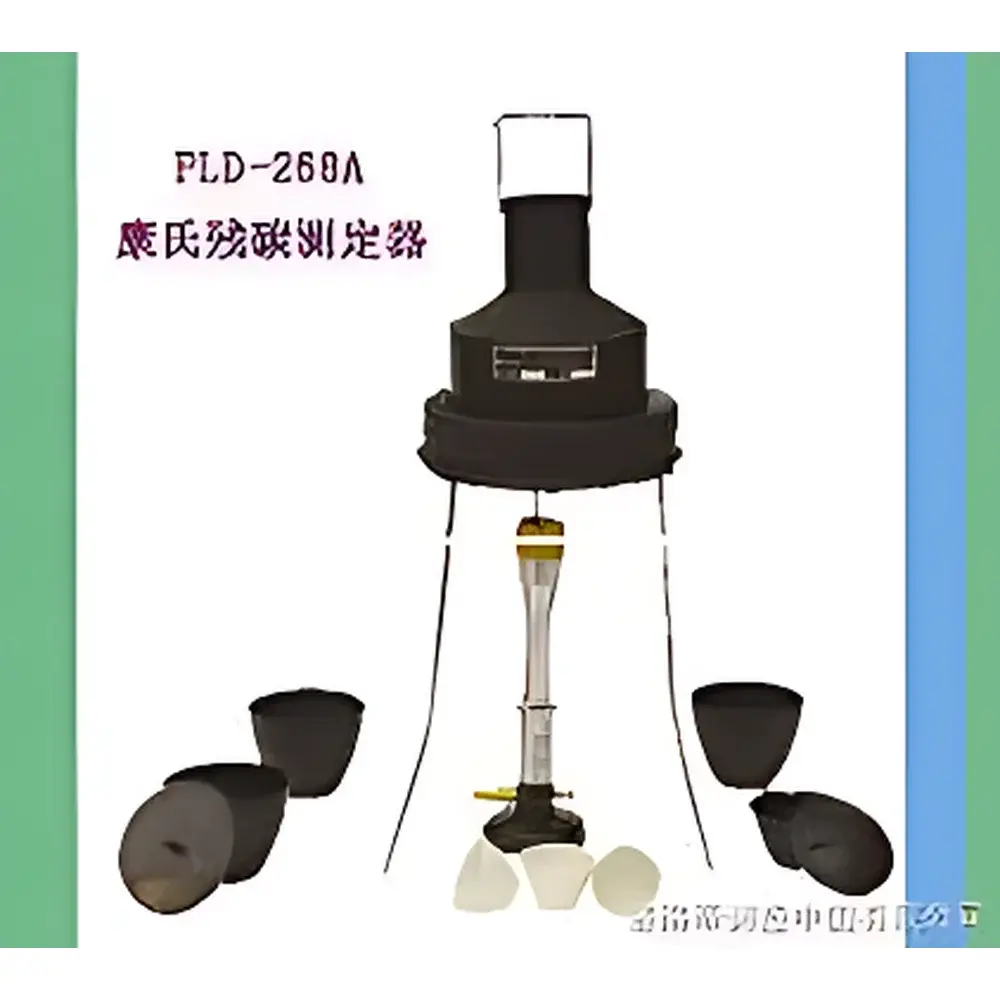
PULUODY PLD-268A Conradson Carbon Residue Tester
| Brand | PULUODY |
|---|---|
| Origin | Shaanxi, China |
| Manufacturer Type | Direct Manufacturer |
| Country of Origin | China |
| Model | PLD-268A |
| Ceramic Crucible | Low-form, 30 mL |
| Inner Iron Crucible | Galvanized steel, 75 ± 5 mL with lid |
| Outer Iron Crucible | Galvanized steel, 190 ± 10 mL with lid |
| Tripod Stand | Stainless steel, height 250 ± 10 mm, ring diameter Φ130 ± 5 mm |
| Flame Shield | Stainless steel, conical bore — top opening Φ90 ± 2 mm, bottom opening Φ82 ± 2 mm |
| Stainless Steel Cover | Lower cylindrical section height 50–53 mm |
| Gas Burner | Metric-pattern gas blowpipe (Conradson-type) |
Overview
The PULUODY PLD-268A Conradson Carbon Residue Tester is a dedicated laboratory instrument engineered for precise determination of carbon residue in petroleum products according to the standardized Conradson method, as specified in ASTM D189 and GB/T 268. This gravimetric technique involves controlled pyrolysis of a weighed sample under defined thermal conditions—without access to air—to quantify the coke-forming tendency of fuels, lubricants, and distillates. The test yields the mass percentage of residual carbonaceous material remaining after volatilization and thermal decomposition, serving as a critical indicator of thermal stability, combustion behavior, and potential deposit formation in refining, engine testing, and quality assurance workflows. The PLD-268A replicates the classical Conradson apparatus configuration with metrologically traceable dimensional tolerances and thermally stable materials, ensuring high reproducibility across laboratories operating under ISO/IEC 17025-compliant environments.
Key Features
- Full compliance with ASTM D189, IP 14, and GB/T 268 specifications for Conradson carbon residue testing.
- Precision-machined stainless steel tripod stand (height 250 ± 10 mm, ring diameter Φ130 ± 5 mm) ensures stable, level positioning of crucibles during heating cycles.
- Dual-layer crucible system: low-form ceramic crucible (30 mL) nested within a galvanized inner iron crucible (75 ± 5 mL) and outer iron crucible (190 ± 10 mL), all supplied with lids to maintain defined pyrolysis geometry.
- Integrated flame shield with calibrated conical aperture (top Φ90 ± 2 mm, bottom Φ82 ± 2 mm) and compressed asbestos ring to regulate heat distribution and suppress convective interference during charring.
- Stainless steel cover assembly featuring a metric-pattern gas burner interface and a fixed-height flame bridge (Φ3 mm iron wire, 50 ± 3 mm elevation) for consistent flame height verification per standard procedure.
- All structural components fabricated from corrosion-resistant stainless or galvanized steel to withstand repeated thermal cycling and chemical exposure typical in refinery QC labs.
Sample Compatibility & Compliance
The PLD-268A is validated for use with liquid petroleum products including fuel oils, diesel blends, lubricating base stocks, and cracked distillates. Sample volume is standardized at 10.00 g ± 0.05 g, introduced into the ceramic crucible prior to assembly. The apparatus supports routine operation in accordance with GLP (Good Laboratory Practice) frameworks and aligns with QA/QC requirements under ISO 9001 and API RP 2540. While the instrument itself does not generate electronic data, its mechanical design enables full auditability of test setup—critical for regulatory submissions requiring documented adherence to ASTM or national standards. No electrical safety certifications (e.g., CE, UL) apply, as the system operates solely on externally supplied laboratory-grade LPG or natural gas.
Software & Data Management
The PLD-268A is a fully manual, non-instrumented thermal apparatus with no embedded electronics, microprocessors, or digital interfaces. All operational parameters—including heating duration, flame adjustment, cooling intervals, and final residue weighing—are executed manually by trained analysts following SOPs derived from ASTM D189. Consequently, data acquisition and reporting are performed externally using calibrated analytical balances (0.1 mg readability recommended) and LIMS-integrated spreadsheets or paper-based CFR Part 11–compliant logbooks where required. The absence of firmware eliminates cybersecurity concerns and simplifies validation for regulated environments where deterministic, human-verified protocols are mandated over automated control loops.
Applications
- Refinery process control: Monitoring carbon residue trends in vacuum gas oils and coker feedstocks to optimize cracking severity.
- Fuel specification compliance: Verifying conformance of marine fuels (ISO 8217) and aviation turbine fuels (ASTM D1655 Annex A3) with maximum allowable carbon residue limits.
- Lubricant formulation development: Assessing thermal degradation propensity of base oils and additive packages under simulated high-temperature service conditions.
- Research & development: Supporting correlation studies between Conradson carbon residue and other thermal stability metrics such as Ramsbottom carbon residue (ASTM D524) or microcarbon residue (ASTM D4530).
- Educational laboratories: Teaching fundamental principles of petroleum thermochemistry and standardized test method execution in chemical engineering curricula.
FAQ
What standards does the PLD-268A comply with?
It is designed and verified for strict conformance with ASTM D189, IP 14, and GB/T 268—the definitive international and national standards for Conradson carbon residue determination.
Is the instrument supplied with calibration documentation?
Dimensional verification reports for critical components (crucible volumes, tripod height, flame bridge elevation) are provided upon request; however, periodic user verification using certified gauges and volumetric standards is recommended per ISO/IEC 17025 Clause 6.4.
Can the PLD-268A be used for Ramsbottom or Microcarbon Residue tests?
No—this apparatus implements only the Conradson method. Ramsbottom (ASTM D524) and Microcarbon (ASTM D4530) require distinct furnace geometries, pressure control, and sample containment systems not present in this design.
What gas supply is required for the metric-pattern burner?
Laboratory-grade propane or natural gas with regulated pressure (typically 10–15 kPa) and clean, particulate-free delivery lines are required; a dedicated gas regulator and flashback arrestor must be installed upstream per local safety codes.
Does the unit include a balance or timer?
No—analytical weighing and timing functions are external responsibilities. Users must provide a Class I analytical balance (0.1 mg resolution) and a stopwatch or laboratory timer meeting ISO 9001 traceability requirements.




