
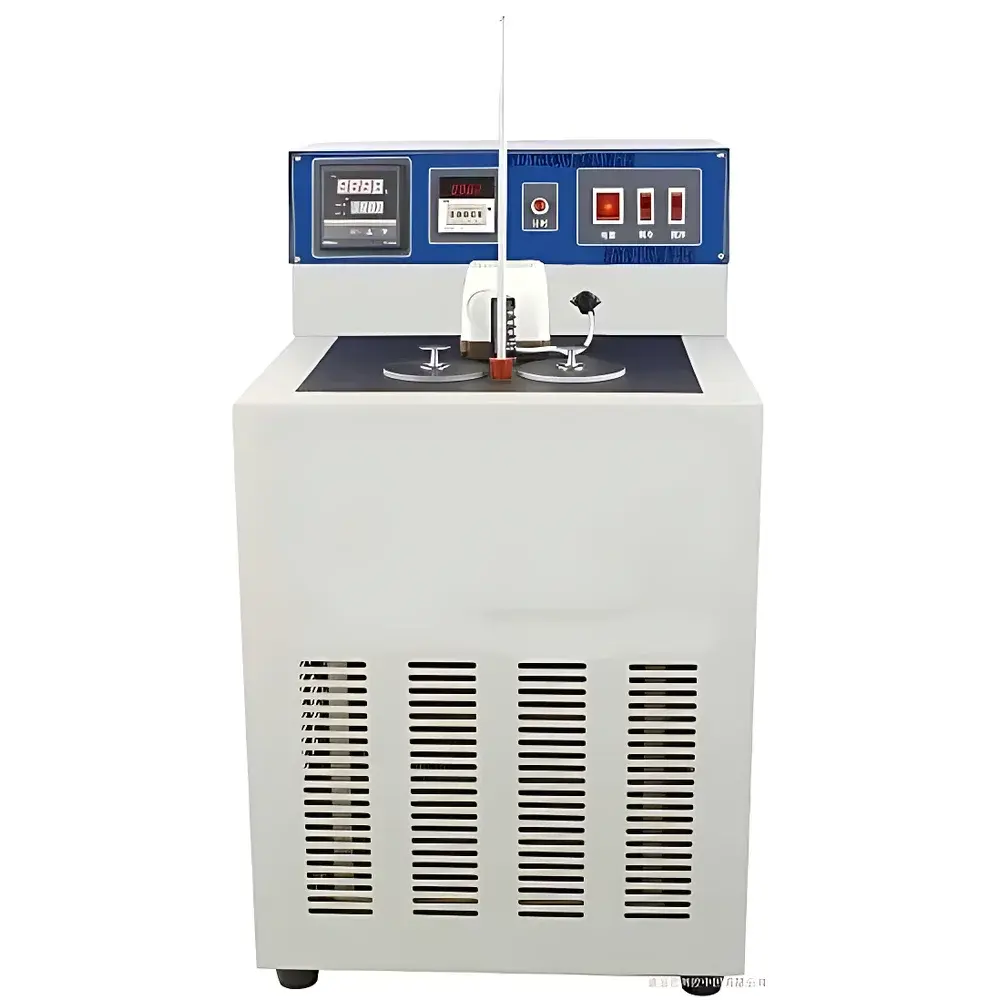
PULUODY PLD-510A Petroleum Pour and Cloud Point Tester
| Brand | PULUODY |
|---|---|
| Origin | Shaanxi, China |
| Manufacturer Type | Direct Manufacturer |
| Country of Origin | China |
| Model | PLD-510A |
| Power Input | <800 W |
| Supply Voltage | AC 220 V ±10%, 50 Hz |
| Temperature Control Range | Ambient to –38 °C (Standard) |
| Temperature Stability | ±1 °C |
| Cooling Time to –38 °C | ≤100 min |
| Cold Bath Dimensions | 200 × 90 × 120 mm |
Overview
The PULUODY PLD-510A Petroleum Pour and Cloud Point Tester is a dedicated low-temperature physical property analyzer engineered for precise determination of pour point and cloud point in crude oils, distillates, lubricants, and other petroleum-based fluids. It operates in strict accordance with ASTM D97 (equivalent to GB/T 510–2010), enabling standardized assessment of the lowest temperature at which a petroleum product remains flowable (pour point) and the temperature at which wax crystals first become visually detectable upon cooling (cloud point). The instrument employs a dual-stage refrigeration architecture—comprising a cascade compressor system—to achieve stable, reproducible sub-ambient thermal control. Its design prioritizes thermal uniformity across the cold bath, minimizing axial and radial gradients that could compromise test repeatability. Unlike ambient-air-cooled or Peltier-based alternatives, this unit delivers consistent cooling performance under continuous operation, making it suitable for high-throughput laboratory environments where method compliance and inter-laboratory comparability are critical.
Key Features
- Two-stage cascade refrigeration system ensuring reliable operation down to –68 °C (PLD-510B configuration), with standard PLD-510A rated to –38 °C
- Digital PID temperature controller with real-time feedback loop, maintaining thermal stability within ±1 °C over extended test durations
- Stainless-steel cold bath (200 × 90 × 120 mm) optimized for uniform heat transfer and minimal thermal lag during ramped cooling cycles
- Integrated electronic temperature sensing and display with resolution of 0.1 °C, traceable to NIST-traceable reference standards
- Low-power consumption design (<800 W) compliant with IEC 61000-3-2 harmonic emission limits for laboratory instrumentation
- Front-panel test start/stop controls with audible and visual status indicators for unattended operation
Sample Compatibility & Compliance
The PLD-510A accommodates standard ASTM D97 sample tubes (19 mm OD × 150 mm length) and supports manual or semi-automated observation protocols per GB/T 510. It is validated for use with transparent and opaque hydrocarbon liquids—including diesel fuel, jet fuel (Jet A-1), base oils, and residual fuels—provided samples are free of excessive particulate contamination or water emulsions prior to testing. All operational parameters align with ISO/IEC 17025 requirements for test method validation, and the instrument’s temperature calibration protocol supports documented traceability to national metrology institutes. While the device itself does not carry CE or UKCA marking, its electrical architecture complies with IEC 61010-1 safety standards for laboratory equipment, and its thermal control logic meets the functional safety expectations outlined in ANSI Z535.4 for hazard communication.
Software & Data Management
The PLD-510A operates as a standalone benchtop instrument without embedded software or network connectivity. Temperature setpoints, run time, and bath status are managed via front-panel controls and displayed on a high-contrast LED screen. For laboratories requiring audit-ready documentation, optional external data loggers (e.g., Omega OM-DAQPRO-5300 series) may be interfaced via analog 0–5 V output (available on request). This analog interface enables integration into LIMS environments supporting 4–20 mA or voltage-sourced inputs, facilitating GLP-compliant record retention. Though the unit does not natively support FDA 21 CFR Part 11 electronic signatures or audit trails, its mechanical simplicity and deterministic thermal response make it highly suitable for regulated QC workflows where manual entry into validated electronic notebooks is standard practice.
Applications
- Quality assurance of middle distillates during refinery blending and storage
- Specification verification of winter-grade diesel (EN 590, ASTM D975) and aviation turbine fuels (ASTM D1655)
- Research into wax crystallization kinetics and additive efficacy in pour point depressants
- Batch release testing in lubricant manufacturing per ISO 3016 and IP 15
- Supporting cold-flow improver formulation studies in R&D laboratories
- Compliance testing for marine fuel specifications (ISO 8217 Annex A)
FAQ
What standards does the PLD-510A comply with?
It is designed and verified for full conformance with GB/T 510–2010 and technically equivalent to ASTM D97, IP 15, and ISO 3016.
Can the instrument be used for both pour point and cloud point testing?
Yes—its thermal range, bath geometry, and observation window configuration support both test methods per standard procedure; operator must follow the respective visual assessment criteria defined in each method.
Is calibration certification included with shipment?
A factory calibration report (covering temperature accuracy at –18 °C, –29 °C, and –38 °C) is provided; users are responsible for periodic recalibration using certified reference thermometers per ISO/IEC 17025.
Does the unit require external coolant or refrigerant top-up?
No—the sealed cascade refrigeration system uses environmentally compliant R404A/R23 refrigerant blends and requires no user maintenance beyond routine cleaning of condenser fins.
What is the typical service life of the compressor system?
Under normal laboratory usage (≤6 hrs/day, ambient ≤30 °C), the dual-stage compressors are rated for ≥15,000 operating hours with scheduled preventive maintenance every 24 months.






