
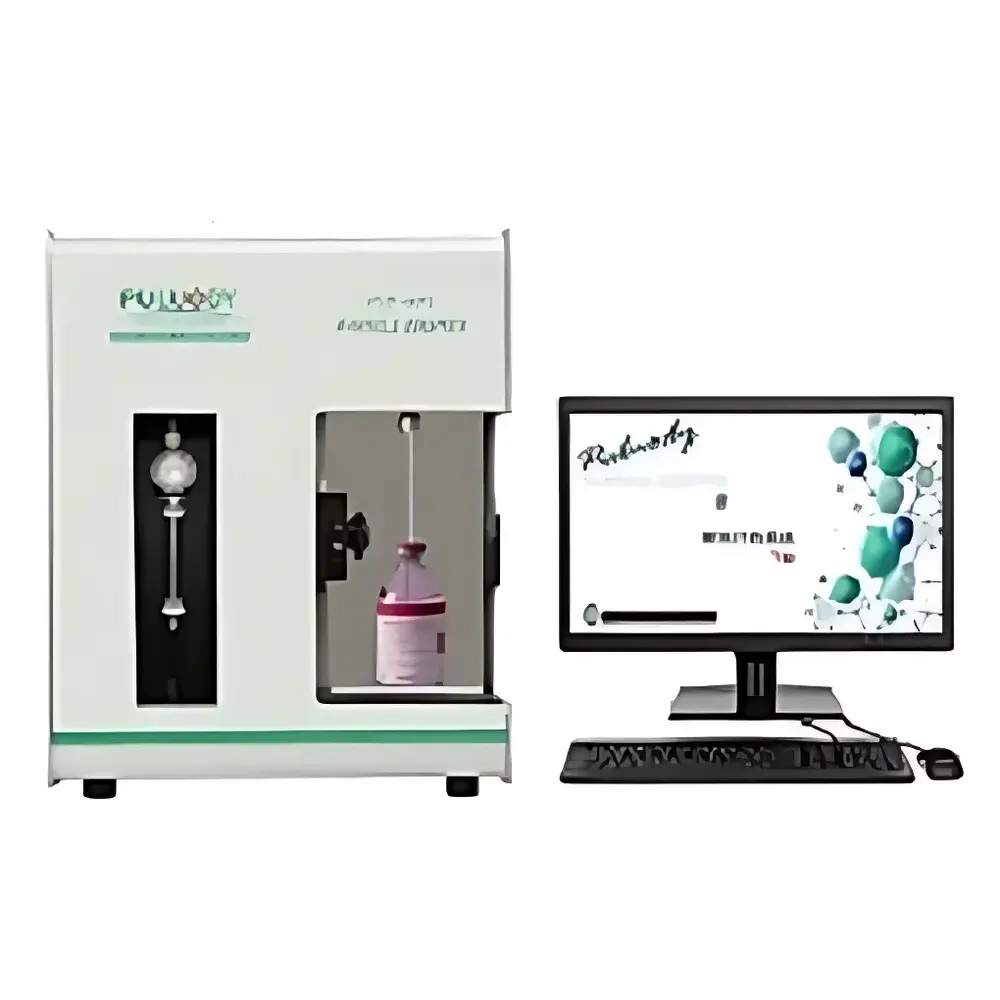
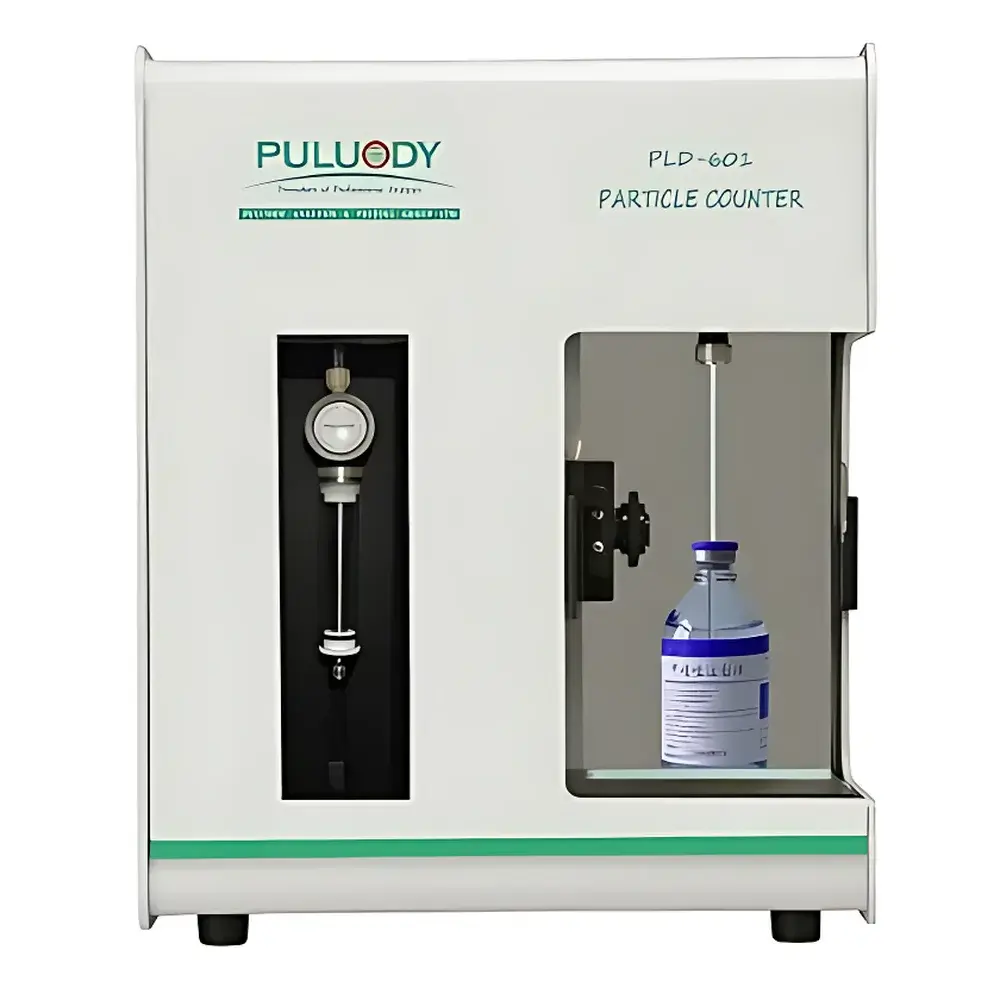
PULUODY PLD-601 Chinese Pharmacopoeia 2020 Edition Insoluble Particle Detector (Method 0903)
| Brand | PULUODY |
|---|---|
| Origin | Shaanxi, China |
| Manufacturer Type | Authorized Distributor |
| Country of Origin | China |
| Model | PLD-601 |
| Price | USD 26,500 (FOB) |
| Detection Principle | Light Obscuration (LO) with Dual-Laser Narrow-Beam Sensor |
| Particle Size Range | 1–500 µm (optional 0.03–3000 µm) |
| Channel Count | 1000 customizable channels (down to 0.01 µm resolution) |
| Flow Accuracy | < ±1% |
| Volumetric Precision | < ±3% (typical) |
| Coincidence Limit | ≤2.5% at 1000 particles/mL |
| Resolution | >95% (CP 2015/2020 calibration), <10% (USP/ISO 21501 calibration) |
| Sample Flow Rate | 5–150 mL/min |
| Rinse Flow Rate | 5–500 mL/min |
| Fluid Temperature Range | 0–80 °C |
| Ambient Operating Temperature | −15–50 °C |
| Compliance | CP 2020 Method 0903, GB 8368, USP <788>, <789>, <797>, EP 10.0, BP 2019, JP 17, ISO 21501-2, ISO 11171, ASTM D6786, FDA 21 CFR Part 11 (audit trail, e-signature, role-based 5-level access) |
Overview
The PULUODY PLD-601 Insoluble Particle Detector is a regulatory-grade light obscuration (LO) instrument engineered for quantitative measurement of insoluble particulate matter in parenteral pharmaceuticals and medical devices, fully compliant with the Chinese Pharmacopoeia (ChP) 2020 Edition General Chapter 0903, GB 8368, and international pharmacopoeial standards including USP , , EP 10.0, and JP 17. It implements an eighth-generation dual-laser narrow-beam optical sensor architecture—designed to minimize scattering artifacts and maximize signal-to-noise ratio across sub-micron to coarse particle ranges. The system operates on the principle of particle-induced light blockage: as each particle passes through a precisely collimated laser beam, the transient reduction in photodetector output is converted into pulse amplitude, which is calibrated against NIST-traceable polystyrene latex (PSL) standards per ISO 21501-2. This enables accurate sizing and counting of particles ≥1 µm in aqueous and low-viscosity non-aqueous liquids—including sterile injectables, lyophilized powders reconstituted in WFI, ophthalmic solutions, vaccines, infusion sets, IV containers, and packaging materials—without filtration or dilution.
Key Features
- Eighth-generation dual-laser narrow-beam optical sensor with real-time baseline stabilization and auto-compensation for refractive index variations
- Dual-precision fluid control system: high-accuracy metering piston pump (±1% volumetric repeatability) coupled with ultra-stable electromagnetic flow regulation (5–150 mL/min programmable)
- 1000-channel high-resolution detection matrix—configurable down to 0.01 µm bin width—supporting simultaneous compliance with ChP 0903, USP , and ISO 4406 reporting formats
- FDA 21 CFR Part 11-compliant software suite (V8.9) featuring five-tier user permission architecture, electronic signatures, immutable audit trails, and automated electronic report generation
- Integrated rinse protocol with independent high-flow (up to 500 mL/min) cleaning circuit to eliminate carryover between samples and ensure GLP/GMP traceability
- Full-featured color touchscreen interface with optional wireless keyboard/mouse support; bilingual (English/Chinese) navigation aligned with global lab workflows
- On-board calibration verification using JJG 1061-certified reference standards or ISO 21501-2 PSL suspensions; compatible with third-party metrology validation per ISO/IEC 17025
Sample Compatibility & Compliance
The PLD-601 supports direct analysis of a broad spectrum of regulated pharmaceutical and biotech samples without pre-filtration or centrifugation: sterile aqueous injections (small-volume and large-volume), lyophilized powders (post-reconstitution), concentrated injection solutions, ophthalmic preparations, vaccine suspensions, water-for-injection (WFI), purified water, and pharmaceutical packaging components (e.g., IV bags, stoppers, tubing per GB 8368). It also accommodates non-pharma applications requiring high-sensitivity particulate quantification—including ultrapure water in semiconductor manufacturing (per ASTM D5127), CMP slurries, nanomaterial dispersions, and medical device extractables testing. All operational parameters, calibration records, and raw pulse data are retained in accordance with ALCOA+ principles (Attributable, Legible, Contemporaneous, Original, Accurate, Complete, Consistent, Enduring, Available) to support regulatory inspections under FDA, EMA, PMDA, and NMPA frameworks.
Software & Data Management
The embedded V8.9 analytical software provides full lifecycle data integrity management. Raw pulse histograms, channel-specific counts, cumulative/differential distributions, and pass/fail status per selected pharmacopoeial threshold (e.g., ChP 0903 limits: ≥10 µm ≤ 25 particles/mL; ≥25 µm ≤ 3 particles/mL) are stored in encrypted SQLite databases with SHA-256 hashing. Audit logs record every user action—including method edits, calibration events, result approvals, and data exports—with timestamps and operator IDs. Data backup/recovery is supported via USB, network share, or cloud-sync (with TLS 1.2 encryption). The system supports CSV, PDF, and XML export formats compliant with LIMS integration requirements. Optional IQ/OQ/PQ documentation packages are available for GMP validation per Annex 11 and ICH Q5A.
Applications
- Quality control of injectable drug products throughout development, manufacturing, and stability studies
- Validation of terminal sterilization filters and inline filtration systems (e.g., filter challenge testing and retention efficiency assessment)
- Extractables and leachables evaluation of primary packaging (glass vials, rubber stoppers, plastic syringes) per YBB 00272004-2015
- Particulate contamination monitoring in cleanroom utilities (WFI, purified air condensate, compressed gases)
- Process troubleshooting in biomanufacturing—e.g., identifying agglomerates from stainless-steel surface erosion or silicone oil shedding
- Research-grade microcontamination profiling in advanced therapies (mRNA-LNPs, viral vectors, cell therapy media)
- Cross-industry use in electronics (ultrapure water certification), aerospace (hydraulic fluid cleanliness per NAS 1638), and medical device R&D
FAQ
Does the PLD-601 meet FDA 21 CFR Part 11 requirements for electronic records and signatures?
Yes. The V8.9 software includes role-based access control, time-stamped audit trails, electronic signature capture with biometric or token-based authentication, and system-generated validation reports—all validated per Part 11 Annex A guidance.
Can the instrument be calibrated using ISO 21501-2 reference materials?
Yes. Calibration is performed using NIST-traceable PSL standards certified to ISO 21501-2, with optional verification by China National Institute of Metrology (CNIM) or Northwest Metrology Testing Center (Defence Science Commission Level-1 Particle Metrology Station No. 116).
What sample volume is required for a compliant ChP 0903 test?
Per ChP 2020, minimum 10 mL per container is recommended; the PLD-601 supports programmable sampling volumes from 1–100 mL with automatic volume tracking and error correction.
Is method transfer support available for laboratories migrating from older LO instruments?
Yes. PULUODY provides documented equivalence protocols, comparative testing reports, and co-validation assistance with qualified third-party labs accredited to ISO/IEC 17025.
How does the dual-laser sensor improve measurement robustness compared to single-beam systems?
Dual-laser geometry enables real-time compensation for refractive index mismatches, bubble interference, and sensor drift—significantly reducing false positives and improving reproducibility in complex matrices such as protein-rich biologics or viscous ophthalmic gels.



