
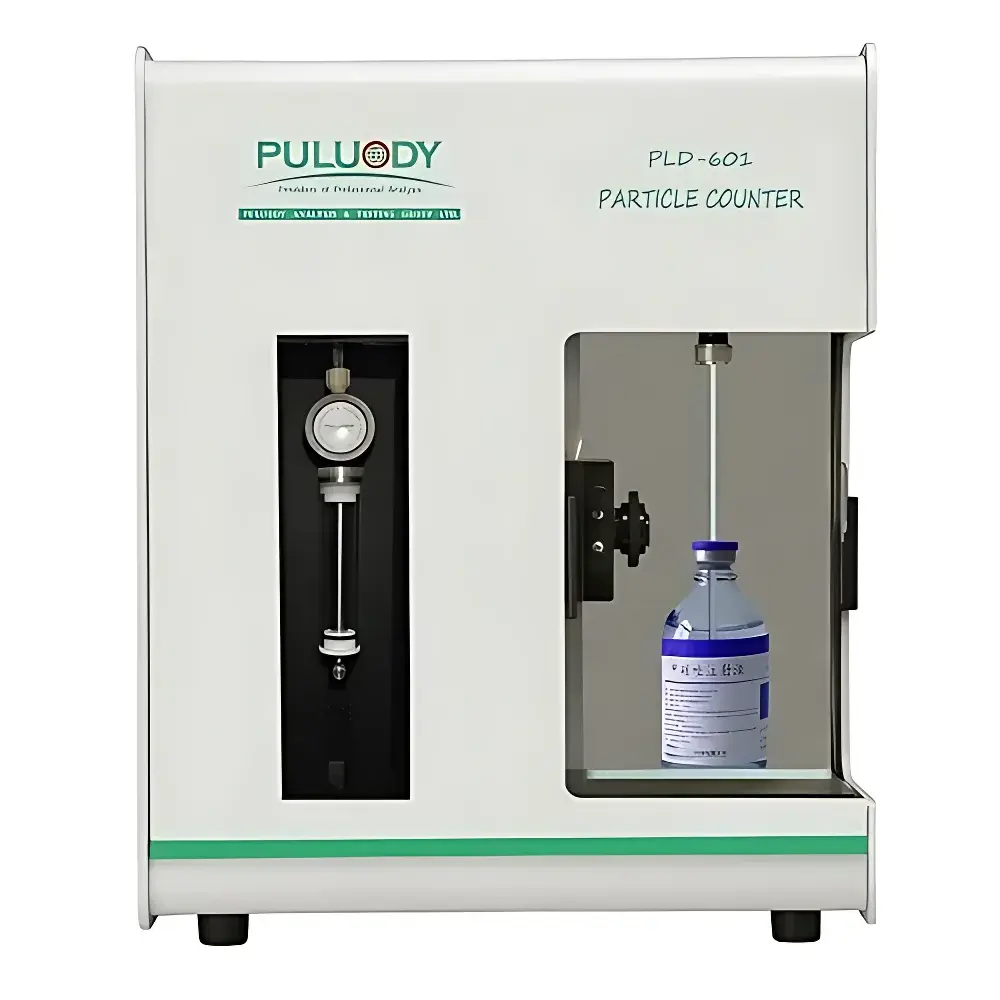
PULUODY PLD-601 Intelligent Particulate Contamination Analyzer
| Brand | PULUODY |
|---|---|
| Model | PLD-601 |
| Origin | Shaanxi, China |
| Sensor Technology | 8th-Generation Dual-Laser Narrow-Beam Light Obscuration |
| Detection Principle | Light Obscuration (LO) per USP <788>, EP 2.9.19, and ChP 0903 |
| Measurement Range | 1–500 µm (optional extension to 0.03–3000 µm) |
| Channel Resolution | 1000 adjustable size channels (down to 0.01 µm resolution) |
| Flow Control | Precision metering piston pump + ultra-precise electromagnetic flow regulation |
| Accuracy | ±3% typical (per ChP 2020) |
| Coincidence Limit | ≤2.5% error at 1000 particles/mL |
| Calibration Standards | NIST-traceable latex spheres, ISO 21501-4, JJG 1061 |
| Software Compliance | FDA 21 CFR Part 11, ALCOA+ principles, audit trail, electronic signature, 5-level user权限 management |
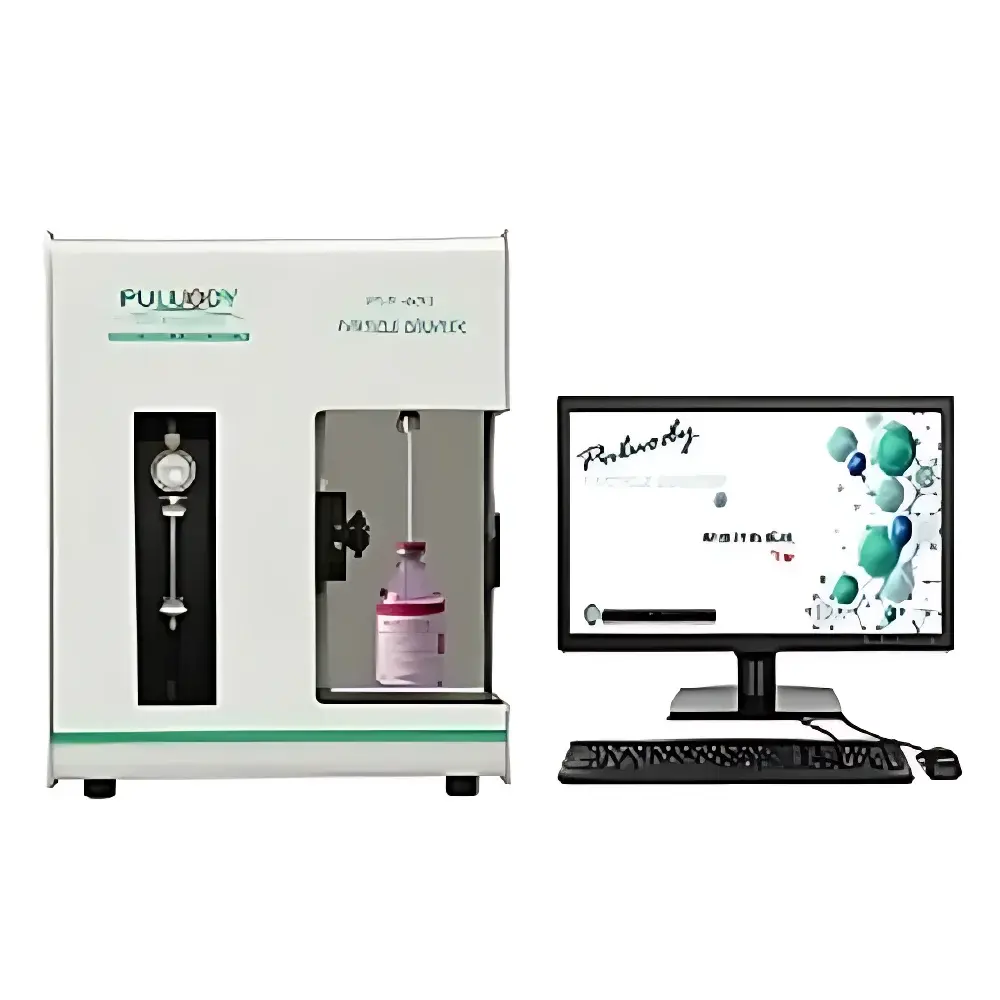
| Operating Interface | Touchscreen + optional wireless keyboard/mouse |
| Sample Temperature Range | 0–80 °C |
| Ambient Operating Range | −15–50 °C |
| Regulatory Alignment | Compliant with ChP 2015/2020, USP <788>/<789>/<797>, EP 10.0/9.0/8.0, BP 2019/2018, JP 17/16/15, WHO IntPh IV, YBB00272004-2015, GB/T 11446.9-2013, ISO 4406, ISO 11171, NAS 1638, SAE AS4059, MIL-STD-1246, ASTM D6786, GB/T 18854, DL/T 432, and more |
Overview
The PULUODY PLD-601 Intelligent Particulate Contamination Analyzer is a regulatory-grade light obscuration (LO) instrument engineered for quantitative detection and sizing of insoluble particulate matter in parenteral solutions, sterile pharmaceuticals, high-purity water, and critical process fluids. Based on the internationally recognized LO principle—where particles passing through a focused laser beam generate transient reductions in detected light intensity—the PLD-601 delivers traceable, reproducible particle counts across 1000 programmable size channels from 1 µm to 500 µm (with optional extended range down to 0.03 µm). Its dual-laser narrow-beam sensor architecture minimizes optical noise and enhances signal-to-noise ratio, enabling robust discrimination of sub-3 µm particles essential for USP Category I testing and ChP 2020 General Chapter 0903 compliance. The system integrates a dual-stage flow control architecture: a precision metering piston pump ensures volumetric accuracy better than ±1%, while an ultra-stable electromagnetic flow regulator maintains consistent laminar velocity during both sampling and rinse cycles—critical for minimizing coincidence error and ensuring repeatable channel calibration.
Key Features
- 8th-generation dual-laser narrow-beam light obscuration sensor with enhanced sensitivity below 3 µm and >95% resolution per ChP 2020 calibration protocols
- 1000-channel particle size distribution analysis with user-definable binning (e.g., 4, 16, 64, or full 1000-channel mode), supporting simultaneous compliance with multiple pharmacopoeial thresholds (e.g., ≥10 µm and ≥25 µm per USP )
- FDA 21 CFR Part 11-compliant software suite (V8.9) featuring full audit trail, time-stamped electronic signatures, role-based 5-level access control, and automated backup/recovery of raw data and metadata
- Programmable flow rates: 5–150 mL/min for sample aspiration; 5–500 mL/min for system rinsing—enabling optimization for viscous formulations, low-volume ampoules, or high-throughput batch testing
- Temperature-controlled fluid path (0–80 °C) and ambient operation range (−15–50 °C) suitable for cold-chain biologics, hot-fill ophthalmic solutions, and cleanroom-integrated deployment
- Pre-loaded regulatory method templates for ChP 0903, USP , EP 2.9.19, YBB00272004-2015, and ISO 21501-4, with configurable pass/fail logic and automatic report generation
Sample Compatibility & Compliance
The PLD-601 supports direct analysis of diverse liquid matrices without filtration or dilution, including aqueous and non-aqueous injectables (e.g., monoclonal antibody formulations, lipid emulsions), lyophilized powder reconstitutes, ophthalmic solutions, vaccine suspensions, WFI and purified water, CMP slurries, semiconductor process chemicals, and medical device extractables. It meets stringent validation requirements under GMP/GLP environments: all hardware components are documented per ISO 9001 and ISO/IEC 17025, while software undergoes periodic verification against NIST-traceable latex standards (JJG 1061) and ISO 21501-4 reference materials. Instrument qualification packages—including IQ/OQ/PQ documentation templates—are available upon request. The analyzer is routinely verified by national metrology institutes, including the China National Institute of Metrology (Northwest Center) and the Defense Science & Technology Commission’s Grade-I Particle Measurement Station No. 116.
Software & Data Management
The embedded V8.9 Analytical Software provides a dual-mode interface: intuitive touchscreen navigation for routine QC operators and advanced PC-based configuration for method development and statistical process control. All analytical sessions generate immutable digital records containing raw pulse data, calibrated size histograms, flow rate logs, temperature traces, and user action timestamps. Data integrity safeguards include write-once storage, cryptographic hash verification, and export to secure PDF/A-2 or CSV formats compliant with ALCOA+ principles. Electronic signatures adhere to Annex 11 and 21 CFR Part 11 Subpart B requirements, with full audit trail visibility across login events, parameter changes, result approvals, and report exports. Optional integration with LIMS via ASTM E1384-compliant HL7 or RESTful API enables seamless workflow automation in centralized laboratory networks.
Applications
- Pharmaceutical Quality Control: Routine batch release testing of injectables per ChP 0903 and USP ; filter challenge studies for terminal sterilization validation; extractables/leachables assessment of IV bags, stoppers, and tubing
- Biotechnology: Monitoring particle burden in cell culture media, viral vector suspensions, and final drug substance solutions prior to fill-finish
- Water & Semiconductor: Quantification of metallic and dielectric contaminants in UPW (ultrapure water) per SEMI F63 and ASTM D5127; slurry stability profiling in CMP processes
- Medical Devices: Evaluation of particulate shedding from catheters, syringes, and infusion sets per GB 8368 and ISO 8536-4
- Chemical & Materials R&D: Nanoparticle dispersion homogeneity in inks, lubricants, and functional coatings; wear debris analysis in hydraulic and turbine oils
FAQ
Does the PLD-601 comply with FDA 21 CFR Part 11 for electronic records and signatures?
Yes. The V8.9 software implements full Part 11 functionality—including audit trail, electronic signature with identity verification, and role-based permissions—with validation documentation available upon request.
Can the instrument be calibrated using ISO 21501-4 reference standards?
Yes. Calibration is performed using NIST-traceable polystyrene latex spheres certified to ISO 21501-4, with optional third-party certification from CNIM or DSTC Metrology Station No. 116.
Is it possible to customize particle size channel definitions for non-standard pharmacopoeial limits?
Yes. Users may define arbitrary bin boundaries (e.g., 2.5–5 µm, 10–15 µm) and assign pass/fail criteria per channel group, supporting internal specifications or emerging regulatory guidance.
What maintenance intervals are recommended for routine operation?
Daily system flush with filtered isopropanol or water; quarterly optical alignment verification; annual sensor performance validation using reference standards—detailed in the included GMP-aligned Maintenance Logbook.
How is data backup and disaster recovery handled?
Automated daily backups to internal SSD and external USB/NAS targets; encrypted archive files support forensic reconstruction of any session within 72 hours of incident reporting.





