
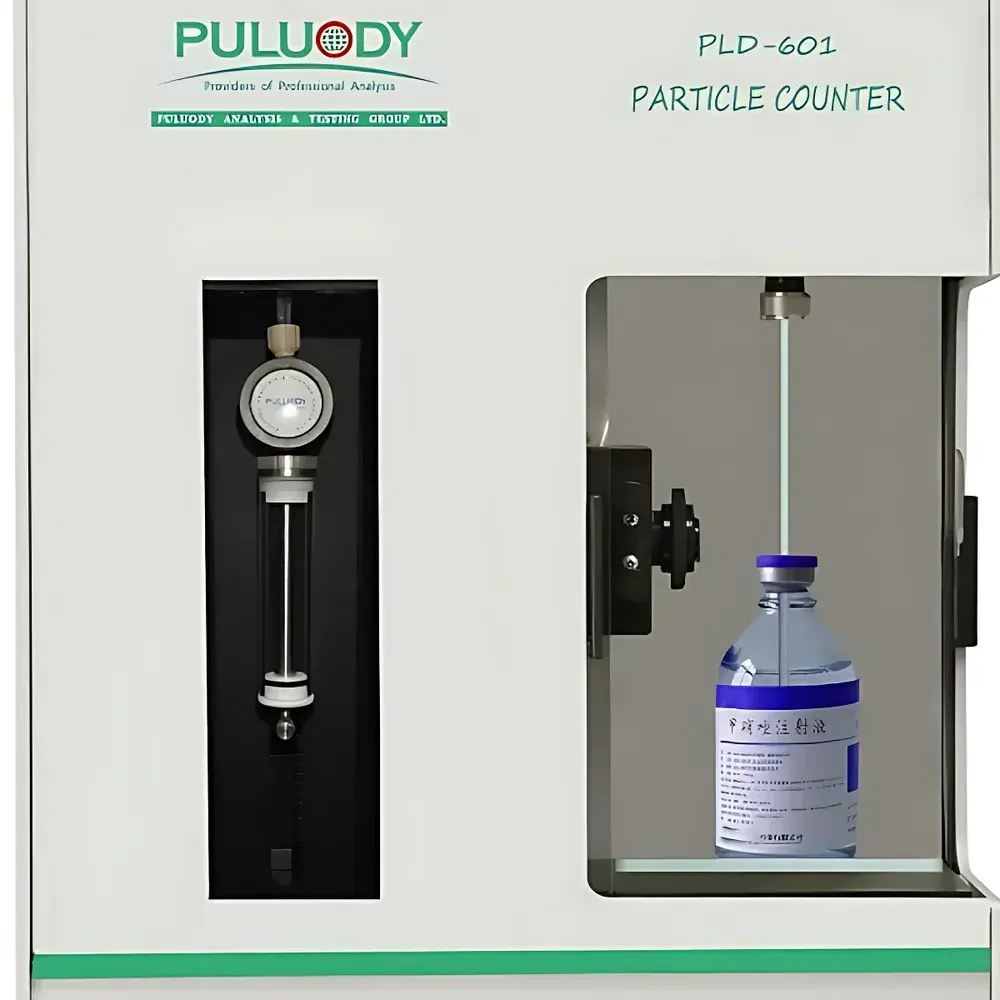
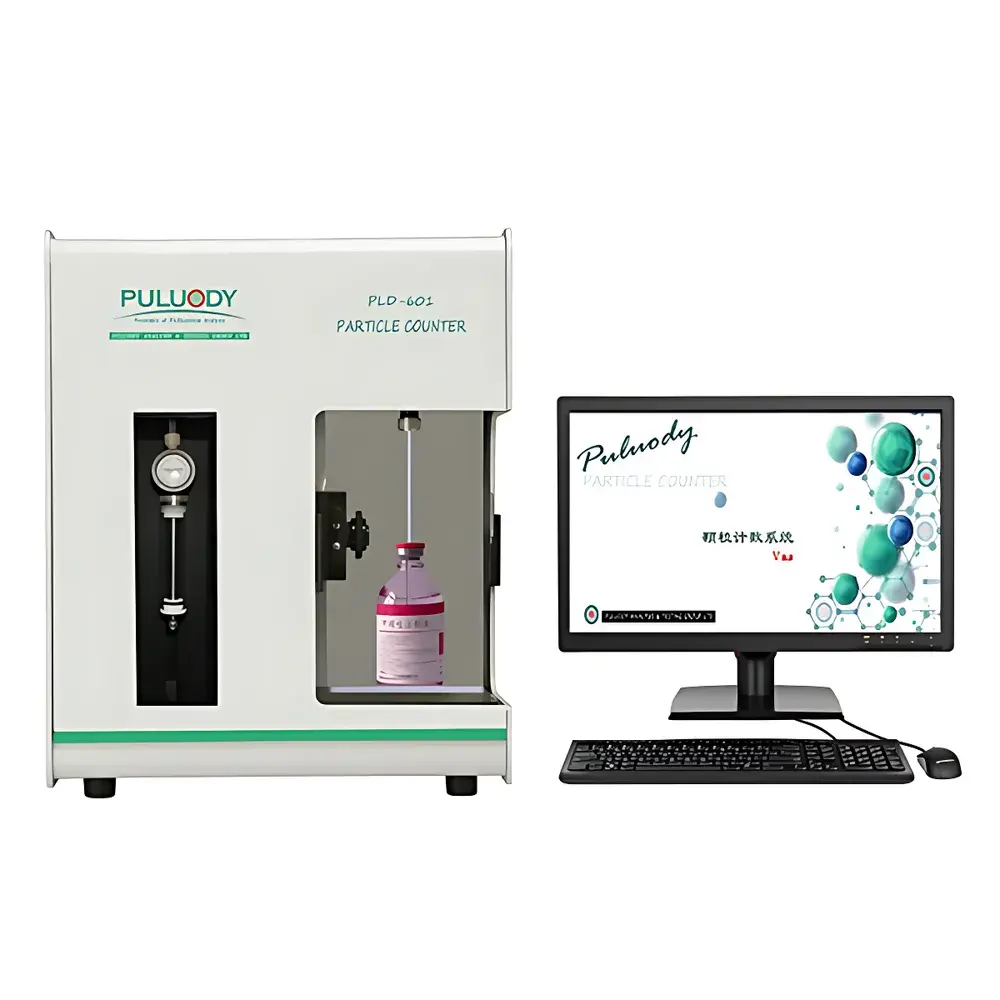
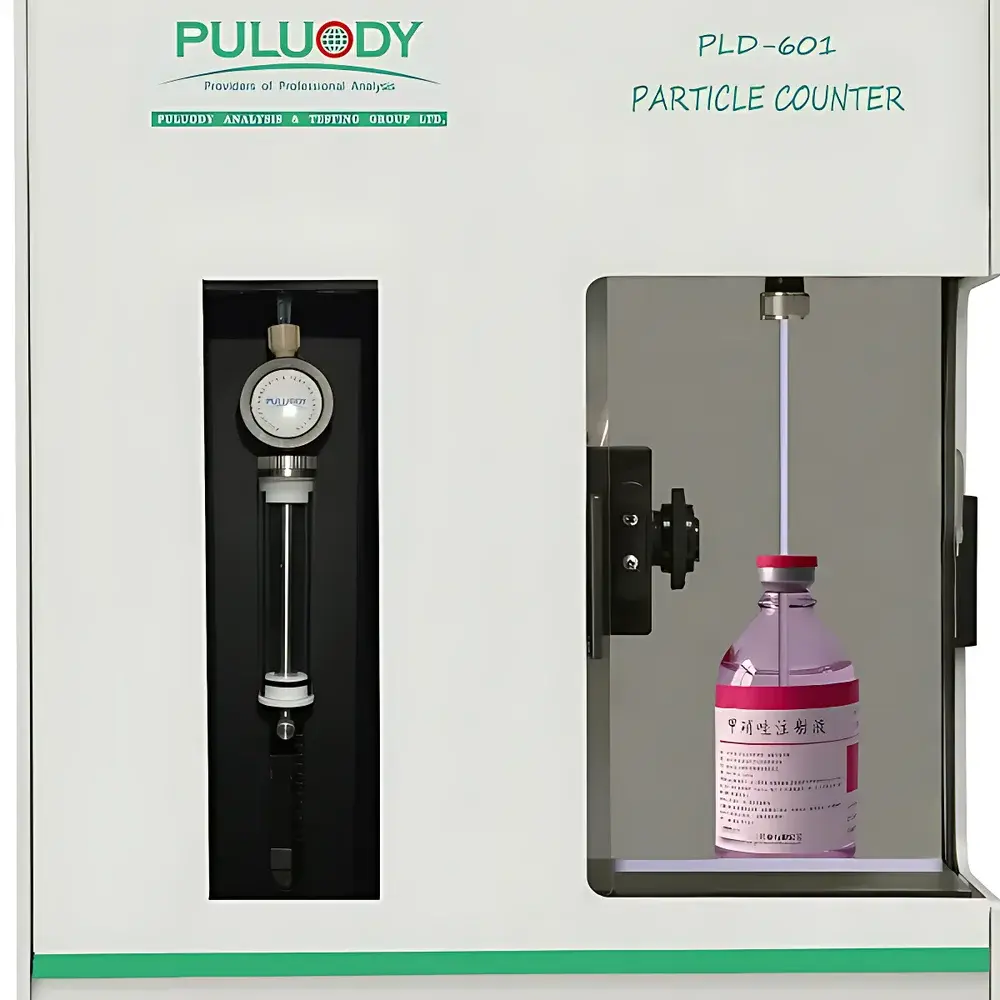
PULUODY PLD-601D Optical Particle Counter for Insoluble Particulate Testing in Lyophilized Powders
| Brand | PULUODY |
|---|---|
| Model | PLD-601D |
| Instrument Type | Optical Particle Counter |
| Detection Principle | Dual-Laser Narrow-Beam Light Obscuration |
| Sensor Generation | 8th-Generation Dual-Laser Sensor |
| Flow Control | Precision Metering Plunger Pump + Ultra-Precise Electromagnetic Flow Control System |
| Detection Range | 1–450 µm (customizable sub-ranges: 1–100 µm, 4–70 µm(c), or 0.1 µm(c)) |
| Channel Resolution | 1000 adjustable channels |
| Accuracy | ±5% typical |
| Sampling Precision | <±1% |
| Coincidence Limit | 1000 particles/mL (5% coincidence error) |
| Resolution | >95% (calibrated per ChP 2015/2020), <10% (per USP/ISO 21501) |
| Operating Fluid Temperature | 0–80 °C |
| Ambient Temperature | 0–50 °C |
| Compliance Standards | ChP 2015 & 2020, USP <788> & <789>, Ph. Eur. 2.9.19, BP, GB 8368, ISO 21501-4, JJG 1061 |
| Calibration Reference | NIST-traceable latex standards or ISO 21501-compliant reference materials |
| Software | V8.9 Integrated Analysis Software (PC & embedded) with 5-level user权限 management, audit trail, electronic signature, and 21 CFR Part 11 compliance |
| Display | Color LCD touchscreen + optional wireless keyboard/mouse |
| Metrology Support | Accredited calibration by NWMS (National Northwest Metrology & Testing Center) and DFSC No. 116 Station (CNSA Grade-I Particle Metrology Lab) |
Overview
The PULUODY PLD-601D Optical Particle Counter is an advanced, regulatory-grade instrument engineered for quantitative detection and sizing of insoluble particulates in lyophilized pharmaceutical powders, sterile injectables, and high-purity process liquids. It operates on the principle of dual-laser narrow-beam light obscuration—where two spatially offset laser beams generate coincident pulse signals to discriminate true particle events from optical noise and transient flow anomalies. This architecture significantly improves counting fidelity in low-conductivity, low-viscosity, or protein-rich matrices where conventional single-beam sensors suffer from refractive index artifacts and false positives. Designed specifically to meet stringent pharmacopoeial requirements—including Chinese Pharmacopoeia (ChP) 2015 & 2020, United States Pharmacopeia (USP) and , European Pharmacopoeia 2.9.19, and ISO 21501-4—the PLD-601D delivers traceable, repeatable, and GMP-aligned particulate data essential for product release, filter validation, extractables/leachables assessment, and container-closure integrity studies.
Key Features
- 8th-generation dual-laser narrow-beam sensor with real-time pulse shape analysis for enhanced discrimination of sub-micron and aggregated particles
- Dual-mode flow control system: precision metering plunger pump (volumetric accuracy <±1%) combined with closed-loop electromagnetic flow regulation for stable, pulsation-free delivery across viscosity ranges (0.8–20 cP)
- 1000-channel high-resolution detection architecture—enabling customizable binning from 0.1 µm(c) to 450 µm, with full compliance to multi-threshold pharmacopoeial protocols (e.g., ChP 2020 requires ≥2 size thresholds; USP mandates ≥10 µm and ≥25 µm reporting)
- V8.9 integrated software platform featuring full 21 CFR Part 11 compliance: role-based 5-tier user permissions, immutable audit trail with timestamped operator actions, electronic signatures, automated report generation, and encrypted local/cloud backup with version-controlled data restoration
- Embedded environmental monitoring: real-time fluid temperature logging (0–80 °C) and ambient condition tracking (0–50 °C) synchronized with each measurement event for full analytical traceability
- Factory-calibrated against NIST-traceable polystyrene latex standards and certified per JJG 1061; supported by accredited metrology services from NWMS and DFSC No. 116 Station—ensuring ongoing validity under ISO/IEC 17025 and GLP/GMP audit conditions
Sample Compatibility & Compliance
The PLD-601D accommodates a broad spectrum of sample types without dilution or filtration—provided they are optically transparent or semi-transparent in the 650–780 nm wavelength range. Validated applications include reconstituted lyophilized powders, sterile bulk drug substances (APIs), ophthalmic solutions, vaccine suspensions, WFI and purified water, infusion sets, elastomeric stoppers, glass vials, and polymeric tubing extracts. Its fluidic path is constructed from chemically inert 316L stainless steel and fluoropolymer components, minimizing adsorption and leaching during repeated use. Regulatory alignment extends beyond pharmacopoeial conformance: the system supports full ALCOA+ data integrity principles, satisfies FDA and EMA expectations for computerized system validation (CSV), and maintains full audit readiness for inspections under Annex 11, ICH Q5A(R2), and PIC/S PE 009-16 guidelines.
Software & Data Management
The V8.9 software suite provides both embedded touchscreen operation and full PC-based analysis capability. All raw pulse data—including amplitude, width, and dual-beam correlation metrics—are retained in proprietary binary format with SHA-256 hashing for tamper-evident archiving. Reports are exportable as PDF/A-2b (archival standard), CSV, and XML formats compliant with LIMS integration protocols (ASTM E1467, HL7). Batch-level metadata tagging supports product code, lot number, operator ID, equipment ID, and environmental parameters. Automated pass/fail evaluation is configurable per pharmacopoeial limits (e.g., ≤6000 particles ≥10 µm per container for large-volume parenterals), with deviation alerts triggered via email or SMS through optional SNMP/SMTP gateways.
Applications
- Pharmaceutical Quality Control: Quantitative particulate testing of lyophilized formulations pre- and post-reconstitution; verification of terminal sterilization filter efficiency (e.g., 0.22 µm PVDF); particulate load assessment of primary packaging components (glass, rubber, plastic)
- Biologics & Vaccines: Monitoring aggregation kinetics in monoclonal antibody formulations; detecting silicone oil droplets in prefilled syringes; characterizing residual host cell debris in downstream purification streams
- Water & Utilities: Solid particle contamination grading of WFI, PW, and UPW per ASTM D5127 and SEMI F63; routine monitoring of recirculating cooling loops in cleanroom HVAC systems
- Semiconductor & Advanced Materials: Slurry cleanliness verification for CMP processes; nanoparticle dispersion stability analysis in graphene and quantum dot suspensions; catalyst residue quantification in battery electrolyte formulations
- Medical Devices: Extractable particulate profiling from catheters, stents, and dialysis membranes per ISO 10993-12; validation of cleaning efficacy for reusable surgical instruments
FAQ
Does the PLD-601D comply with FDA 21 CFR Part 11 requirements?
Yes—the system implements full electronic record and signature controls including audit trail, role-based access, password complexity enforcement, and cryptographic data integrity verification.
Can it measure particles below 1 µm?
It supports configurable detection down to 0.1 µm(c) using calibrated reference standards; however, routine pharmacopoeial testing typically begins at 1 µm or 2 µm depending on application context and regulatory expectation.
Is third-party calibration documentation provided with the instrument?
Each unit ships with a certificate of calibration traceable to national standards (NWMS or DFSC No. 116), including uncertainty budgets and as-found/as-left data per ISO/IEC 17025.
How is data backup and recovery managed?
V8.9 supports scheduled encrypted backups to network drives or cloud storage; all historical datasets retain full metadata linkage and can be restored to any prior operational state without loss of audit integrity.
What maintenance intervals are recommended for long-term reliability?
Optical alignment verification every 6 months; flow path cleaning after every 500 samples or when baseline noise exceeds 3σ; annual full metrological recalibration recommended for GMP environments.



