
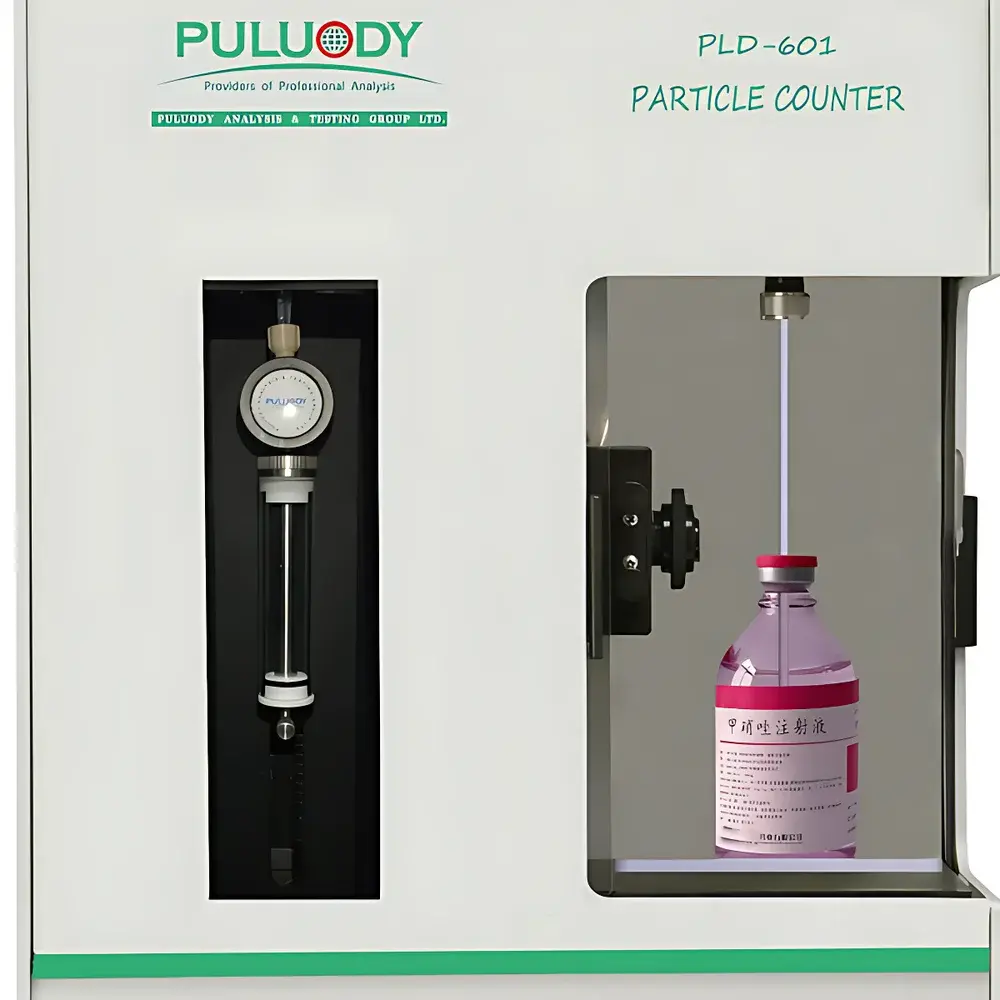
PULUODY PLD-601G GB8368 Compliant Insoluble Particle Counter
| Brand | PULUODY |
|---|---|
| Origin | Shaanxi, China |
| Model | PLD-601G |
| Instrument Type | Optical Light-Blockage Particle Counter |
| Detection Principle | Light Obscuration (LO) / Single-Particle Optical Sizing (SPOS) |
| Calibration Standards | ISO 21501-4, USP <788>, EP 2.9.19, ChP 2020 Edition 0903, GB/T 11446.9–2013, GB 8368 |
| Channel Resolution | 1000 user-definable channels from 0.01 µm to 450 µm (extended range up to 3000 µm optional) |
| Flow Control | Dual-precision volumetric piston pump + electromagnetic flow regulation |
| Accuracy | ±5% typical (per ChP 2020/USP <788>) |
| Sample Volume Precision | <±1% |
| Coincidence Limit | ≤2.5% error at 1000 particles/mL |
| Counting Resolution | >95% (ChP-calibrated), >90% (ISO 21501-4 calibrated) |
| Flow Rate | Sampling 5–150 mL/min |
| Fluid Temp Range | 0–80 °C |
| Operating Ambient | −15–50 °C |
| Software Compliance | FDA 21 CFR Part 11, ALCOA+ data integrity, audit trail, electronic signature, 5-level user permission management |
| Regulatory Documentation Support | GMP/GLP-compliant test reports, IQ/OQ documentation templates, traceable calibration certificates (JJG 1061, ISO 21501-4, NIST-traceable latex standards) |
Overview
The PULUODY PLD-601G GB8368 Compliant Insoluble Particle Counter is a high-precision optical light-obscuration (LO) instrument engineered for quantitative analysis of insoluble particulate contamination in parenteral pharmaceuticals, medical devices, and ultra-pure process liquids. Designed to meet the stringent requirements of Chinese National Standard GB 8368 (Infusion Sets), ChP 2020 Edition General Chapter 0903, and international pharmacopoeial methods including USP , , EP 2.9.19, and JP 17, the PLD-601G employs eighth-generation dual-laser narrow-beam sensing technology to deliver robust, reproducible particle counting across a dynamic size range from 0.01 µm to 450 µm (with extended-range configurations available). Its measurement principle adheres strictly to the light-blockage method defined in ISO 21501-4 and ASTM F312-18, ensuring metrological traceability to national primary standards via calibration with NIST-traceable polystyrene latex (PSL) spheres or certified reference materials per JJG 1061. The system is validated for use in regulated environments where data integrity, method specificity, and regulatory compliance are non-negotiable—particularly in QC laboratories supporting sterile product release, filter validation, extractables/leachables assessment, and container-closure system evaluation.
Key Features
- Eighth-generation dual-laser narrow-beam optical sensor with real-time pulse-height discrimination for enhanced signal-to-noise ratio and improved resolution below 1 µm
- Dual-mode precision fluidic control: high-stability volumetric piston pump coupled with closed-loop electromagnetic flow regulation ensures <±1% volumetric accuracy across full operational flow range (5–150 mL/min)
- 1000-channel configurable sizing matrix enabling granular distribution profiling compliant with over 510 global standards—including NAS 1638, ISO 4406, SAE AS4059, and MIL-STD-1246
- FDA 21 CFR Part 11–compliant V8.9 software platform featuring role-based access control (5-tier permissions), immutable audit trail, time-stamped electronic signatures, and automated backup/recovery protocols
- Integrated thermal management system supporting sample analysis at controlled fluid temperatures from 0 °C to 80 °C, critical for thermally sensitive biologics and ophthalmic solutions
- Modular hardware architecture allowing seamless integration into LIMS environments via ASTM E1384-compliant HL7 or CSV export; supports raw pulse data logging for secondary analysis
Sample Compatibility & Compliance
The PLD-601G is validated for direct analysis of low-viscosity aqueous and organic liquids without filtration or dilution, including but not limited to: sterile injectables (solution, lyophilized powder, concentrated solution), ophthalmic preparations, vaccines, WFI and purified water, pharmaceutical excipients, silicone oil, and packaging component extracts. It supports both single-sample and continuous-flow modes for evaluating terminal filter efficiency (e.g., 0.22 µm PVDF membranes), quantifying particle shedding from IV tubing and connectors per GB 8368 Annex C, and assessing cleaning validation endpoints in aseptic processing suites. All testing workflows align with ICH Q5A(R2), ISO 13408-1, and Annex 1 (2022) requirements for particulate control in sterile manufacturing. Calibration and verification procedures follow ISO/IEC 17025–accredited protocols performed by the National Northwest Metrology Testing Center (CNAS L116) or China Academy of Metrology Science (CAM).
Software & Data Management
The embedded V8.9 analytical software provides full lifecycle data governance: from method setup and instrument qualification (IQ/OQ) to routine testing, trend analysis, and regulatory reporting. Each measurement session generates timestamped, digitally signed PDF reports containing raw count data, size distribution histograms, pass/fail status against user-defined acceptance criteria (e.g., ChP limits for ≥10 µm and ≥25 µm particles), and metadata on operator, instrument ID, calibration status, and environmental conditions. Audit trails record all user actions—including parameter edits, report generation, and data deletion—with hash-secured immutability. Data export formats include CSV, XML, and PDF/A-2 for long-term archival under 21 CFR Part 11 Subpart B and EU Annex 11 requirements. Optional LIMS interface modules support automated result transfer and electronic batch record integration.
Applications
- Pharmaceutical QC: Routine release testing of injectables per ChP 0903, USP , and EP 2.9.19; stability-indicating particle monitoring during accelerated and real-time studies
- Medical Device Evaluation: Quantification of particulate leachables from infusion sets (GB 8368), syringes, catheters, and elastomeric pumps; filter challenge testing per ISO 8536-4
- Water System Monitoring: Continuous or grab sampling of WFI, PW, and UPW per USP , EP 2.2.43, and ISO 14644-1 Class 5–8 cleanroom water specifications
- Electronics Manufacturing: Slurry cleanliness verification in CMP processes, wafer rinse water analysis, and photoresist purity screening
- Chemical & Cosmetics: Nanomaterial dispersion stability assessment, pigment agglomeration kinetics, and preservative efficacy testing in emulsions
FAQ
Does the PLD-601G comply with FDA 21 CFR Part 11 requirements for electronic records and signatures?
Yes. The V8.9 software implements full ALCOA+ principles: attributable, legible, contemporaneous, original, and accurate data handling. It includes role-based authentication, electronic signatures with biometric or PKI options, and tamper-evident audit logs meeting Part 11 Subpart B controls.
Can the instrument be used for both pharmacopoeial compliance testing and internal process monitoring?
Absolutely. Preconfigured test methods for ChP, USP, EP, and GB 8368 are included, while fully customizable channel definitions, thresholds, and reporting templates support internal SOP-driven applications such as filter integrity trending or equipment wear analysis.
What calibration standards are supported, and how often must recalibration occur?
Calibration uses ISO 21501-4–traceable PSL standards (e.g., Duke Scientific 3000 series) or certified reference materials per JJG 1061. Recalibration is recommended before each daily run and after maintenance; full performance qualification (PQ) is advised quarterly or per risk-based assessment.
Is remote diagnostics and software update capability available?
Yes. Secure TLS-encrypted remote access enables real-time technical support, firmware updates, and configuration audits without compromising network security or data sovereignty.
How is temperature control managed during analysis of heat-sensitive samples?
An integrated Peltier-cooled sample path maintains fluid temperature within ±0.5 °C of setpoint (range 0–80 °C), preventing thermal degradation of proteins, mRNA vaccines, or labile small molecules during transit through the sensing zone.
Related Products



