
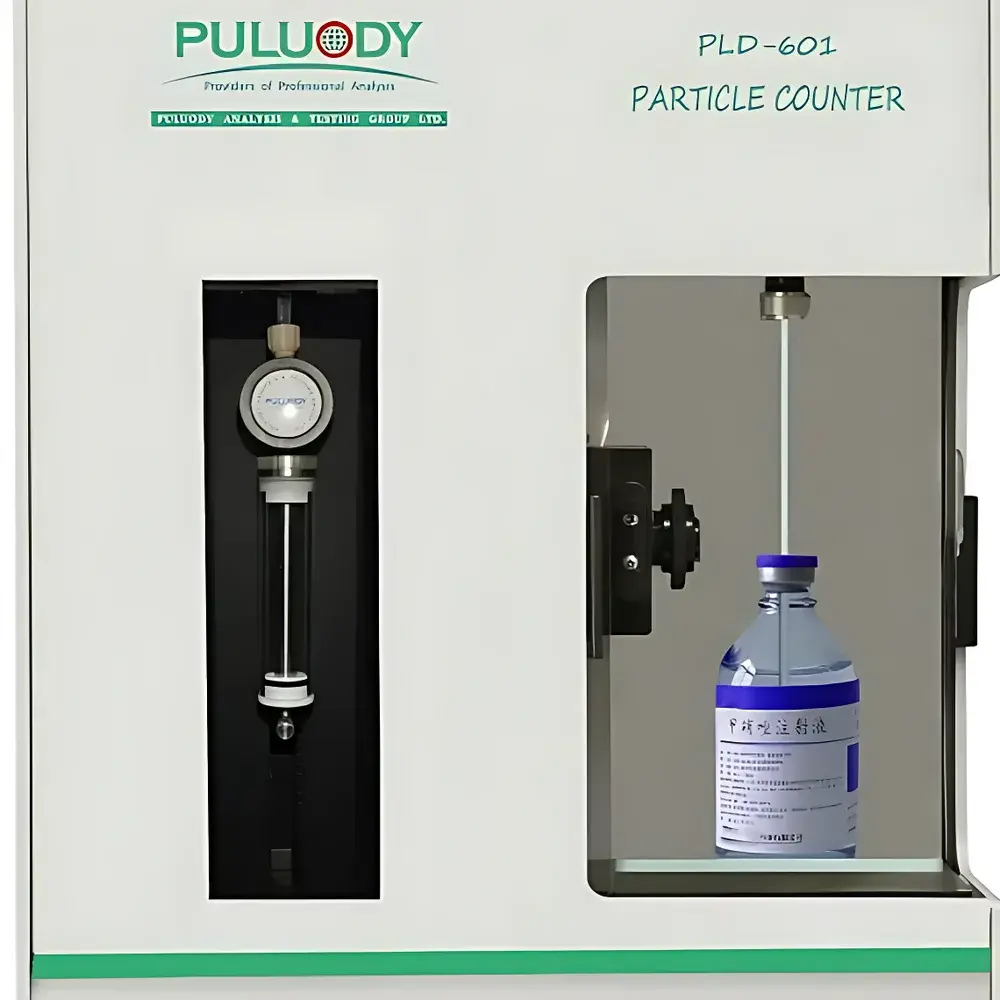
PULUODY PLD-601L Pharmaceutical Insoluble Particle Analyzer for Medical Dressings
| Brand | PULUODY |
|---|---|
| Origin | Shaanxi, China |
| Model | PLD-601L |
| Instrument Type | Optical Liquid Particle Counter |
| Detection Principle | Light Obscuration (LO) / Single-Particle Optical Sizing (SPOS) |
| Sensor Generation | 8th-Generation Dual-Laser Narrow-Beam Sensor |
| Flow Control | Precision Piston Pump + Ultra-Precise Electromagnetic Flow Regulation |
| Calibration Standards | JJG1061, ISO 21501-4, USP <788>, EP 2.9.19, ChP 2020 Vol. IV <0903> |
| Particle Size Range | 1–450 µm (optional extended range: 0.03–3000 µm) |
| Channel Count | 1000 configurable size channels |
| Sampling Flow Rate | 5–150 mL/min |
| Rinse Flow Rate | 5–500 mL/min |
| Sample Temperature Range | 0–80 °C |
| Ambient Operating Temperature | −15–50 °C |
| Accuracy | ±5% typical (per ChP 2020) |
| Coincidence Limit | ≤2.5% at 1000 particles/mL |
| Resolution | >95% (ChP-calibrated), >90% (USP/EP-calibrated) |
| Compliance | ASTM F312-22, ISO 11171:2016, ISO 4406:2017, NAS 1638 Class Code, GB/T 14039–2002, YBB00272004–2015, GB 8368–2018 |
Overview
The PULUODY PLD-601L Pharmaceutical Insoluble Particle Analyzer is an optical liquid particle counter engineered for regulatory-compliant particulate contamination assessment in medical dressings, parenteral drug products, and associated delivery systems. It operates on the light obscuration (LO) principle—also known as single-particle optical sizing (SPOS)—where particles suspended in a liquid stream pass through a focused laser beam, generating transient shadows proportional to their projected area. These signals are converted into calibrated particle counts and size distributions across 1000 programmable channels, enabling high-fidelity quantification of insoluble particulates per pharmacopoeial thresholds. Designed specifically for adherence to ChP 2020 , USP /, EP 2.9.19, and ISO 21501-4, the PLD-601L delivers trace-level sensitivity down to 1 µm (with optional sub-micron capability), supporting critical quality attribute (CQA) monitoring in sterile manufacturing, packaging validation, and filter integrity verification.
Key Features
- 8th-generation dual-laser narrow-beam sensor architecture with independent wavelength alignment for enhanced signal-to-noise ratio and reduced false-trigger events
- Dual-mode flow control system integrating a precision metering piston pump and closed-loop electromagnetic flow regulator, ensuring volumetric accuracy better than ±1% and repeatability within ±5% (typical)
- 1000-channel high-resolution sizing matrix, fully customizable to match pharmacopoeial binning schemes (e.g., ≥10 µm, ≥25 µm per ChP; ≥5 µm, ≥10 µm per USP; or user-defined ranges such as 4–70 µm(c))
- V8.9 analytical software suite compliant with FDA 21 CFR Part 11 requirements—including electronic signatures, audit trail logging, and role-based access control
- Integrated thermal management for sample fluid temperature stabilization between 0–80 °C, minimizing viscosity-induced sizing drift during extended analysis cycles
- Automated self-diagnostic routines, real-time flow calibration verification, and built-in reference standard validation protocols aligned with JJG1061 and ISO 21501-4
Sample Compatibility & Compliance
The PLD-601L accommodates a broad spectrum of low-viscosity aqueous and organic liquids relevant to pharmaceutical and biomedical device manufacturing. Validated applications include injectable solutions (IV, IM, SC), lyophilized powder reconstitutes, ophthalmic preparations, vaccine suspensions, sterile water for injection (WFI), container-closure system extracts, infusion set leachables, and terminal filter challenge fluids. Its measurement methodology satisfies mandatory compliance requirements under Chinese Pharmacopoeia 2020 Edition , USP and , European Pharmacopoeia 10.0 Chapter 2.9.19, Japanese Pharmacopoeia JP17 Annex 7.07, and WHO International Pharmacopoeia IV. Additional conformance includes ISO 11171:2016 (calibration standard), ISO 4406:2017 (contamination code reporting), NAS 1638 Class coding, and YBB00272004–2015 for pharmaceutical packaging materials. All test reports generated support GLP/GMP audit readiness and regulatory submission dossiers.
Software & Data Management
The V8.9 software platform provides full lifecycle data governance—from method setup and instrument qualification to raw data export and statistical trending. It supports automated generation of 21 CFR Part 11–compliant reports including particle count histograms, cumulative distribution curves, pass/fail determinations against user-specified limits, and batch-level summary statistics. Audit trails record all operator actions, parameter modifications, calibration events, and report exports with timestamps and digital signatures. Raw data files (.pda format) retain full spectral fidelity and are exportable to CSV, PDF, or LIMS-compatible XML schemas. Optional integration modules enable direct connectivity to enterprise SAP QM, LabWare LIMS, or TrackWise EDC environments via secure OPC UA or RESTful API interfaces.
Applications
- Quality control testing of medical dressing eluates for insoluble particulate burden per ISO 10993-12 and YBB00272004–2015
- Filter validation studies assessing retention efficiency of 0.22 µm sterilizing-grade membranes using challenge suspensions
- Cleanliness verification of pharmaceutical process equipment, filling lines, and isolator surfaces via rinse solution analysis
- Stability-indicating monitoring of nanoparticle drug carriers and liposomal formulations for aggregation onset
- Raw material screening of excipients (e.g., mannitol, lactose) and active pharmaceutical ingredients (APIs) for extraneous particulates
- Supporting ISO 14644-1 cleanroom classification through continuous monitoring of ultrapure water loops and HVAC condensate streams
FAQ
Does the PLD-601L comply with USP for injectable product testing?
Yes—the instrument meets all hardware, calibration, and procedural requirements specified in USP , including flow rate stability, sensor resolution, coincidence correction, and reporting format specifications.
Can it analyze viscous or non-aqueous solvents?
It is optimized for low-viscosity liquids (<20 cP). For higher-viscosity samples (e.g., silicone oils, glycerin-based gels), optional heated flow path modules and dilution protocols must be implemented per validated SOPs.
Is third-party certification available for regulatory submissions?
Yes—certificates of calibration traceable to NIM (National Institute of Metrology, China) and DL/T1096–2008–accredited verification reports are provided upon request, along with IQ/OQ documentation templates.
How is data integrity ensured during multi-shift operations?
All user interactions are logged in an immutable audit trail with SHA-256 hashing; password policies, session timeouts, and electronic signature workflows enforce accountability per ALCOA+ principles.
What maintenance intervals are recommended for GMP environments?
Daily system suitability checks, weekly optical path cleaning, and quarterly sensor recalibration using NIST-traceable latex standards are advised—fully documented in the included Maintenance Logbook and Preventive Maintenance Schedule.



