
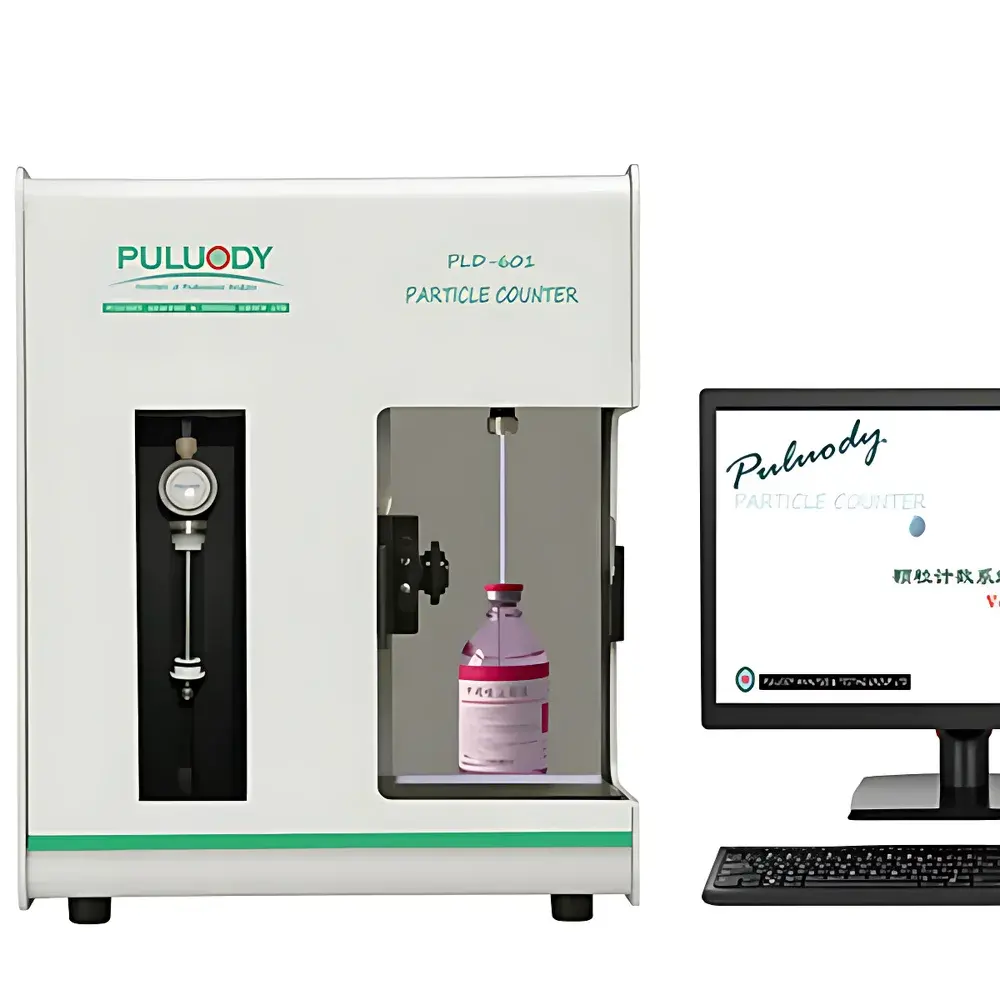
PULUODY PLD-601ZY 1000-Channel, Five-Tier Permission-Controlled Insoluble Particle Analyzer
| Brand | PULUODY |
|---|---|
| Origin | Shaanxi, China |
| Model | PLD-601ZY |
| Detection Principle | Light Obscuration (LO) / Dual-Laser Narrow-Beam Particle Sensing |
| Channel Count | 1000 adjustable channels |
| Detection Range | 1–450 µm |
| Minimum Detectable Size | 0.01 µm (c) |
| Sampling Flow Rate | 5–150 mL/min |
| Rinse Flow Rate | 5–500 mL/min |
| Sample Temperature Range | 0–80 °C |
| Ambient Operating Temperature | 0–50 °C |
| Accuracy | ±5% typical (per USP <788>, ISO 21501) |
| Coincidence Limit | ≤5% at 1000 particles/mL |
| Resolution | >95% (ChP 2020 calibration), <10% (USP/ISO 21501 calibration) |
| Flow Control | Precision metering piston pump + ultra-precise electromagnetic flow regulation |
| Software Compliance | FDA 21 CFR Part 11, ALCOA+ principles, audit trail, electronic signature, data backup & restore, power-fail recovery |
| Regulatory Standards Supported | ChP 0903 (2015/2020), USP <788>/<789>/<797>, EP 10.0/9.0/8.0, BP 2019/2018, JP 17/16/15, WHO IntPh IV, YBB00272004-2015, ISO 4406, ISO 11171, NAS 1638, SAE AS4059, MIL-STD-1246C, GB/T 14039, DL/T 432, GJB/T 420A/B, GB/T 18854 |
Overview
The PULUODY PLD-601ZY is a high-resolution, regulatory-grade insoluble particle analyzer engineered for precise quantification and sizing of suspended particulate matter in parenteral and sterile liquid pharmaceuticals, biologics, medical devices, ultrapure water systems, and advanced industrial fluids. It operates on the light obscuration (LO) principle—where particles passing through a focused dual-laser narrow-beam detection zone attenuate incident light proportionally to their cross-sectional area—enabling direct, real-time counting and sizing without reliance on calibration surrogates or statistical interpolation. The eighth-generation dual-laser sensor architecture delivers exceptional signal-to-noise ratio and minimizes optical diffraction artifacts across the full 0.01 µm (c) to 450 µm range. Designed explicitly for compliance-critical environments, the instrument integrates hardware-level flow stability control (±1% volumetric accuracy via precision piston pump and closed-loop electromagnetic flow regulation) with software-enforced data integrity protocols aligned with FDA 21 CFR Part 11, EU Annex 11, and ICH GCP/GLP expectations.
Key Features
- Dual-laser narrow-beam optical sensing system with sub-micron resolution down to 0.01 µm (c), validated per ISO 21501-4 and USP Annex A.
- 1000 fully configurable detection channels—supporting user-defined binning from 4 to 128 size intervals—enabling granular compliance reporting against 510+ global pharmacopoeial and industrial standards.
- Five-tier hierarchical permission management (Administrator, QA Manager, Lab Supervisor, Analyst, Trainee) with role-based access control (RBAC), session locking, and forced password rotation.
- FDA 21 CFR Part 11-compliant software suite (V8.9) featuring full audit trail, immutable electronic signatures, automated report generation, encrypted data backup, and power-loss recovery.
- Integrated temperature-controlled fluid path (0–80 °C) and ambient operation range (0–50 °C) for stable analysis of thermally sensitive biologics and high-viscosity formulations.
- Traceable metrology support via collaboration with National Northwest Metrology Testing Center (CNAS-accredited) and Defense Science & Technology Commission Level-1 Particle Metrology Station No. 116.
Sample Compatibility & Compliance
The PLD-601ZY accommodates a broad spectrum of sample types under strictly defined operational constraints: aqueous and non-aqueous injectables (including lyophilized reconstitutes), ophthalmic solutions, vaccines, infusion sets, IV tubing, pharmaceutical excipients, medical packaging leachables, CMP slurries, semiconductor process chemicals, and ultrapure water (UPW) used in Class 10 cleanrooms. All testing workflows adhere to method suitability requirements outlined in USP , ChP 0903, EP 2.9.19, and ISO 21501-4. Instrument qualification follows IQ/OQ/PQ protocols compliant with ASTM E2925 and EU GMP Annex 15. Raw data files are stored in vendor-neutral .csv and .xml formats, preserving metadata integrity for regulatory inspection readiness.
Software & Data Management
The V8.9 analytical software provides an intuitive bilingual (English/Chinese) GUI with touchscreen and optional wireless keyboard/mouse support. It supports dynamic threshold adjustment, customizable particle count histograms, cumulative distribution curves, and automatic pass/fail flagging against preloaded pharmacopoeial limits (e.g., ChP 2020 Table 1, USP Table 1). All user actions—including parameter changes, result approvals, and report exports—are timestamped, attributed, and cryptographically hashed within the embedded audit trail. Electronic signatures meet FDA 21 CFR Part 11 Subpart C requirements, including identity verification, intent confirmation, and linkage to specific data records. Data archiving complies with ALCOA+ principles (Attributable, Legible, Contemporaneous, Original, Accurate, Complete, Consistent, Enduring, Available).
Applications
- Pharmaceutical Quality Control: Routine batch release testing of injectables, raw materials, and container-closure systems per USP , ChP 0903, and YBB standards.
- Filtration Validation: Quantitative assessment of terminal filter retention efficiency using challenge suspensions (e.g., NIST-traceable latex spheres).
- Water System Monitoring: Continuous or periodic monitoring of UPW, WFI, and PW systems per USP and ISO 8573-7.
- Medical Device Evaluation: Particulate shedding analysis from syringes, IV bags, catheters, and infusion pumps per ISO 8536-4 and ISO 11608-2.
- Semiconductor Manufacturing: Slurry cleanliness verification for CMP processes and wafer rinse water compliance with SEMI F63 and JEDEC JESD22-A113.
- Chemical & Materials R&D: Nanoparticle dispersion stability studies, pigment agglomeration kinetics, and lubricant contamination profiling.
FAQ
Does the PLD-601ZY support method transfer between laboratories?
Yes—the instrument’s standardized optical geometry, traceable flow calibration, and ISO 21501-4–aligned sensor response enable robust inter-laboratory comparability when operated under identical SOPs and environmental controls.
Can it perform differential particle counting (e.g., ≥10 µm vs. ≥25 µm) as required by USP ?
Yes—its 1000-channel architecture allows simultaneous, independent binning for any two or more size thresholds without interpolation error or channel crosstalk.
Is third-party calibration certification included with purchase?
Each unit ships with a Certificate of Conformance and optional factory calibration report traceable to NIST or CNAS-accredited reference materials; full metrological validation services are available via authorized partner labs.
How does the system handle viscous or protein-rich samples that may cause sensor fouling?
The dual-pump architecture enables programmable high-speed rinse cycles (up to 500 mL/min) with configurable dwell time and solvent selection, minimizing carryover and maintaining baseline stability across heterogeneous sample matrices.
Is remote diagnostics and software update capability supported?
Yes—secure TLS 1.2–encrypted remote maintenance access is available via authenticated VPN connection, enabling firmware updates, log review, and configuration audits without physical site visits.






