
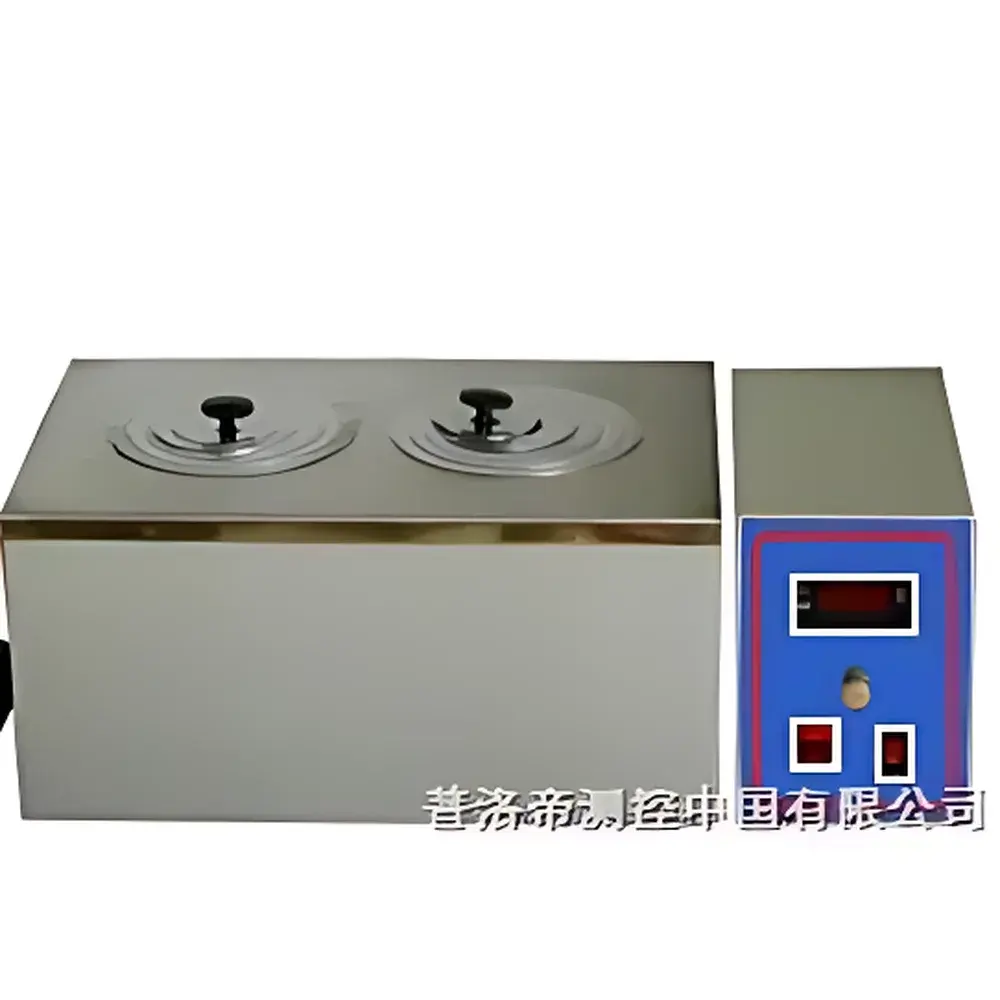
PULUODY PLD-6532A Petroleum Salt Content Analyzer
| Brand | PULUODY |
|---|---|
| Origin | Shaanxi, China |
| Manufacturer Type | Direct Manufacturer |
| Regional Classification | Domestic (China) |
| Model | PLD-6532A |
| Pricing | Available Upon Request |
| Standard Compliance | GB/T 6532–2019 |
| Temperature Control | Digital PID-controlled heating system (range: ambient to 80 °C, ±0.5 °C stability) |
| Extraction Configuration | Dual independent extraction units with synchronized solvent delivery |
| Pressure Regulation | Precision digital pressure controller (0–0.6 MPa, resolution 0.01 MPa) |
| Display Interface | Backlit LCD with real-time parameter monitoring |
| Power Supply | AC 220 V ±10%, 50 Hz |
Overview
The PULUODY PLD-6532A Petroleum Salt Content Analyzer is a dedicated laboratory instrument engineered for the quantitative determination of inorganic chloride salts—primarily sodium chloride (NaCl) and calcium chloride (CaCl₂)—in crude oil, fuel oils, distillates, and other petroleum-based hydrocarbon streams. It operates on the principle of solvent extraction followed by potentiometric titration or conductometric detection (per user-configured methodology), in strict alignment with the Chinese national standard GB/T 6532–2019, “Petroleum Products — Determination of Salt Content in Crude Oil and Refined Products.” This method is functionally equivalent to ASTM D6470 and IP 265 for salt-in-crude analysis, ensuring compatibility with international refinery quality control workflows. The analyzer addresses a critical challenge in upstream and midstream operations: excessive salt content causes corrosion in distillation columns, fouling of heat exchangers, catalyst poisoning in hydrotreaters, and chloride-induced stress corrosion cracking (CSCC) in piping systems. Accurate, repeatable salt quantification is therefore essential for custody transfer, desalting process optimization, and compliance with refinery feedstock specifications.
Key Features
- Dual independent extraction stations enable parallel sample processing, improving throughput without cross-contamination risk.
- Digital PID temperature control ensures stable heating of extraction solvent (typically isopropanol–toluene–water mixture) within ±0.5 °C across the operational range (ambient to 80 °C), critical for consistent phase separation kinetics.
- Precision digital pressure regulation (0–0.6 MPa, 0.01 MPa resolution) allows fine-tuned control of solvent delivery pressure during the extraction cycle, enhancing reproducibility between operators and batches.
- Integrated backlit LCD interface displays real-time temperature, pressure, extraction time, and system status—no external PC required for basic operation.
- Robust stainless-steel construction and chemically resistant fluid pathways accommodate aggressive solvent blends and high-salinity samples typical of offshore crude slugs or produced water emulsions.
- Designed for integration into GLP-compliant laboratories: all critical parameters are logged internally with timestamping; optional RS232/USB output supports external data archiving.
Sample Compatibility & Compliance
The PLD-6532A accepts liquid petroleum samples ranging from light naphthas to heavy residual fuels and emulsified crude oils. Sample volume requirements are 10–50 mL, depending on expected salt concentration (typical detection range: 0.1–100 ppm NaCl equivalent). The instrument complies fully with GB/T 6532–2019, which specifies extraction efficiency validation using certified reference materials (CRMs) traceable to NIM (National Institute of Metrology, China). While not pre-certified to ISO/IEC 17025, its architecture supports method validation per ISO/IEC 17025:2017 Clause 7.2 (validation of non-standard methods) when deployed in accredited testing labs. The system meets mechanical safety requirements under GB/T 25480–2010 (laboratory equipment safety general requirements) and electromagnetic compatibility per GB/T 18268.1–2010.
Software & Data Management
The PLD-6532A operates in standalone mode but includes a serial communication interface (RS232) for optional connection to laboratory information management systems (LIMS) or custom data acquisition software. Internal memory stores up to 200 test records with date/time stamps, operator ID (manually entered), sample ID, temperature setpoint, pressure profile, and final salt concentration result. Data export is supported in CSV format for traceability and audit readiness. For regulated environments (e.g., refineries operating under API RP 500 or ISO 9001), the instrument’s manual logbook functionality satisfies FDA 21 CFR Part 11 predicate rules when paired with documented SOPs and access-controlled operator training records—though native electronic signature or audit trail features are not embedded.
Applications
- Crude oil assay laboratories verifying salt content prior to pipeline transport or refinery intake.
- Desalter unit optimization: correlating feed salt levels with wash water injection rates and effluent conductivity.
- Quality assurance of marine fuels (ISO 8217) and jet fuels (ASTM D1655) where chloride-induced corrosion is a primary failure mode.
- Research on demulsifier efficacy: evaluating salt removal efficiency across varying chemical formulations and residence times.
- Environmental monitoring of produced water salinity in E&P operations, supporting discharge compliance reporting.
FAQ
What standards does the PLD-6532A comply with?
It is designed and verified against GB/T 6532–2019. Its operational methodology aligns with ASTM D6470 and IP 265 for comparative analysis.
Can the instrument handle highly viscous or emulsified crudes?
Yes—pre-heating and solvent selection (e.g., addition of co-solvents) are recommended per GB/T 6532 Annex A for such samples; dual extraction helps manage phase separation variability.
Is calibration traceable to national standards?
Calibration verification requires certified NaCl-in-oil reference standards; users must source CRMs traceable to NIM or equivalent NMIs (e.g., NIST SRM 2722).
Does it support automated titration or only extraction?
The PLD-6532A performs standardized solvent extraction only; downstream analysis (e.g., potentiometric titration with AgNO₃) requires a separate titrator per GB/T 6532 Section 8.
What maintenance is required for long-term reliability?
Routine cleaning of extraction vessels and solvent lines with toluene/isopropanol; annual verification of temperature sensor accuracy and pressure transducer linearity is advised.




