
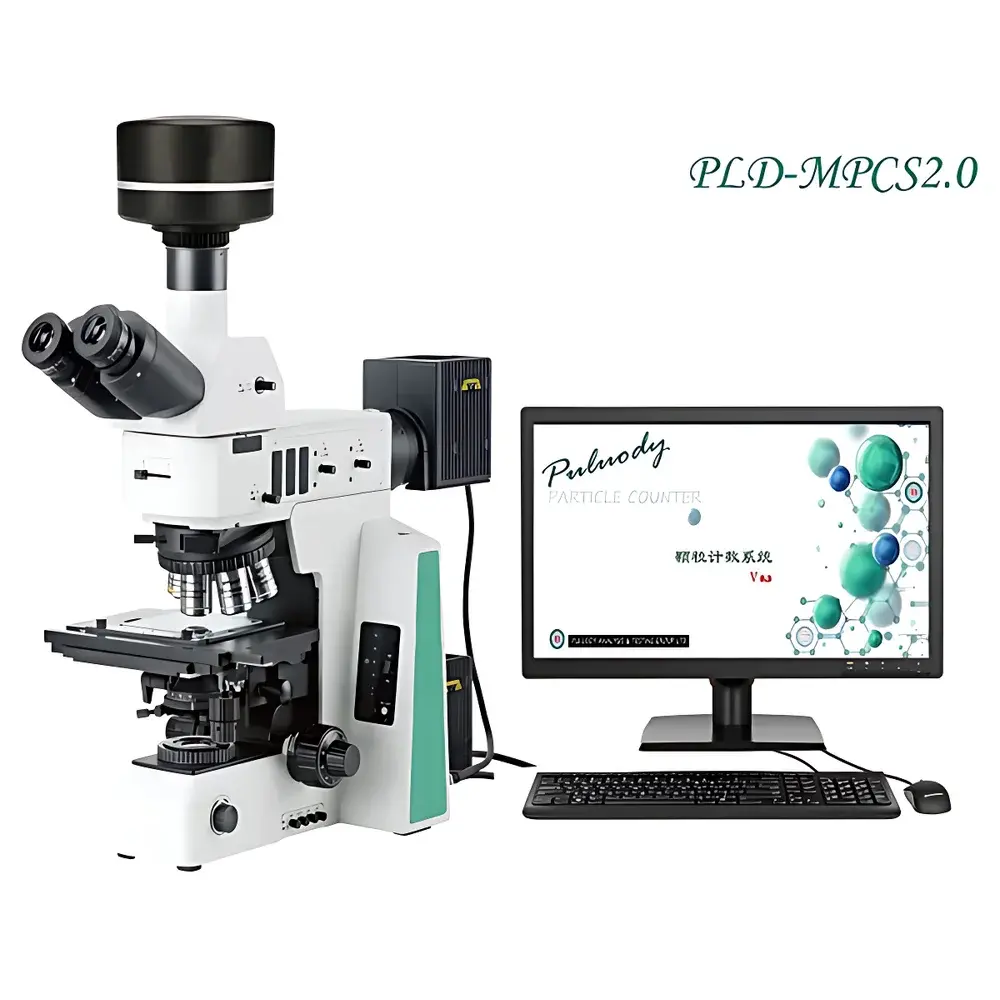
PULUODY PLD-MPCS2.0 Insoluble Particulate Microscopic Counting System
| Brand | PULUODY |
|---|---|
| Origin | Shaanxi, China |
| Manufacturer Type | Authorized Distributor |
| Product Category | Domestic |
| Model | PLD-MPCS2.0 |
| Price | USD 50,000 (FOB) |
| Measurement Principle | Brightfield Microscopy + Digital Image Analysis |
| Compliance | Chinese Pharmacopoeia ChP 0903 Method 2 (Microscopic Particle Counting), USP <788>, USP <789>, EP 2.9.19, ISO 21501-4, ISO 21510, GB/T 11446.9-2013 |
| Particle Detection Range | 1–500 µm |
| Magnification | 40×–1000× |
| Resolution | 0.1 µm |
| Repeatability Error | <5% (excluding sample preparation variability) |
| CCD Sensor | 3 MP monochrome digital camera |
| Calibration Traceability | Northwest Metrology & Testing Center (Civil Products) |
| Software Platform | Windows 2000/XP compatible |
| Interface | RS-232 or USB 2.0 |
| Automatic Field Stitching | Full membrane scan with seamless mosaic generation |
| Particle Segmentation Speed | <1 s per image |
| Segmentation Success Rate | >93% |
| Accuracy | ±3% typical (ChP 2020 reference calibration) |
| Coincidence Limit | 10,000 particles/mL (5% coincidence error) |
| Resolution Performance | >95% (ChP 2020), <10% false-negative rate (USP/ISO 21501-4) |
Overview
The PULUODY PLD-MPCS2.0 Insoluble Particulate Microscopic Counting System is a regulatory-compliant, image-based particle analysis platform engineered for quantitative assessment of insoluble particulates in parenteral and sterile liquid products. It implements the microscopic counting method defined in Chinese Pharmacopoeia (ChP) General Chapter 0903, Method 2 — equivalent to USP Microscopic Particle Count Test and EP 2.9.19. Unlike light obscuration (LO) or laser diffraction techniques, this system relies on high-resolution brightfield optical microscopy coupled with calibrated digital imaging and deterministic image segmentation algorithms. This approach preserves morphological fidelity, enables shape-based classification (e.g., aspect ratio, circularity), and avoids refractive index bias inherent in optical extinction methods. The system is validated for use in GMP-regulated environments where traceability, audit readiness, and method transparency are critical — particularly in QC laboratories supporting pharmaceutical development, biologics manufacturing, and medical device component testing.
Key Features
- Regulatory-grade optical architecture: Standardized 40×–1000× magnification range with 0.1 µm stage-calibrated scale bar and NIST-traceable micrometer slide verification.
- Automated membrane scanning: Motorized XY stage with precision stepper control delivers full-filter-field coverage; proprietary stitching algorithm ensures geometrically accurate, distortion-free mosaics.
- Deterministic particle segmentation engine: Optimized for low-contrast, irregular, and agglomerated particles; achieves >93% segmentation success rate across diverse matrices (e.g., viscous injectables, CMP slurries, ultrapure water).
- Comprehensive morphometric analysis: Computes size distribution (equivalent spherical diameter), aspect ratio distribution, circularity histogram, convex hull area, and Feret diameters — all exportable as CSV or PDF.
- Operator access control & audit trail: Role-based user management (administrator, analyst, reviewer); full electronic log of parameter changes, image acquisition timestamps, and report generation events.
- Standards-integrated reporting: Preconfigured templates for ChP 2020, USP /, ISO 21501-4, and NAS 1638; automatic pass/fail grading per specified particle count thresholds per volume.
Sample Compatibility & Compliance
The PLD-MPCS2.0 accommodates standard 25 mm or 47 mm membrane filters (mixed cellulose ester, polycarbonate, or PVDF) used in pharmacopeial filtration protocols. It supports direct analysis of filtered samples from injectables, ophthalmic solutions, vaccines, IV tubing extracts, hydraulic fluids, semiconductor process chemicals, and ultra-pure water systems. All analytical workflows comply with GLP and GMP documentation requirements. The system’s software meets FDA 21 CFR Part 11 criteria for electronic records and signatures when deployed with appropriate IT validation (e.g., password-protected user roles, immutable audit logs, and electronic signature capture). Certificate of Calibration is issued by the Northwest Metrology & Testing Center, accredited to CNAS CL01 (ISO/IEC 17025).
Software & Data Management
The embedded PULUODY ParticleVision™ v2.0 software operates natively on Windows platforms and provides a modular interface for acquisition, processing, and reporting. Raw images are stored in lossless TIFF format with embedded EXIF metadata (magnification, exposure time, stage coordinates). Analysis parameters — including minimum/maximum pixel area thresholds, grayscale intensity cutoffs, and connectivity rules — are saved per test template and version-controlled. Reports include annotated particle maps, cumulative distribution curves, statistical summaries (mean, D10/D50/D90), and compliance status against selected pharmacopeial limits. Data export supports CSV, XML, and PDF/A-1a formats for long-term archival and regulatory submission. Optional integration with LIMS via ODBC or HL7 is available under custom configuration.
Applications
This system serves as a primary or orthogonal method for particulate contamination assessment across regulated and industrial sectors. In pharmaceutical QA/QC, it validates filter integrity, assesses extractables/leachables from packaging components (e.g., glass vials, rubber stoppers), and verifies compliance of large-volume parenterals per ChP 0903. In semiconductor manufacturing, it quantifies residual slurry particles post-CMP and monitors ultrapure rinse water quality per SEMI F63. In aerospace and power generation, it supports fluid cleanliness grading per ISO 4406 and NAS 1638 for hydraulic and lubricating oils. Additional use cases include evaluation of nanoparticle dispersions in drug delivery formulations, cleanliness verification of surgical instruments, and particulate load assessment in beverage and cosmetic emulsions.
FAQ
Does the system support automated focus adjustment?
No — manual fine-focus control is retained to ensure optimal contrast for low-refractive-index particles (e.g., silicone oil droplets, polymer fragments), which is essential for pharmacopeial compliance.
Can the software import external calibration standards?
Yes — users may load custom calibration files (e.g., NIST SRM 1963, ISO MTD particles) to reconfigure pixel-to-micron mapping for non-standard optics or objectives.
Is remote diagnostics or software update capability included?
Standard deployment includes secure remote support via TeamViewer with customer consent; firmware and software updates are delivered via encrypted download portal with SHA-256 checksum verification.
What validation documentation is provided?
Each unit ships with Factory Acceptance Test (FAT) report, Installation Qualification (IQ) checklist, and Operational Qualification (OQ) protocol template aligned with ASTM E2877-22 and EU Annex 11 expectations.
How is particle coincidence addressed at high concentrations?
The system applies a validated dilution protocol per ChP 0903 and calculates coincidence correction using the Poisson-based model specified in ISO 21501-4 Annex B; maximum recommended concentration is 10,000 particles/mL to maintain <5% coincidence error.





