
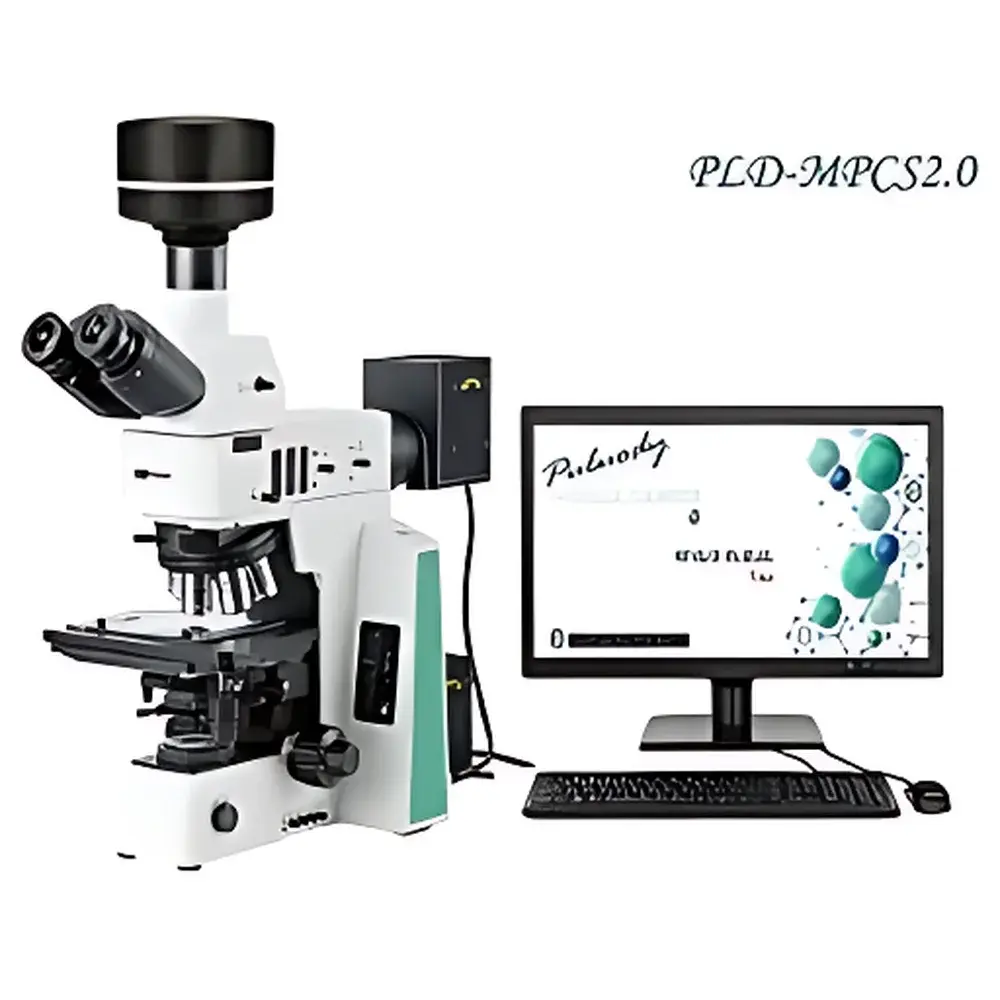
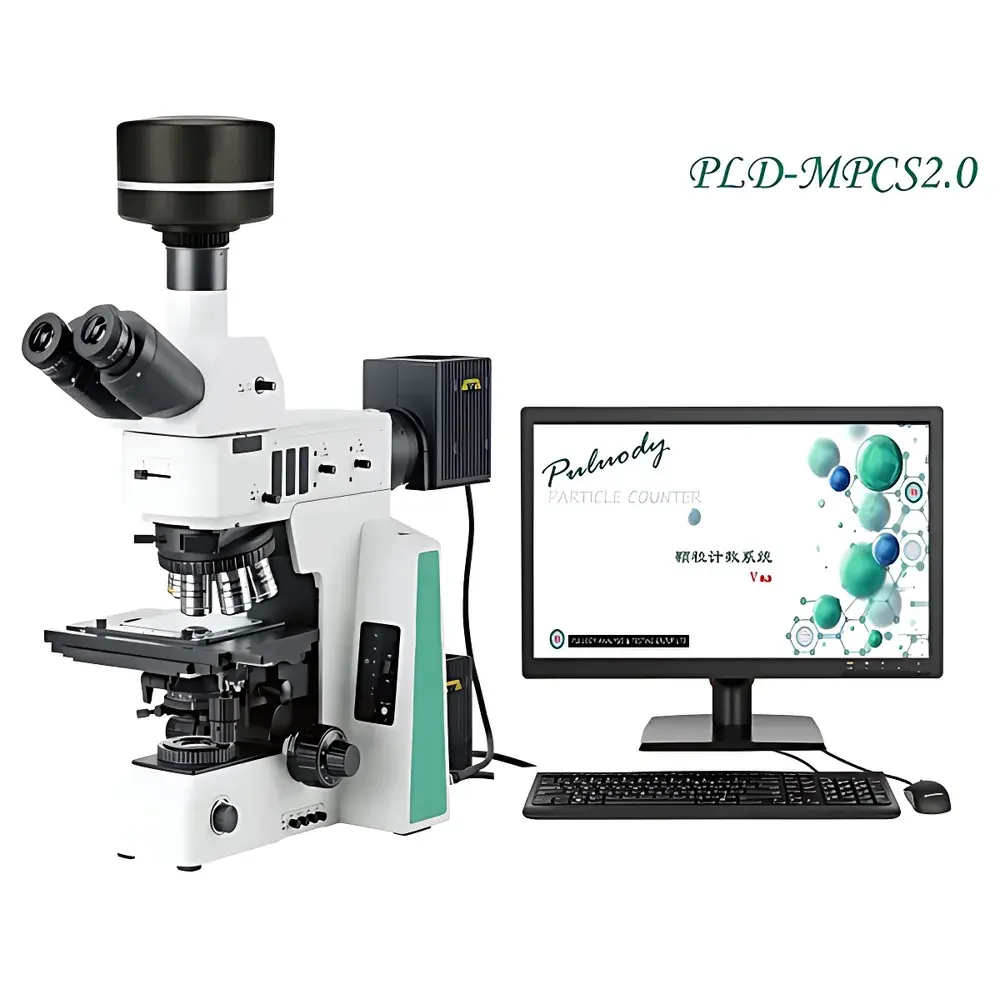
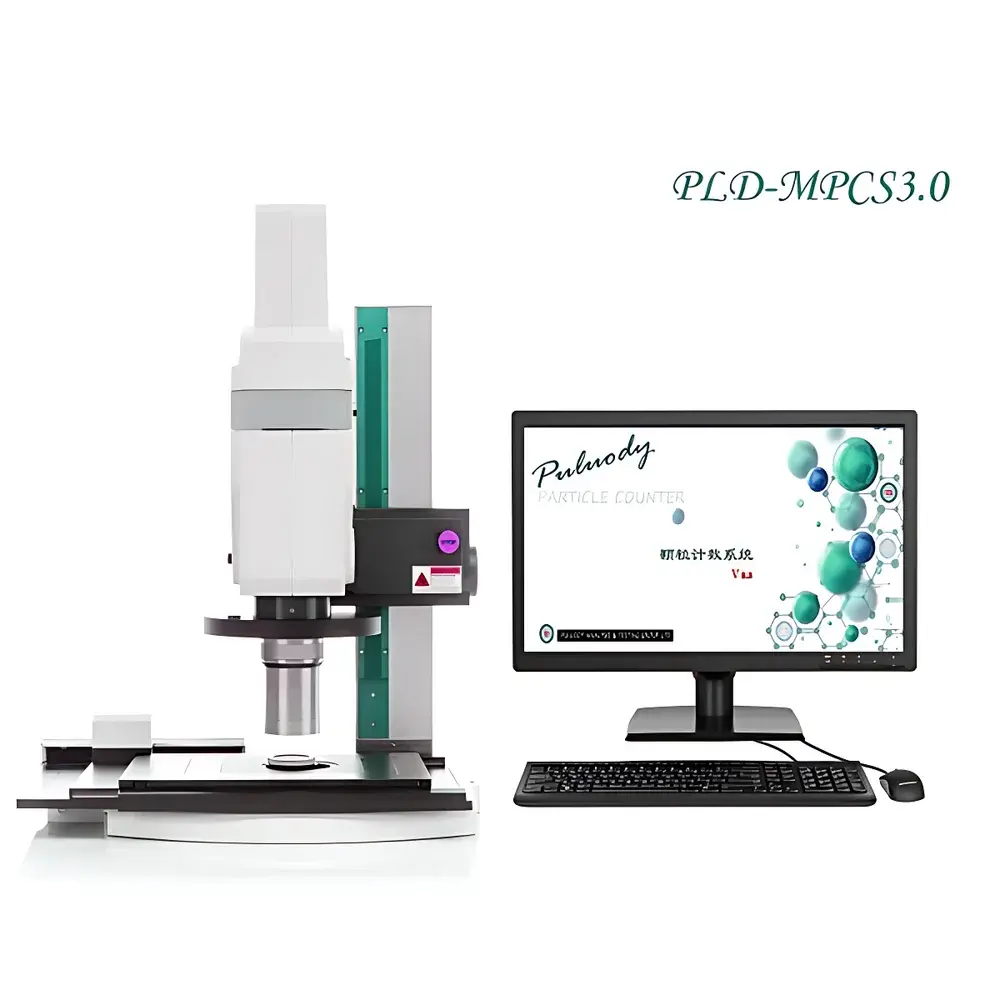
PULUODY PLD-MPCS2.0 Microscopic Insoluble Particle Analyzer
| Brand | PULUODY |
|---|---|
| Origin | Shaanxi, China |
| Model | PLD-MPCS2.0 |
| Instrument Type | Optical Microscopy-Based Particle Counter |
| Measurement Principle | ISO 21501-4 / USP <788> Microscopic Particle Counting Method |
| Test Range | 1–500 µm |
| Magnification | 40×–1000× |
| Resolution | 0.1 µm |
| Microscope Accuracy | ±0.02 µm (excluding sample preparation variability) |
| Repeatability Error | <5% (excluding sample preparation variability) |
| CCD Camera | 3 MP |
| Calibration Standard | NIST-traceable stage micrometer (0.1 µm graduation) |
| Particle Segmentation Speed | <1 s per field |
| Segmentation Success Rate | >93% |
| Detection Resolution | >95% (per ChP 2020), <10% false-negative rate (per USP <788>, ISO 21501) |
| Coincidence Limit | 10,000 particles/mL (5% coincidence error) |
| Software Platform | Windows 2000/XP-compatible proprietary image analysis suite |
| Interface | RS-232 or USB 2.0 |
| Compliance | USP <788>, <789>, EP 6.0–8.0, JP 14–16, BP 2009–2013, IP 2010, IntPh V, ChP 2015 & 2020, GB/T 11446.9–2013, GB 8368, ISO 21501-4, ISO 21510, ISO 11171 |
Overview
The PULUODY PLD-MPCS2.0 Microscopic Insoluble Particle Analyzer is a regulatory-compliant, image-based particle characterization system engineered for quantitative morphological and dimensional analysis of insoluble particulates in parenteral solutions, ophthalmic preparations, biologics, and high-purity process liquids. It implements the microscopic counting method defined in United States Pharmacopeia , European Pharmacopoeia 2.9.19, and Chinese Pharmacopoeia General Chapter 0903 — Method II. Unlike light-blockage (light-obscuration) instruments, this system acquires high-fidelity digital micrographs of filtered particles deposited on membrane filters, enabling simultaneous measurement of particle size distribution, aspect ratio, circularity, convexity, and surface texture. Its optical architecture integrates a precision mechanical stage, infinity-corrected plan-apochromatic objectives (40× to 1000×), and a calibrated 3-megapixel monochrome CCD sensor with 0.1 µm pixel-level resolution traceable to NIST standards. The system operates under controlled illumination (Köhler configuration) to minimize glare, shadow artifacts, and edge diffraction effects that compromise segmentation fidelity.
Key Features
- Regulatory-grade image acquisition platform compliant with USP , ChP 0903, and ISO 21501-4 requirements for method validation and reporting.
- Automated motorized XY stage with sub-micron positioning repeatability for systematic grid-based scanning of 25 mm or 47 mm filter membranes.
- Proprietary particle segmentation algorithm optimized for low-contrast, irregular, and agglomerated particles — achieving >93% detection success rate across diverse pharmaceutical matrices.
- Real-time morphometric quantification including equivalent circular diameter (ECD), Feret max/min length, aspect ratio, circularity, solidity, and convex hull area.
- Calibration traceability supported by certified stage micrometers (0.1 µm graduation) and reference microsphere standards (NIST SRM 1963, ISO 11171).
- Dual-reporting capability: generates both pharmacopoeial pass/fail summaries (e.g., particles ≥10 µm and ≥25 µm per mL) and full-size distribution histograms (1–500 µm binning).
Sample Compatibility & Compliance
The PLD-MPCS2.0 accommodates standard mixed-cellulose ester (MCE), polycarbonate (PC), and polyvinylidene fluoride (PVDF) membrane filters (25 mm and 47 mm diameters) used in pharmacopoeial filtration protocols. It supports aqueous, oily, and low-viscosity organic solvents commonly encountered in injectable drug manufacturing, excipient QC, and medical device extractables testing. All analytical workflows adhere to Good Laboratory Practice (GLP) and Good Manufacturing Practice (GMP) data integrity principles: audit trails record user actions, parameter changes, calibration events, and report generation timestamps. Software complies with FDA 21 CFR Part 11 requirements for electronic records and signatures when configured with role-based access control and digital certificate authentication. System validation documentation includes IQ/OQ/PQ protocols aligned with ASTM E2454 and ISO/IEC 17025 guidelines.
Software & Data Management
The embedded Windows-native software provides a validated graphical interface for acquisition, review, re-analysis, and export. Image stacks are stored in lossless TIFF format with embedded metadata (magnification, exposure time, filter ID, operator, date/time). Quantitative outputs include CSV-exportable raw particle tables (X/Y coordinates, dimensions, shape descriptors), cumulative/differential size distributions, and summary statistics (mean, median, D10/D50/D90, %RSD). Reports conform to pharmacopoeial templates and may be customized for internal SOPs or regulatory submissions. Data archiving supports network drive mapping, encrypted local storage, and optional integration with LIMS via HL7 or ASTM E1384 interfaces. Audit trail logs are immutable and exportable as PDF/A-1b for inspection readiness.
Applications
- Final container testing of sterile injectables (e.g., monoclonal antibodies, vaccines, small-molecule APIs) per USP and ChP 0903.
- Filter integrity verification and extractables/leachables assessment in single-use bioprocessing systems.
- Raw material qualification of excipients (e.g., polysorbates, PEGs, lipids) where subvisible particles impact stability or immunogenicity.
- Investigational analysis of protein aggregation, silicone oil droplets, and glass delamination fragments in prefilled syringes.
- QC release testing of ophthalmic solutions, dialysis fluids, and implantable device rinsates.
- Root cause analysis in deviation investigations involving visible particle complaints or sterility failures.
FAQ
Does the PLD-MPCS2.0 meet USP Method II requirements for microscopic particle counting?
Yes. The system implements all hardware, software, and procedural specifications outlined in USP Section “Microscopic Particle Count” — including minimum magnification (400×), calibrated scale, defined filter types, and statistical sampling rules.
Can it analyze particles smaller than 10 µm?
Yes. With 1000× magnification and 0.1 µm resolution, it reliably detects and sizes particles from 1 µm upward — supporting sub-visible particle profiling beyond pharmacopoeial thresholds.
Is software validation support available?
Yes. PULUODY provides documented IQ/OQ protocols, installation qualification checklists, and performance verification test scripts aligned with GAMP 5 and Annex 11 expectations.
How is calibration verified?
Calibration is performed using NIST-traceable stage micrometers and certified polystyrene microspheres (e.g., Thermo Scientific AccuCount Fluorescent Microspheres), with annual verification recommended by national metrology institutes.
What training and service options are offered?
On-site installation, operator training, and annual preventive maintenance are provided through PULUODY’s authorized service centers in Asia, with remote diagnostics and software updates available globally.



