
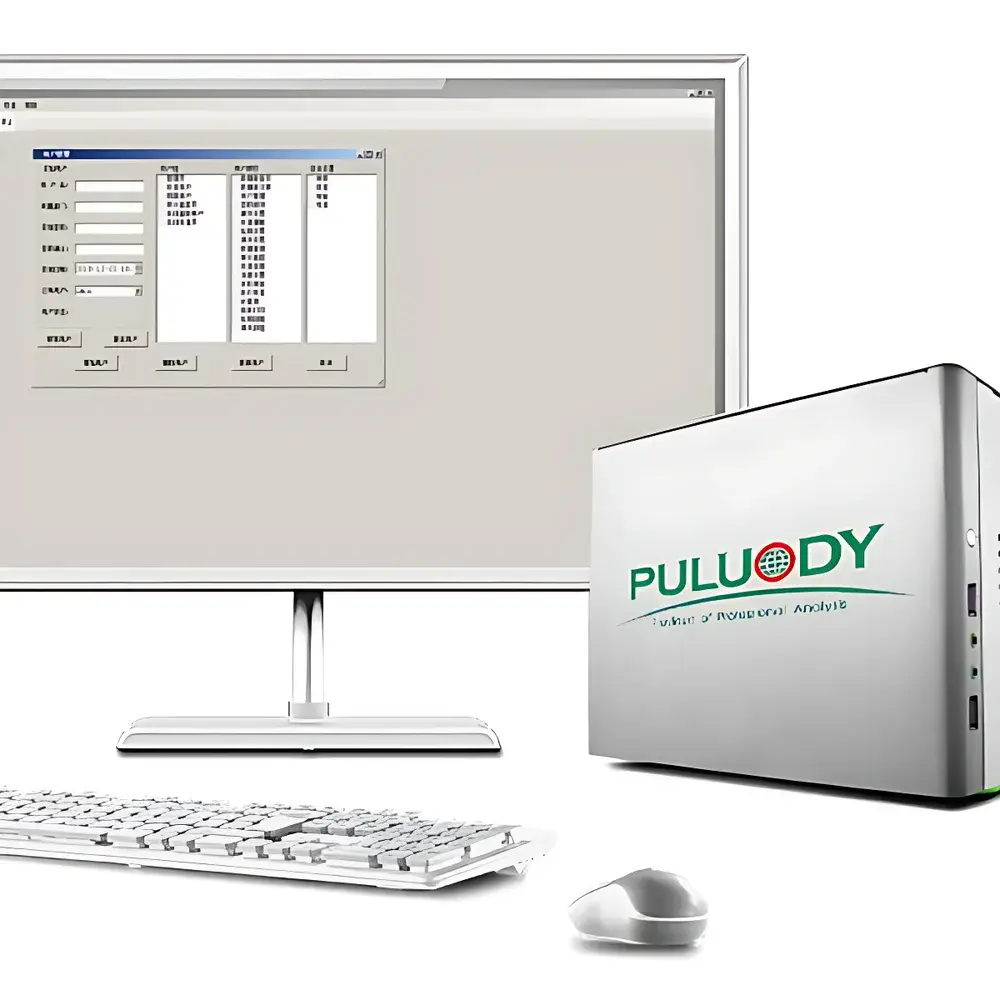
PULUODY PMT-2-K Aviation Component Liquid Particle Counter
| Brand | PULUODY |
|---|---|
| Origin | Shaanxi, China |
| Manufacturer Type | Authorized Distributor |
| Product Category | Domestic |
| Model | PMT-2-K |
| Price | USD 34,800 (FOB) |
| Dispersion Method | Wet Dispersion |
| Instrument Type | Laboratory Laser Particle Counter |
| Measurement Range | 2–750 µm |
| Repeatability | ≤5% RSD |
| Measurement Time | 60 s per sample |
| Sensor Generation | 8th-Generation Dual-Laser Narrow-Beam Detection |
| Calibration Standards | JJG 1061, ISO 21501-4, NIST-Traceable Latex Spheres |
| Software Version | V8.3 Integrated Analysis & Calibration Suite (PC + Touchscreen) |
| Sampling Accuracy | <±1% |
| Size Accuracy | <±3% (typ.) |
| Coincidence Limit | 1000 particles/mL (2.5% coincidence error) |
| Output Interface | 4–20 mA analog output with customizable over-limit alarm |
| Reporting | Particles/mL and ISO 4406 / NAS 1638 contamination codes |
| Power Input | 100–265 VAC, 50–60 Hz |
Overview
The PULUODY PMT-2-K Aviation Component Liquid Particle Counter is a high-precision, laboratory-grade laser particle counter engineered for quantitative analysis of solid particulate contamination in critical liquid media used across aerospace manufacturing, semiconductor fabrication, and ultra-pure water systems. It operates on the principle of light obscuration (LO) combined with dual-laser narrow-beam scattering detection — a validated optical methodology compliant with ISO 21501-4 and ASTM F328 for liquid-borne particle sizing and counting. Unlike conventional single-wavelength instruments, the 8th-generation dual-laser sensor enables simultaneous differential signal processing to suppress noise from refractive index variation, bubble interference, and background fluorescence—significantly improving resolution for sub-5 µm particles in low-conductivity fluids such as IPA, deionized water, and fluorinated solvents. Designed specifically for aviation component cleaning validation, the PMT-2-K meets the stringent requirements of SAE AS4059F and ISO 11171 for hydraulic fluid cleanliness verification, while supporting offline batch testing and inline process monitoring via optional flow cell integration.
Key Features
- 8th-generation dual-laser narrow-beam detection system with independent wavelength channels (650 nm + 405 nm) for enhanced sensitivity to both metallic wear debris and polymeric contaminants
- Precision metering piston pump with electromagnetic flow control (<±1% volumetric accuracy) ensuring consistent sample draw and minimizing shear-induced particle breakup
- Wet dispersion module optimized for low-viscosity, low-surface-tension liquids including acetone, isopropyl alcohol, and ultrapure water (UPW)
- Integrated touchscreen interface (color LCD) with optional wireless keyboard/mouse support for glove-compatible operation in cleanroom environments (ISO Class 5–7)
- Real-time analog output (4–20 mA) with programmable alarm thresholds aligned to ISO 4406:2017 contamination code bands
- V8.3 analysis software featuring dual-mode architecture: separation of calibration metrology and routine testing workflows to prevent accidental parameter override during GxP operations
- Compliance-ready audit trail, electronic signature support, and 21 CFR Part 11–compatible user access controls (optional configuration)
Sample Compatibility & Compliance
The PMT-2-K is validated for use with aviation-grade cleaning agents (e.g., Vertrel XF, Transcutol), semiconductor process chemicals (SC-1, SC-2, BOE), UPW (resistivity ≥18.2 MΩ·cm), and polymer solutions (e.g., photoresist diluents). It supports measurement of insoluble particulates in organic solvents per USP and EP 2.9.19. Instrument calibration adheres to national metrological standard JJG 1061–2010 and international reference methods ISO 21501-4:2018 and ISO 11171:2016. Full traceability is maintained through NIST-traceable polystyrene latex (PSL) standards. The system satisfies documentation requirements for ISO/IEC 17025 accredited laboratories and supports GLP/GMP-compliant reporting with timestamped raw data export (CSV, PDF, XML).
Software & Data Management
The V8.3 software suite provides dual-domain functionality: a locked calibration environment accessible only by authorized metrologists, and a production testing interface with configurable SOP templates. All measurement sessions generate immutable metadata—including instrument ID, operator credentials, environmental conditions (temperature/humidity), and calibration certificate IDs. Data exports include full-size distribution histograms, cumulative counts, and automated contamination grading per ISO 4406, NAS 1638, or custom binning schemes (e.g., 4–70 µm(c), 1–100 µm). Cloud synchronization and local NAS backup options are available. Audit logs record every parameter change, report generation, and user login event with SHA-256 hashing for forensic integrity verification.
Applications
- Aerospace component cleanliness verification post-rinse (turbine blades, fuel nozzles, hydraulic manifolds)
- In-process monitoring of semiconductor wet benches and track-out rinse tanks
- Validation of point-of-use filters in UPW distribution loops (≥0.1 µm detection capability with optional upgrade)
- Contamination trending in photomask cleaning baths and display panel etch lines
- Quality release testing of medical device cleaning agents and pharmaceutical excipient solvents
- Research-grade particle shedding studies in nanofiltration membrane development
FAQ
Does the PMT-2-K comply with SAE AS4059F for aerospace fluid cleanliness?
Yes — when configured with ISO 11171-aligned calibration and certified PSL standards, it delivers measurement uncertainty within ±5% for particles ≥4 µm, satisfying AS4059F Level 10–12 reporting requirements.
Can it measure particles below 2 µm?
The base model reports down to 2 µm per ISO 21501-4; sub-2 µm extension (to 0.1 µm) is available via optional high-sensitivity mode with modified optical alignment and signal processing firmware.
Is remote monitoring supported?
Standard Ethernet and optional 4G/LTE modules enable secure remote diagnostics, real-time dashboard viewing, and alarm notifications via SMTP/SNMP protocols.
What maintenance intervals are recommended?
Optical path cleaning every 200 hours; annual sensor recalibration with certified reference materials; pump seal replacement every 12 months under continuous operation.
How is data integrity ensured during regulatory audits?
All test records include digital signatures, tamper-evident checksums, and time-stamped audit trails meeting FDA 21 CFR Part 11 Subpart C requirements for electronic records and signatures.



