
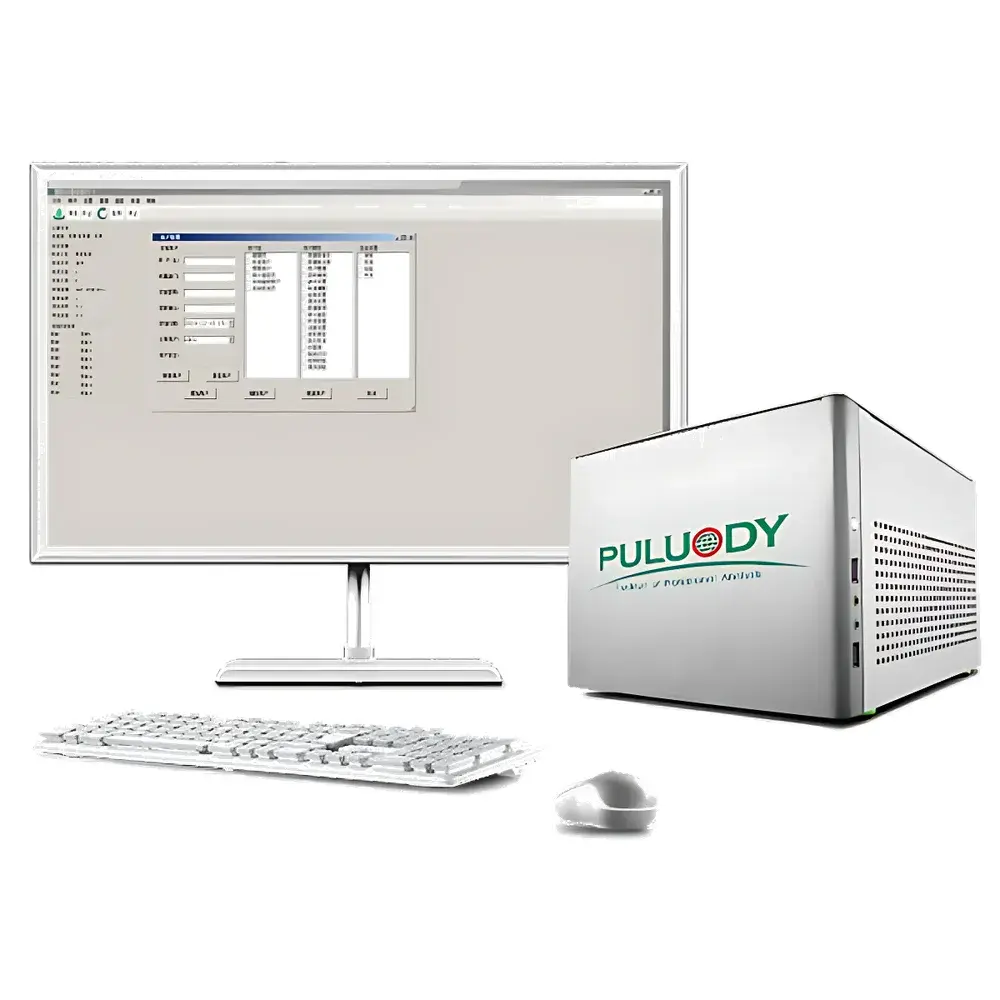
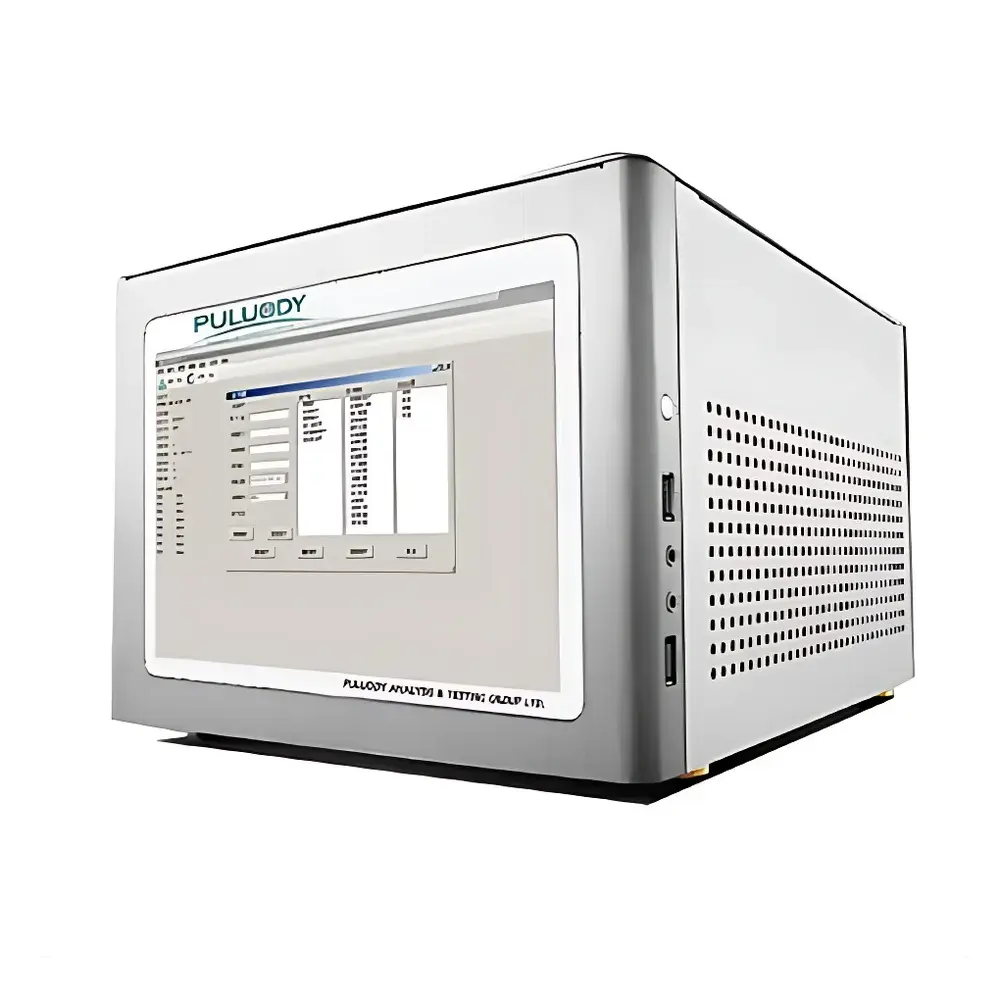
PULUODY PMT-2 Isopropanol & Hydrogen Peroxide Liquid Particle Counter
| Brand | PULUODY |
|---|---|
| Origin | Shaanxi, China |
| Manufacturer Type | Authorized Distributor |
| Product Origin | Domestic (China) |
| Model | PMT-2 |
| Price | USD 72,800 (approx. based on ¥520,000 @ 1 USD = ¥7.15) |
| Sensor Generation | 8th-generation dual-laser narrow-beam optical sensor |
| Detection Range | 0.1–0.5 µm (standard) |
| Sampling Method | Precision metering piston pump |
| Flow Control | Dual-stage — high-accuracy piston pump + ultra-precise electromagnetic flow regulator |
| Accuracy | ±3% typical |
| Sampling Precision | <±1% |
| Coincidence Error | ≤2.5% at 1000 particles/mL |
| Calibration Standards | ISO 21501-4, JJG 1061, NIST-traceable latex spheres |
| Compliance | Chinese Pharmacopoeia 2015/2020, USP <788>, EP 2.9.19, BP, GB 8368 |
| Output Interface | 4–20 mA analog output |
| Alarm Function | Configurable particle threshold alert |
| Data Acquisition | iPad-integrated real-time acquisition |
| Software | PULUODY V8.3 Integrated Analysis & Calibration Software (PC + embedded touchscreen version) |
| Display | Color LCD touchscreen + optional wireless keyboard/mouse |
| Power Input | 100–265 VAC, 50–60 Hz |
| Reporting | Particles per mL + ISO 4406 / NAS 1638 contamination codes |
Overview
The PULUODY PMT-2 Isopropanol & Hydrogen Peroxide Liquid Particle Counter is a high-sensitivity, laboratory-grade and industrial inline particle monitoring instrument engineered for rigorous micro- and nanoscale contamination analysis in aggressive, low-viscosity solvents—specifically optimized for isopropanol (IPA), hydrogen peroxide (H₂O₂), deionized water, semiconductor process chemicals, and other ultra-pure cleaning agents. It operates on the principle of dual-laser light scattering with narrow-beam optics, enabling high-resolution detection of sub-micron particulates down to 0.1 µm (c) under controlled laminar flow conditions. Unlike conventional single-wavelength counters, the 8th-generation dual-laser sensor mitigates refractive index dependency and improves signal-to-noise ratio for non-aqueous, low-absorption media such as IPA and H₂O₂—critical for photolithography rinse validation, wafer cleaning verification, and wet bench process control in advanced semiconductor fabrication.
Key Features
- Dual-laser narrow-beam optical detection architecture, specifically calibrated for organic solvents and oxidizing agents including IPA and 30% H₂O₂
- Two-stage precision fluidics: a metrology-grade piston pump for volumetric accuracy (<±1%) combined with an electromagnetic flow regulator for dynamic stability across variable backpressures
- Configurable detection thresholds: standard 0.1–0.5 µm range; extended modes support user-defined channels from 1–100 µm or 4–70 µm(c), with selectable 0.1 µm(c) counting capability
- Embedded V8.3 software platform with physically separated calibration and analysis modules—ensuring metrological integrity and eliminating software-induced bias during routine QC testing
- Real-time data acquisition via integrated iPad interface, supporting time-stamped trend logging, alarm-triggered capture, and remote diagnostics
- 4–20 mA analog output with programmable alarm relays for integration into SCADA, MES, or PLC-controlled cleanroom environments
- Compliance-ready firmware architecture supporting audit trails, electronic signatures, and 21 CFR Part 11–compatible user access controls (optional configuration)
Sample Compatibility & Compliance
The PMT-2 is validated for use with low-conductivity, low-refractive-index liquids commonly employed in front-end semiconductor manufacturing—including anhydrous isopropanol, aqueous hydrogen peroxide solutions (up to 30%), ultrapure water (UPW), and fluorinated solvents. Its wetted path employs chemically inert materials (e.g., fused silica flow cell, PFA and ETFE tubing) resistant to oxidative degradation and solvent swelling. Regulatory alignment includes full traceability to ISO 21501-4 for light-scattering particle counters, calibration per JJG 1061 (Chinese national metrology regulation), and conformance with pharmacopeial standards: USP , EP 2.9.19, BP Appendix XVII, and Chinese Pharmacopoeia Vol. IV (2015 & 2020 editions). It supports reporting in both absolute particle concentration (particles/mL) and standardized contamination codes (ISO 4406, NAS 1638), fulfilling requirements for GMP-compliant process validation and GLP-aligned analytical method verification.
Software & Data Management
PULUODY V8.3 software comprises two logically isolated subsystems: the Calibration Module (requiring administrator-level credentials and cryptographic hash-locked reference runs) and the Routine Analysis Module (for daily operator use). This separation prevents accidental parameter override and ensures measurement reproducibility across shifts and laboratories. Data export supports CSV, PDF, and XML formats—with embedded metadata including instrument ID, sensor serial number, calibration date, operator ID, and environmental timestamp. Audit trail functionality logs all critical events (e.g., calibration initiation, threshold modification, report generation) with immutable timestamps and user attribution. Optional 21 CFR Part 11 compliance package includes role-based access control, electronic signature workflows, and encrypted database storage.
Applications
The PMT-2 serves as a critical quality assurance tool in high-precision manufacturing environments where sub-0.5 µm particulate contamination directly impacts yield and device reliability. Primary use cases include: real-time monitoring of IPA and H₂O₂ dispense lines in 300 mm wafer fabs; offline verification of filter integrity for point-of-use (POU) filtration systems serving lithography tools; cleanliness validation of silicon wafers post-scouring and pre-coating; particle load assessment in flat-panel display (FPD) cleaning baths; and routine testing of nano-filtration membranes used in ultrapure chemical delivery systems. It is also deployed in R&D labs evaluating novel cleaning formulations, polymer solution clarity, and colloidal stability in nanomaterial synthesis processes.
FAQ
Does the PMT-2 support direct inline installation in pressurized IPA or H₂O₂ supply lines?
Yes—it is rated for continuous operation at up to 3 bar inlet pressure and features pressure-compensated flow control to maintain stable sampling rates under fluctuating line conditions.
Can the instrument be recalibrated using customer-prepared reference standards?
Calibration must be performed using NIST-traceable polystyrene latex (PSL) spheres per ISO 21501-4; however, users may execute verification checks with in-house reference suspensions under documented SOPs.
Is firmware upgrade capability available remotely?
Firmware updates are delivered via secure USB key with digital signature verification; remote network updates are disabled by default to preserve regulatory compliance integrity.
What maintenance intervals are recommended for the optical sensor and fluidic path?
Optical window inspection is advised every 200 operational hours; full sensor cleaning and flow-path flush recommended quarterly or after 500 mL of aggressive solvent exposure.
Does the system meet cleanroom classification requirements for Class 1 (ISO 3) environments?
The PMT-2 enclosure meets IP54 ingress protection; for Class 1 integration, it must be mounted externally with sample drawn via stainless-steel capillary tubing and filtered purge gas manifold.
Related Products




