
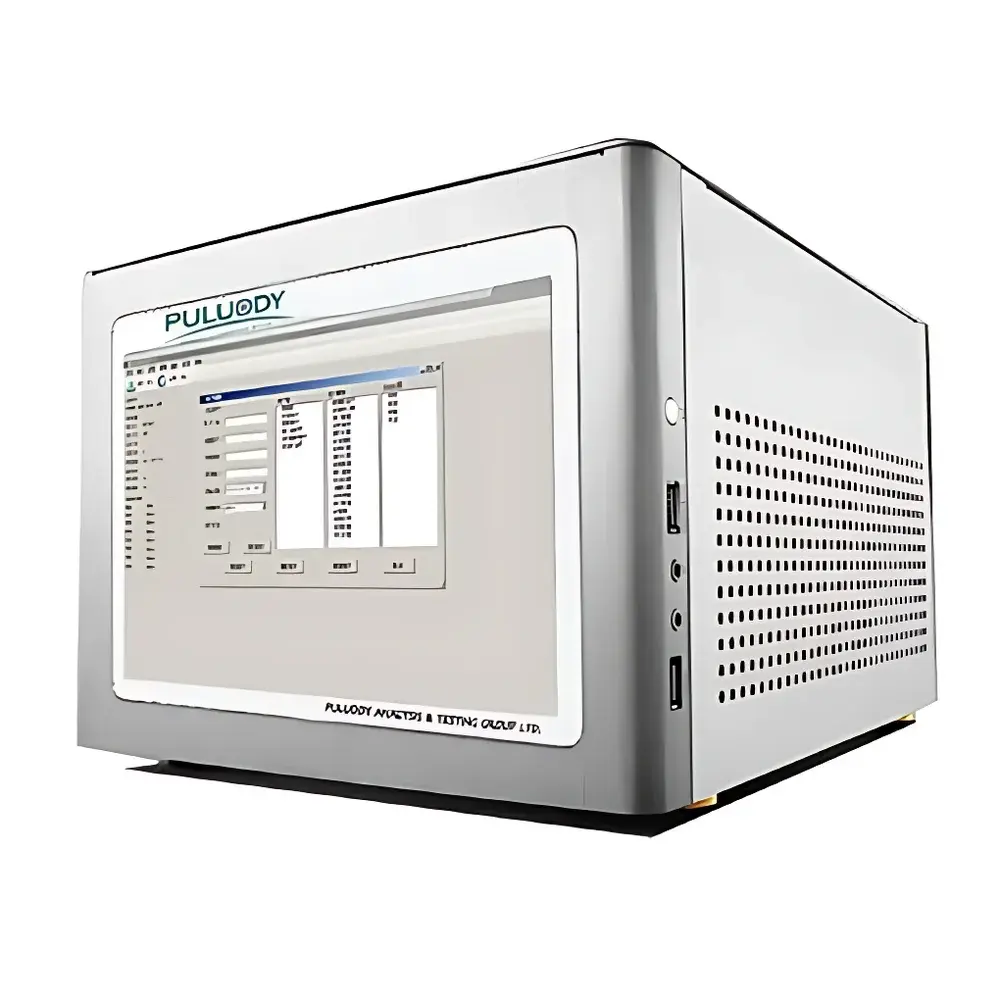
PULUODY PMT-2A Organic Solvent Liquid Particle Counter
| Brand | PULUODY |
|---|---|
| Model | PMT-2A |
| Instrument Type | Optical Particle Counter |
| Detection Principle | Dual-Laser Narrow-Beam Light Scattering |
| Detection Range | 0.1–100 µm (customizable sub-ranges: 0.1 µm(c), 4–70 µm(c)) |
| Accuracy | ±3% typical |
| Sampling Precision | <±1% |
| Coincidence Limit | 1000 particles/mL (2.5% coincidence error) |
| Flow Control | Precision Plunger Pump + Electromagnetic Flow Regulation |
| Compliance Standards | USP <788>, USP <789>, EP 2.9.19, BP 2.9.19, ChP 2015/2020, GB 8368, ISO 21501-4, JJG 1061 |
| Data Output | 4–20 mA analog interface, iPad-compatible wireless acquisition |
| Reporting | Particles per mL & ISO 4406 / NAS 1638 contamination codes |
| Power Input | 100–265 VAC, 50–60 Hz |
| Software | PULUODY V8.3 Integrated Analysis & Calibration Suite (PC + embedded touchscreen) |
Overview
The PULUODY PMT-2A Organic Solvent Liquid Particle Counter is an advanced optical particle counter engineered for high-sensitivity, trace-level particulate contamination monitoring in low-conductivity, non-aqueous media. It employs dual-laser narrow-beam light scattering technology—specifically the eighth-generation sensor architecture developed by PULUODY Analytical Testing Group—to deliver stable, reproducible detection of insoluble particles across a broad dynamic range (0.1 µm to 100 µm). Unlike conventional aqueous-focused counters, the PMT-2A is chemically inert and optically optimized for organic solvents including IPA, acetone, NMP, DMSO, ethyl acetate, and polymer solutions—making it suitable for semiconductor wet process chemicals, photolithography resists, battery electrolyte formulations, and pharmaceutical excipient solvents. Its core measurement principle relies on Mie scattering theory under controlled laminar flow conditions, with real-time signal processing calibrated against NIST-traceable polystyrene latex (PSL) standards per ISO 21501-4.
Key Features
- Dual-laser narrow-beam optical detection system with independent wavelength channels for enhanced signal-to-noise ratio and reduced false counts from refractive index mismatch.
- Chemically resistant fluidic path constructed from sapphire capillaries, PEEK tubing, and Hastelloy C-276 wetted components—validated for compatibility with aggressive organic solvents and halogenated cleaning agents.
- Precision plunger pump coupled with electromagnetic flow regulation ensures volumetric sampling accuracy better than ±1%, critical for compliance with pharmacopoeial volume-based reporting requirements (e.g., USP ).
- Embedded 7-inch color touchscreen interface with intuitive icon-driven navigation; supports optional wireless keyboard/mouse operation for lab bench or cleanroom glovebox integration.
- Modular design enables seamless transition between online (in-line bypass loop or direct pipe tap) and offline (portable syringe or bottle sampling) configurations without recalibration.
- Integrated 4–20 mA analog output with programmable alarm thresholds for real-time process interlock signaling—fully configurable for ISO 4406 code-based or absolute particle count triggers.
Sample Compatibility & Compliance
The PMT-2A is validated for use with low-dielectric liquids where traditional conductivity-based sensors fail—including hydrocarbon solvents, fluorinated fluids, silicone oils, and viscous polymer solutions up to 50 cP. It meets regulatory data integrity requirements under FDA 21 CFR Part 11 when operated with audit-trail-enabled V8.3 software (electronic signatures, user access levels, change logs). Method validation documentation supports GLP and GMP environments, with full traceability to national metrology institutes via JJG 1061 calibration protocols. The instrument satisfies compendial testing mandates for parenteral drug manufacturing (ChP 2020 Appendix IX R, USP Annex), medical device rinsate analysis (GB 8368), and microelectronics chemical purity grading (SEMI F57, SEMI F63).
Software & Data Management
PULUODY V8.3 is a dual-mode software platform comprising a dedicated calibration module and a separate analysis engine—ensuring metrological separation between instrument qualification and routine testing. The PC version provides advanced statistical tools: cumulative/differential histograms, trend charting with SPC control limits, batch comparison overlays, and automated report generation compliant with ISO/IEC 17025 templates. All raw scatter pulse data are stored in encrypted binary format with immutable timestamps. Audit trails record operator ID, parameter changes, calibration events, and result exports—supporting inspection readiness for regulatory audits. iPad integration enables remote viewing of live counts, historical trends, and alarm status via secure Wi-Fi connection.
Applications
- Semiconductor fab: Real-time monitoring of photoresist developers, etchants, and CMP slurries for sub-0.3 µm defect control.
- Pharmaceutical manufacturing: Quantification of insoluble particles in sterile filtration validation studies using organic co-solvent systems (e.g., ethanol/water blends for API suspensions).
- Battery R&D: Contamination profiling of lithium-ion electrolytes during formulation and aging studies.
- Optical coating: Verification of solvent cleanliness prior to spin-coating of anti-reflective or conductive layers on display glass substrates.
- Medical device cleaning validation: Residue quantification in final rinse baths containing alcohol-based sterilants.
- Nanomaterial synthesis: In-process tracking of aggregate formation kinetics in colloidal dispersions stabilized in toluene or chloroform.
FAQ
Can the PMT-2A measure particles in highly viscous polymer solutions?
Yes—the flow system accommodates viscosities up to 50 cP at regulated shear rates; optional heated sample chamber (up to 60°C) reduces viscosity-induced sedimentation artifacts.
Is ISO 21501-4 calibration included with purchase?
Calibration using NIST-traceable PSL standards per ISO 21501-4 is performed at the factory and documented in the Certificate of Conformance; annual recalibration services are available through PULUODY Certified Metrology Centers.
Does the instrument support multi-point size binning per USP for ophthalmic solutions?
Yes—V8.3 software allows customizable bin definitions aligned with USP thresholds (e.g., ≥10 µm, ≥25 µm) and automatic pass/fail flagging against acceptance criteria.
How is electrostatic interference mitigated during organic solvent measurement?
The optical chamber features grounded Faraday shielding, and all fluidic components are electrically bonded to eliminate triboelectric charging effects common in low-conductivity media.
Can data be exported to LIMS systems?
Yes—CSV and XML export formats are natively supported; optional OPC UA server module enables direct integration with major laboratory information management systems.



