
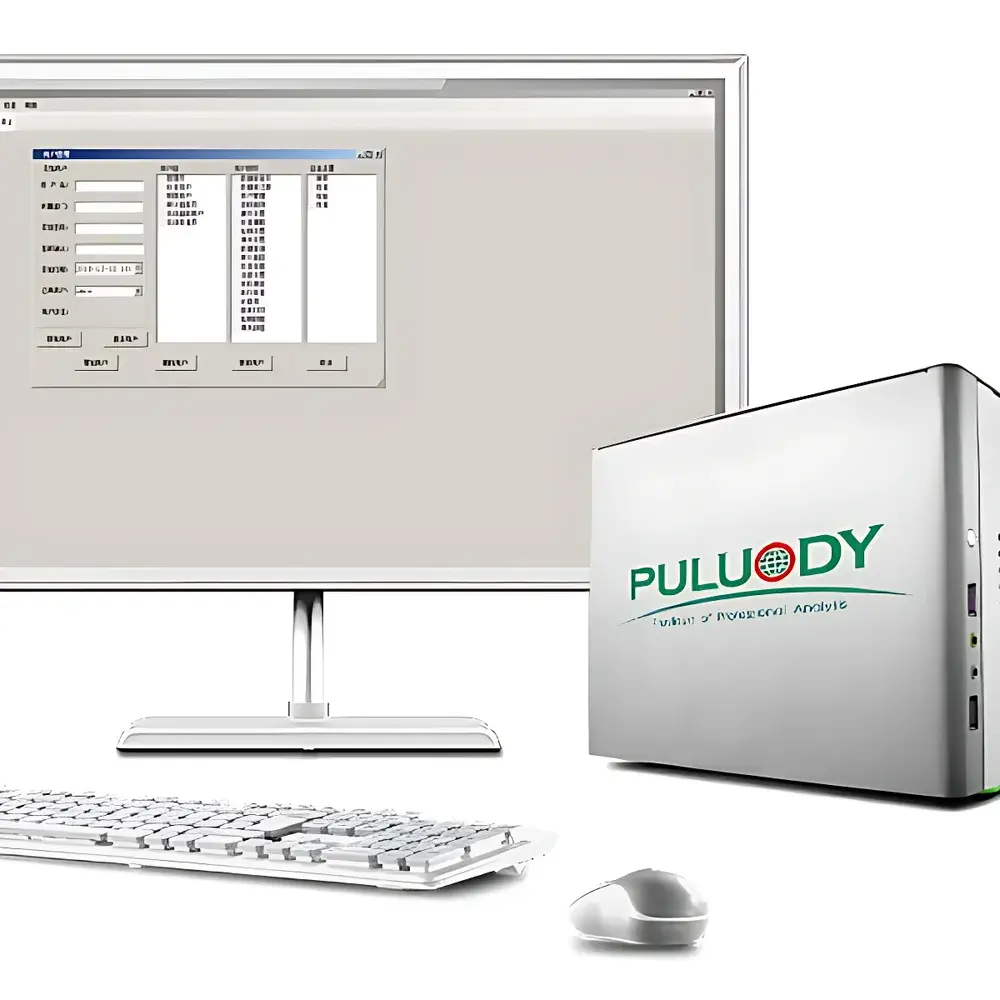
PULUODY PMT-2DR Advanced Nanoparticle Counter for Supercapacitor Electrolytes
| Brand | PULUODY |
|---|---|
| Model | PMT-2DR |
| Detection Principle | Dual-Laser Narrow-Beam Light Obscuration |
| Detection Range | 0.5–20.0 µm (standard) |
| Sensor Generation | 8th-Generation Dual-Laser Obscuration Sensor |
| Sampling Method | Precision Metering Piston Pump + Electromagnetic Flow Control |
| Accuracy | ±3% typical |
| Volume Accuracy | <±1% |
| Coincidence Limit | ≤2.5% error at 1000 particles/mL |
| Data Output | 4–20 mA analog interface with configurable particle concentration alarm |
| Calibration Standards | JJG 1061, ISO 21501-4, NIST-traceable latex spheres |
| Software | V8.3 Integrated Analysis & Calibration Software (PC & tablet-compatible) |
| Display & Control | Color LCD touchscreen + optional wireless keyboard/mouse |
| Power Input | 100–265 VAC, 50–60 Hz |
| Compliance | Designed for GLP/GMP-aligned environments |
Overview
The PULUODY PMT-2DR Advanced Nanoparticle Counter is a high-sensitivity, dual-laser light obscuration instrument engineered specifically for quantitative particulate contamination analysis in supercapacitor electrolytes and other ultra-pure liquid media. It operates on the principle of single-particle optical sensing (SPOS), where individual particles passing through a precisely collimated dual-laser beam induce transient reductions in transmitted light intensity—proportional to their equivalent spherical diameter. Unlike conventional single-beam systems, the eighth-generation dual-laser narrow-beam architecture minimizes signal noise, enhances pulse resolution at sub-micron thresholds, and enables robust discrimination between agglomerates and primary particles. This makes the PMT-2DR uniquely suited for electrolyte quality assurance in energy storage R&D and manufacturing, where trace-level metallic, polymeric, or precipitated contaminants directly impact capacitor lifetime, internal resistance, and self-discharge behavior.
Key Features
- Dual-laser narrow-beam obscuration sensor with independent wavelength alignment—optimized for low-scatter, high-refractive-index electrolytes (e.g., acetonitrile/LiPF₆, propylene carbonate/TEABF₄)
- Precision metering piston pump combined with electromagnetic flow regulation ensures repeatable volumetric sampling (±1% volume accuracy) across variable viscosity ranges (0.5–20 cP)
- Configurable detection thresholds: standard 0.5–20.0 µm; extended range options include 1–100 µm or 4–70 µm(c) per ISO 21501-4 Annex D; optional 0.1 µm(c) mode for critical nucleation studies
- V8.3 integrated software platform separates calibration routines from routine analysis workflows—eliminating cross-contamination of reference data and ensuring metrological integrity
- Real-time analog output (4–20 mA) with programmable alarm thresholds for integration into SCADA or PLC-based process control systems
- Touchscreen HMI with optional wireless peripheral support enables both fixed-installation operation and portable offline verification without software reconfiguration
Sample Compatibility & Compliance
The PMT-2DR is validated for use with organic solvent-based electrolytes (e.g., EC/DMC, PC/EMI-TFSI), aqueous supercapacitor formulations, polymer gel precursors, and post-filtration rinse solutions. Its wetted path employs chemically inert sapphire flow cells and PFA/ETFE fluidic components—resistant to hydrolysis, oxidation, and halide corrosion. The system meets mechanical and electrical safety requirements per IEC 61010-1. For regulated environments, firmware and software configurations support 21 CFR Part 11 compliance—including role-based access control, electronic signatures, and immutable audit trails for calibration events, method changes, and result exports. All calibrations are traceable to NIST-certified latex standards or certified reference materials aligned with JJG 1061 and ISO 21501-4.
Software & Data Management
The V8.3 software suite provides dual-mode operation: standalone PC deployment for laboratory reporting and embedded tablet-based acquisition for inline monitoring. It supports automated generation of ISO 4406, NAS 1638, and custom particle count/mL reports—including differential and cumulative histograms, time-series trend overlays, and statistical process control (SPC) charts. Raw pulse data is stored in vendor-neutral HDF5 format, enabling third-party spectral analysis or machine learning preprocessing. Data export options include CSV, PDF, XML, and direct SQL database push. Audit logs record operator ID, timestamp, method version, calibration status, and environmental metadata (temperature, pressure if external sensors are connected).
Applications
- Quality control of electrolyte batches prior to cell filling—detecting catalyst residues, electrode slurry carryover, or packaging-induced particulates
- In-line monitoring of recirculating electrolyte loops during formation cycling or aging tests
- Validation of nanofiltration membrane integrity in electrolyte purification systems
- Contamination mapping in cleanroom dispensing lines for solid-state battery R&D
- Quantitative assessment of particle shedding from current collectors, separators, or packaging seals under thermal or electrochemical stress
- Supporting ASTM F3250 (Standard Guide for Particulate Contamination Control in Lithium-Ion Battery Manufacturing) and IEC 62660-3 (Secondary lithium-ion cells for electric road vehicles)
FAQ
Can the PMT-2DR detect metallic particles in Li-ion compatible electrolytes?
Yes—the dual-laser configuration improves sensitivity to high-refractive-index contaminants (e.g., Ni, Co, Al oxides) without requiring conductive additives or dilution.
Is it possible to integrate this counter into an existing PLC-controlled filling line?
Yes—via the 4–20 mA analog output and optional Modbus TCP or OPC UA protocol add-on modules.
Does the system require annual recalibration by an accredited lab?
While field verification using certified latex standards is recommended quarterly, full traceable recalibration is required annually per ISO/IEC 17025 guidelines when used for regulatory submissions.
Can the software generate reports compliant with ISO 14644-9 for cleanroom liquid monitoring?
Yes—custom report templates can be configured to align with ISO 14644-9 Annex B for ultrapure water and process chemical classification.
What maintenance intervals are specified for the optical sensor and fluidic path?
Optical alignment verification every 6 months; sapphire flow cell cleaning after every 500 mL of high-viscosity or particulate-rich samples; pump seal replacement every 12 months under continuous operation.




