

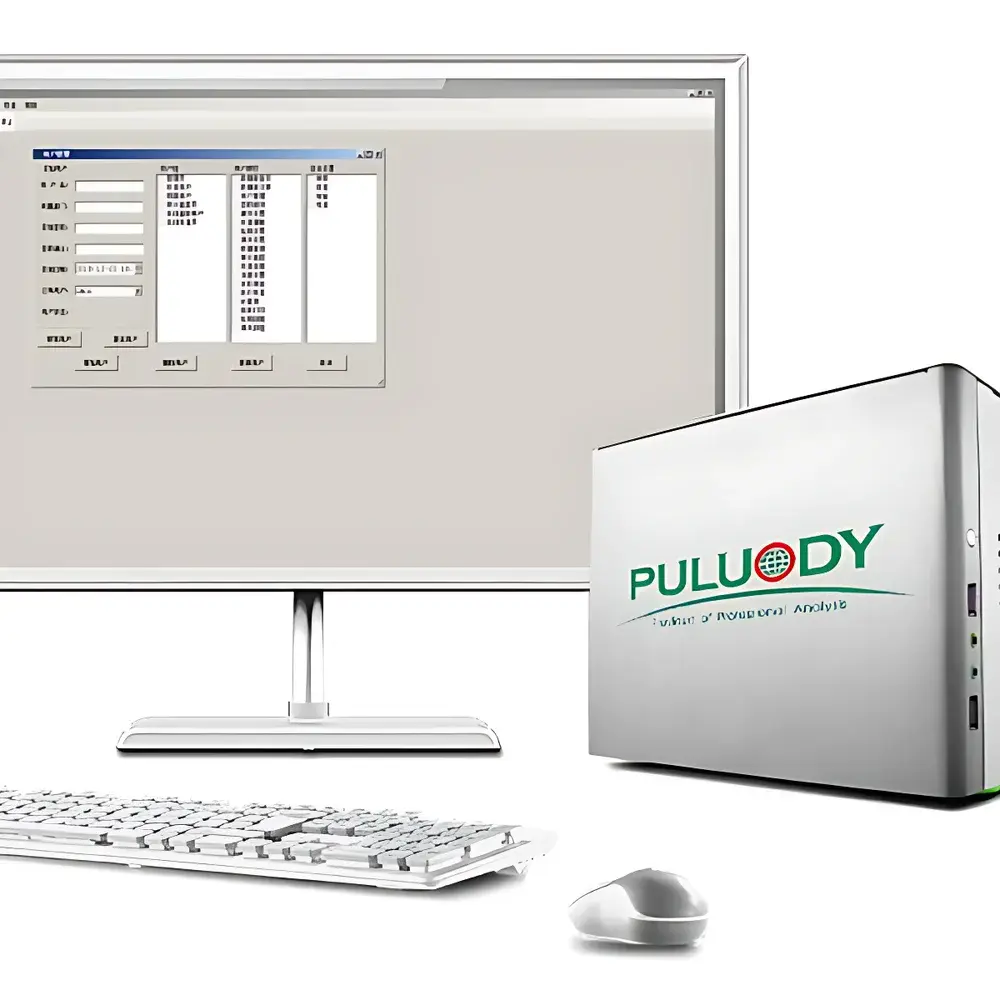
PULUODY PMT-2DRD Capacitive Liquid Particle Counter
| Brand | PULUODY |
|---|---|
| Model | PMT-2DRD |
| Detection Principle | Capacitive Sensing with Dual-Laser Narrow-Beam Optical Verification |
| Detection Range | 0.5–20.0 µm (standard) |
| Accuracy | ±3% typical |
| Sampling Precision | <±1% |
| Coincidence Limit | ≤2.5% error at 1000 particles/mL |
| Repeatability | 5% |
| Power Input | 100–265 VAC, 50–60 Hz |
| Output Interface | 4–20 mA analog signal with configurable particle concentration alarm |
| Compliance Standards | JJG 1061, ISO 21501-4, USP <788> & <789>, ASTM F3232 |
| Software Platform | PULUODY V8.3 Integrated Analysis Suite (PC & tablet-compatible) |
| Display & Control | Color LCD touchscreen + optional wireless keyboard/mouse |
| Sample Delivery | Precision metering piston pump with electromagnetic flow regulation |
| Data Output | Particle count per mL and ISO 4406 / NAS 1638 contamination code reporting |
Overview
The PULUODY PMT-2DRD Capacitive Liquid Particle Counter is an advanced, dual-principle instrumentation platform engineered for high-fidelity particulate contamination monitoring in ultra-clean liquid process streams. It integrates capacitive sensing — a non-optical, dielectric-based detection method highly resistant to optical interference from colored, turbid, or fluorescent fluids — with synchronized verification via eighth-generation dual-laser narrow-beam optical scattering. This hybrid architecture enables robust, interference-free quantification of insoluble particulates in chemically aggressive media where conventional light-obscuration or laser diffraction systems exhibit drift or false counts. Designed specifically for semiconductor front-end fabrication, flat-panel display manufacturing, pharmaceutical water-for-injection (WFI) distribution, and microelectronics cleaning validation, the PMT-2DRD delivers trace-level sensitivity (down to 0.1 µm(c)) while maintaining metrological traceability to national standards (JJG 1061) and international reference protocols (ISO 21501-4). Its architecture supports both online continuous monitoring and offline portable analysis, making it suitable for GMP-compliant cleanroom utilities, inline chemical delivery systems (CDS), and laboratory-grade QC/QA workflows.
Key Features
- Capacitive sensing core with real-time dual-laser optical cross-validation to eliminate false positives from bubbles, dissolved organics, or refractive index fluctuations
- Eighth-generation dual-laser narrow-beam optical module optimized for sub-micron resolution and low-noise signal-to-background ratio
- Precision metering piston pump combined with electromagnetic flow control ensures volumetric accuracy better than ±1% across variable viscosity ranges (0.5–50 cP)
- Configurable detection thresholds: standard 0.5–20.0 µm; extended modes support user-defined bins from 1–100 µm or 4–70 µm(c), including critical 0.1 µm(c) capability for nanoscale defect tracking
- Integrated 4–20 mA analog output with programmable alarm thresholds for integration into DCS/SCADA systems and automated process shutdown protocols
- V8.3 software suite compliant with FDA 21 CFR Part 11 requirements, featuring full audit trail, electronic signature support, and role-based access control
Sample Compatibility & Compliance
The PMT-2DRD is validated for use with aggressive solvents (e.g., NMP, DMSO, acetone, IPA), aqueous etchants (SC1, SC2, BOE), ultrapure water (UPW, ≥18.2 MΩ·cm), polymer solutions (photoresist carriers), and low-conductivity organic liquids. Its capacitive transducer design avoids electrode corrosion and polarization effects common in conductivity-based counters. The system meets ISO 21501-4 for calibration traceability using NIST-traceable latex sphere standards or certified reference materials. For pharmaceutical applications, it supports USP and particulate matter testing requirements when operated under validated SOPs. All firmware and software revisions are documented per GLP/GMP change control procedures, and hardware calibration records are maintained in accordance with JJG 1061 metrological verification guidelines.
Software & Data Management
PULUODY V8.3 is a modular, multi-platform application supporting Windows PC, iOS iPad, and browser-based remote access. It separates analytical measurement logic from calibration management — preventing software-induced bias during routine verification. Features include dynamic binning configuration, real-time trend plotting with statistical process control (SPC) overlays (X-bar/R charts), automated report generation in PDF/CSV/XML formats, and direct export to LIMS via ODBC or RESTful API. Audit trails log all user actions, parameter changes, calibration events, and data exports with timestamps and operator IDs. The system supports 21 CFR Part 11 compliance through digital signature enforcement, encrypted database storage, and immutable record retention policies.
Applications
- Semiconductor wafer cleaning lines: real-time monitoring of megasonic bath effluent and rinse water for residual slurry or metal oxide particles
- Flat-panel display (FPD) manufacturing: detection of abrasive residues in ITO etchant recirculation loops and photo-mask cleaning stations
- Pharmaceutical purified water systems: continuous UPW loop surveillance meeting EU Annex 1 and WHO TRS 970 requirements
- Microfiltration/nanofiltration validation: challenge testing of membrane integrity using polystyrene latex standards
- Electronics assembly: cleanliness verification of flux removers, conformal coating solvents, and solder paste carriers
- Research & development labs: quantitative characterization of nanoparticle dispersions, colloidal stability studies, and formulation degradation kinetics
FAQ
Does the PMT-2DRD require periodic recalibration with reference standards?
Yes — annual calibration against NIST-traceable latex spheres or ISO 21501-4 certified reference materials is recommended. Field verification using primary standards (e.g., 5.0 µm and 10.0 µm spheres) should be performed before each critical batch run.
Can the instrument operate continuously in hazardous area environments?
The base unit is rated for Class I, Division 2 (CID2) environments when installed with appropriate conduit seals and grounding. Explosion-proof enclosures and intrinsically safe flow modules are available as OEM options.
Is raw data export supported for third-party statistical analysis?
Yes — time-stamped particle count histograms, cumulative distributions, and metadata (flow rate, temperature, pressure) are exportable in CSV and HDF5 formats compatible with MATLAB, Python (pandas), and JMP.
How does the system handle air bubbles or microfoam in sample streams?
Capacitive sensing is inherently insensitive to gas-phase inclusions. Dual-laser verification further discriminates bubble-induced scatter signals via pulse width analysis and refractive index correlation algorithms.
What maintenance intervals are specified for the precision metering pump?
Piston seals and check valves require replacement every 12 months or after 5,000 operational hours, whichever occurs first. Full pump performance verification is included in the biannual preventive maintenance service package.







