

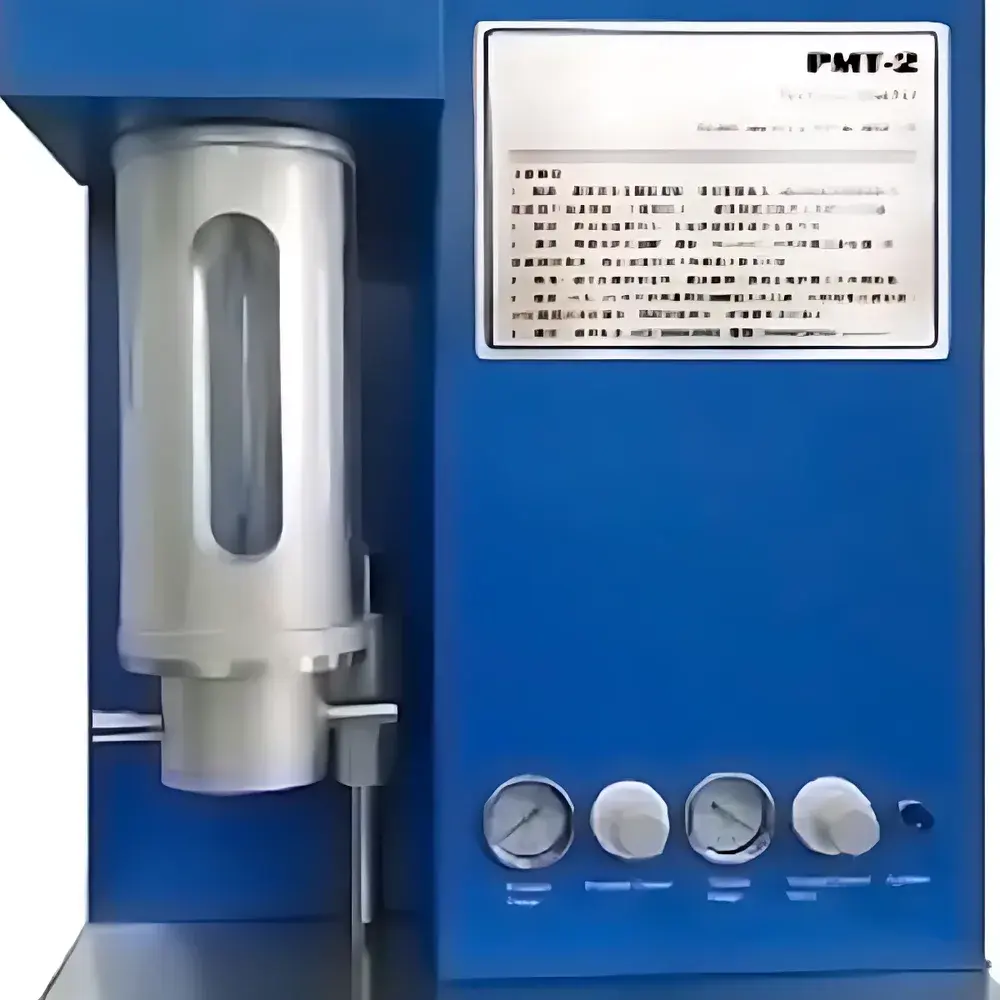
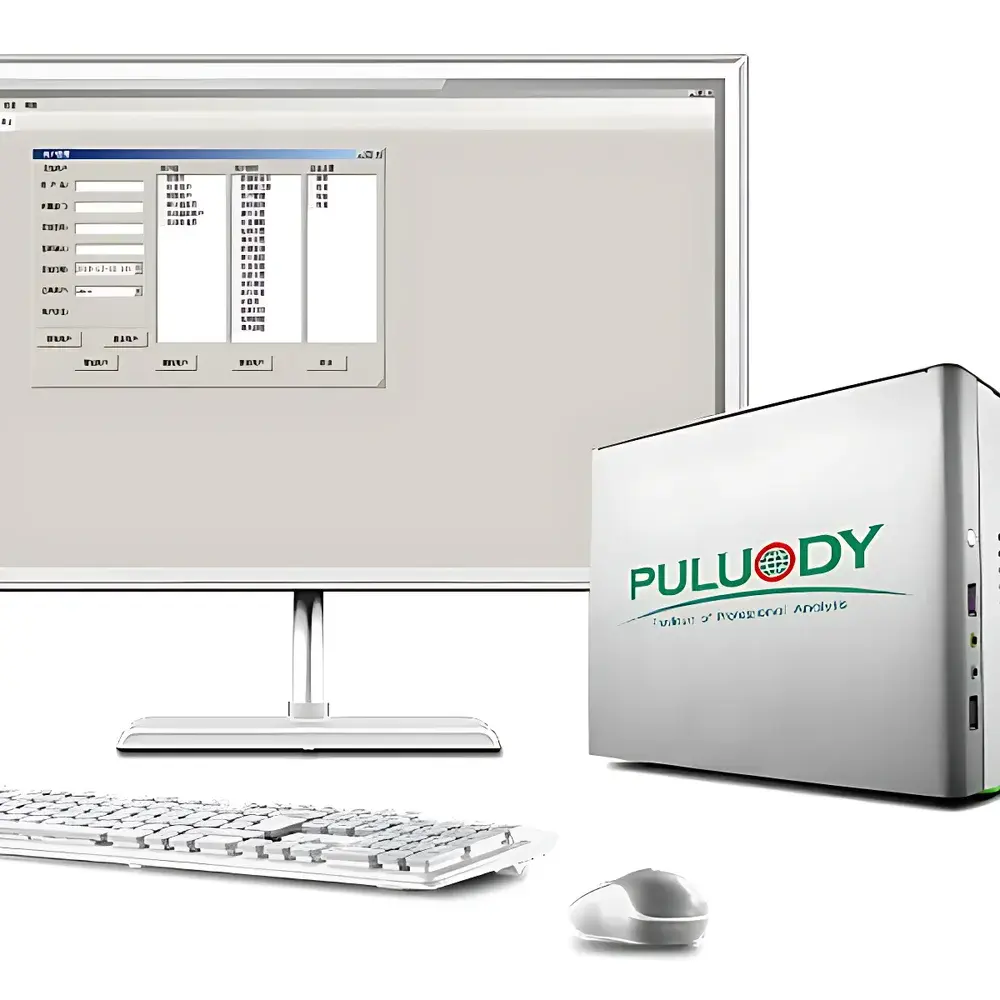
PULUODY PMT-2G Online Photoresist Liquid Particle Counter
| Brand | PULUODY |
|---|---|
| Model | PMT-2G |
| Detection Principle | Dual-Laser Narrow-Beam Light Scattering |
| Measurement Range | 0.1–0.5 µm (standard) |
| Resolution | 0.1 µm(c) minimum detectable size |
| Sampling Accuracy | <±1% |
| Counting Accuracy | ±3% typical |
| Coincidence Limit | ≤2.5% at 1000 particles/mL |
| Output | 4–20 mA analog signal with configurable particle concentration alarm |
| Calibration Standards | JJG 1061, ISO 21501-4, NIST-traceable latex spheres |
| Software | V8.3 Integrated Analysis & Calibration Suite (PC + touchscreen UI) |
| Power Input | 100–265 VAC, 50–60 Hz |
| Compliance | Supports GLP/GMP audit trails, ASTM F3290 (for semiconductor process liquids), USP <788> & <789> (for insoluble particle assessment in polymer solutions) |
Overview
The PULUODY PMT-2G Online Photoresist Liquid Particle Counter is an industrial-grade, real-time particulate monitoring system engineered for ultra-high-purity liquid environments in semiconductor fabrication, photolithography process control, and advanced electronics manufacturing. It employs dual-laser narrow-beam light scattering detection—a principle grounded in Mie theory—to quantify sub-micron insoluble particles in low-conductivity, low-viscosity organic solvents such as photoresist formulations, developer solutions, rinse agents, and ultrapure water (UPW). Unlike conventional single-wavelength counters, the eighth-generation dual-laser architecture enables simultaneous differential scattering analysis across two optimized wavelengths, significantly enhancing sensitivity to refractive index variations and reducing false counts from dissolved organics or bubble artifacts. The instrument operates continuously in-line via pressure-regulated flow path integration, delivering time-synchronized particle concentration data (particles/mL) and ISO 14644-1 or NAS 1638-compliant contamination grading—critical for maintaining Class 1–10 cleanroom fluid integrity.
Key Features
- Dual-laser narrow-beam optical sensor with temperature-stabilized diode lasers (650 nm + 405 nm) for enhanced discrimination of polymeric agglomerates and metallic contaminants in photoresist matrices
- Precision metering piston pump combined with electromagnetic flow control ensures volumetric sampling repeatability better than ±1%, eliminating pulsation-induced counting variance
- Configurable detection thresholds: standard 0.1–0.5 µm resolution; optional extended ranges (1–100 µm or 4–70 µm(c)) support both semiconductor slurry qualification and post-filtration validation
- Integrated 7-inch capacitive touchscreen HMI with V8.3 firmware—enabling on-device calibration verification, SOP-driven measurement sequences, and real-time histogram visualization
- 4–20 mA analog output with programmable alarm thresholds for PLC-integrated process shutdown or filtration system actuation upon exceedance events
- Modular wetted path constructed from electropolished 316L stainless steel and PFA-lined flow cells, compliant with SEMI F57 chemical compatibility standards for acidic/organic solvent exposure
Sample Compatibility & Compliance
The PMT-2G is validated for use with non-aqueous photoresist solvents (e.g., PGMEA, ethyl lactate), aqueous alkaline developers (TMAH-based), deionized rinse water (≥18.2 MΩ·cm), and polymer solutions including polyimide precursors. Its optical design mitigates fluorescence interference common in aromatic solvent systems. Regulatory alignment includes full traceability to ISO 21501-4:2018 for light extinction and scattering particle counters, JJG 1061–2010 national metrological verification, and method suitability per ASTM F3290–22 for semiconductor process liquid cleanliness verification. Data integrity conforms to FDA 21 CFR Part 11 requirements through electronic signature-enabled audit logs, user role-based access control, and immutable timestamped result storage.
Software & Data Management
The V8.3 software platform provides dual-mode operation: embedded touchscreen interface for local calibration and diagnostics, and PC-hosted analytical suite for advanced statistical trending (CUSUM, Shewhart SPC), batch comparison, and automated report generation (PDF/CSV/XLSX). All calibration events—including reference sphere injection, background subtraction, and flow rate verification—are digitally recorded with operator ID, timestamp, and deviation metrics. Raw pulse data is retained for retrospective re-analysis, supporting root cause investigation during yield excursions. Optional OPC UA connectivity enables seamless integration into MES/SCADA infrastructure for centralized dashboarding across fab-wide fluid monitoring nodes.
Applications
- Real-time photoresist dispensing line monitoring to detect nozzle clogging precursors or filter breakthrough events
- In-process verification of megasonic bath cleanliness during wafer cleaning cycles
- Post-filtration validation of 10 nm-rated membrane filters used in resist recirculation loops
- Insoluble particle quantification in polymer precursor solutions per USP for medical device coating applications
- Trend analysis of particle shedding from wafer carriers, chucks, and robotic end-effectors in track systems
- Qualification of reclaimed photoresist streams prior to re-blending—ensuring no cross-contamination between lithography layers
FAQ
Does the PMT-2G require periodic recalibration when deployed in-line with photoresist supply lines?
Yes—calibration verification must be performed at least once per shift using NIST-traceable 0.3 µm and 0.5 µm latex standards, as specified in the instrument’s IQ/OQ protocol. Automatic zero-check routines are executed before each sample cycle.
Can the system differentiate between silica abrasives and photoresist residue particles?
While morphological classification is not supported, the dual-wavelength scattering ratio provides empirical refractive index estimation—enabling semi-quantitative separation of high-R.I. inorganic particles (e.g., SiO₂, Al₂O₃) from low-R.I. organic aggregates in multivariate analysis mode.
Is the wetted path compatible with 2.38% TMAH developer solutions?
Yes—the PFA-lined flow cell and 316L stainless steel manifold meet SEMI C11 chemical resistance requirements for concentrated TMAH up to 80°C, with validated corrosion rates <0.1 mpy.
How is data integrity maintained during network outages in a fab environment?
Local SD card logging continues uninterrupted, storing all raw counts, timestamps, and alarm states. Upon network recovery, queued data synchronizes automatically with timestamp preservation and hash-verified integrity checks.
Does the system support remote firmware updates via secure TLS 1.2?
Yes—updates are delivered through authenticated HTTPS endpoints with SHA-256 signature validation and rollback capability to previous stable versions.





