
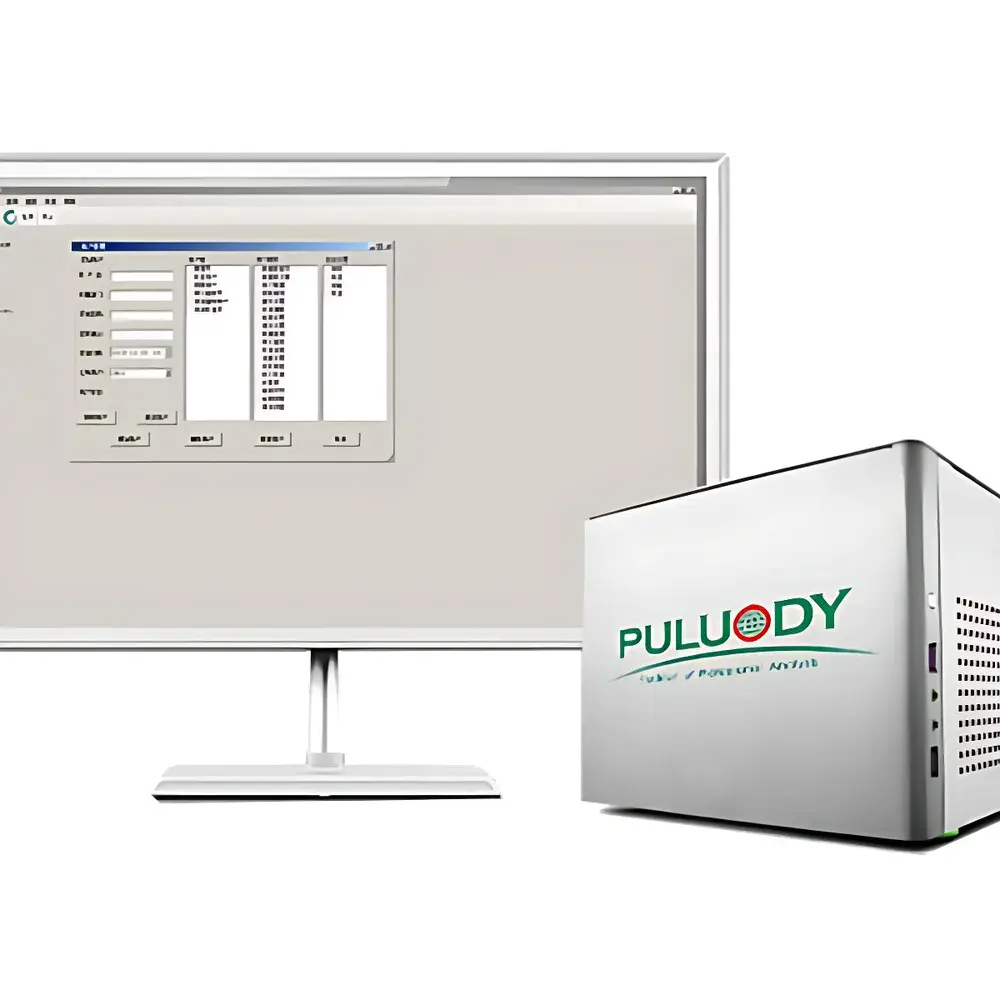
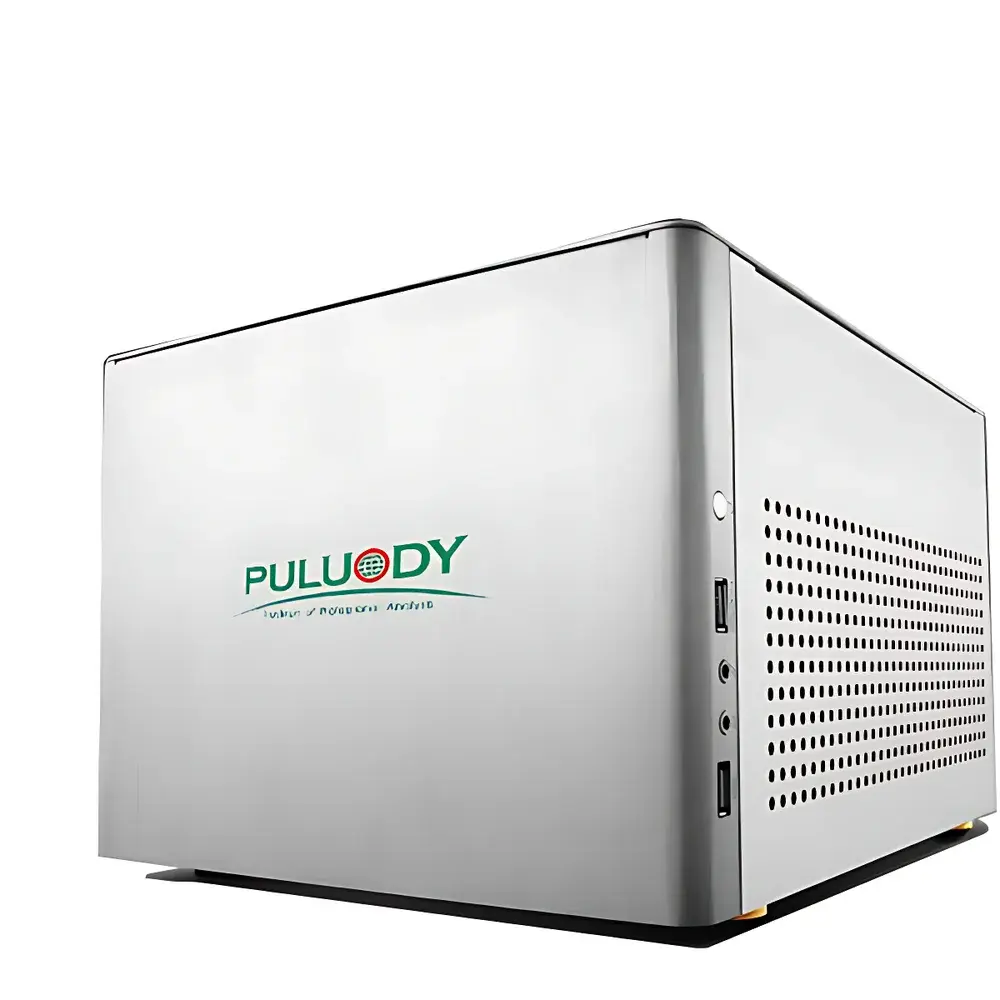
PULUODY PMT-2GT Solid-State Capacitor Dispersion Particle Counter
| Brand | PULUODY |
|---|---|
| Model | PMT-2GT |
| Detection Principle | Dual-Laser Narrow-Beam Light Scattering |
| Detection Range | 0.5–20.0 µm (standard), customizable to 1–100 µm or 4–70 µm(c) |
| Resolution | 0.1 µm(c) minimum detectable threshold |
| Sampling Accuracy | <±1% |
| Measurement Accuracy | <±3% (typical) |
| Coincidence Limit | ≤2.5% at 1000 particles/mL |
| Output | 4–20 mA analog signal with configurable alarm triggers |
| Calibration Standards | JJG 1061, ISO 21501-2, NIST-traceable latex sphere reference materials |
| Software | V8.3 Integrated Analysis & Calibration Software (PC + touchscreen GUI) |
| Power Input | 100–265 VAC, 50–60 Hz |
| Compliance | Designed for GLP/GMP environments |
Overview
The PULUODY PMT-2GT Solid-State Capacitor Dispersion Particle Counter is a high-precision optical particle counter engineered for quantitative analysis of insoluble particulate contamination in ultra-clean liquid media used in advanced electronics manufacturing and energy storage R&D. It operates on the principle of dual-laser narrow-beam light scattering—where two spatially offset laser sources illuminate the sample flow path simultaneously—to enhance signal-to-noise ratio and suppress false counts caused by refractive index mismatch, bubble interference, or transient flow anomalies. This eighth-generation sensor architecture enables robust discrimination of sub-micron particles in low-conductivity, low-viscosity dispersions such as capacitor electrolyte suspensions, semiconductor cleaning solvents, and ultrapure water (UPW) streams. Unlike conventional single-beam instruments, the PMT-2GT’s dual-wavelength detection scheme improves sizing linearity across the 0.5–20.0 µm range and supports user-defined thresholds (e.g., 4–70 µm(c)) aligned with industry-specific cleanliness standards including SEMI F57, IEST-STD-CC1246D, and ISO 14644-9.
Key Features
- Dual-laser narrow-beam optical sensor with independent photodetector channels for cross-validated counting and sizing
- Precision metering piston pump coupled with electromagnetic flow control for stable volumetric sampling (<±1% accuracy)
- Integrated touchscreen HMI (color LCD) with optional wireless keyboard/mouse support for offline operation
- V8.3 analytical software suite featuring separation of calibration routines from routine testing workflows to prevent data integrity compromise
- Configurable analog output (4–20 mA) with programmable alarm thresholds for integration into SCADA or MES systems
- Modular design supporting both online bypass-loop installation and portable offline measurement modes
- Compliance-ready architecture: supports electronic signatures, audit trails, and user access levels per FDA 21 CFR Part 11 when operated under validated software protocols
Sample Compatibility & Compliance
The PMT-2GT is validated for use with non-aqueous and aqueous dispersions exhibiting conductivity below 1 µS/cm and viscosity up to 5 cP—including lithium-ion capacitor electrolytes, photoresist developers, CMP slurries, UPW, deionized rinse solutions, and polymer-based nanofluids. Its fluidic pathway employs chemically inert sapphire flow cells and PFA tubing to minimize adsorption or leaching artifacts. Instrument qualification follows ISO 21501-2 Annex B for optical particle counters and aligns with calibration traceability requirements defined in JJG 1061 (Chinese National Metrological Verification Regulation). For regulated environments, system validation documentation—including IQ/OQ/PQ templates—is available upon request to support GMP, GLP, or ISO/IEC 17025 accreditation.
Software & Data Management
The V8.3 software platform provides dual-mode operation: a standalone PC version for laboratory data review and a real-time embedded GUI for field deployment. All calibration events—including reference standard assignments, gain adjustments, and threshold validations—are timestamped and logged with operator ID. Raw pulse data is retained alongside processed results, enabling retrospective reanalysis without loss of resolution. Reports export in PDF, CSV, and XML formats compliant with LIMS ingestion protocols. Optional add-ons include automated report generation per ISO 4406 or NAS 1638 contamination codes, trend analysis dashboards with SPC charting (X-bar/R), and secure cloud synchronization via TLS 1.2–encrypted API endpoints.
Applications
- In-line monitoring of capacitor electrode slurry homogeneity during coating process development
- Final rinse verification for silicon wafers and flat-panel display substrates prior to thin-film deposition
- Quality release testing of ultrapure water distribution loops in semiconductor fabs
- Stability assessment of nanoscale conductive dispersions used in flexible electronics ink formulation
- Contamination forensics in failure analysis labs investigating microshorts or dielectric breakdown in solid-state capacitors
- Validation of membrane filtration efficiency in nano- and micro-filtration systems serving pharmaceutical or battery-grade solvent purification lines
FAQ
What particle size standards are supported for calibration?
The PMT-2GT supports calibration using NIST-traceable polystyrene latex (PSL) spheres per ISO 21501-2, as well as compliance with JJG 1061 verification procedures for Chinese metrological traceability.
Can the instrument be integrated into an existing factory automation network?
Yes—via its isolated 4–20 mA analog output with configurable alarm logic, plus optional Modbus TCP or OPC UA interface modules for direct PLC or DCS connectivity.
Is offline portable operation possible without a PC?
Yes—the built-in color touchscreen enables full measurement control, real-time histogram viewing, and on-device report generation without external computing hardware.
Does the system meet regulatory requirements for electronic records?
When deployed with validated V8.3 software configuration and appropriate administrative controls, it satisfies data integrity expectations outlined in FDA 21 CFR Part 11, EU Annex 11, and WHO TRS 996.
What maintenance intervals are recommended for long-term reliability?
Optical alignment verification every 6 months; flow cell cleaning after every 500 mL cumulative sample volume; annual sensor sensitivity recalibration recommended for critical applications.



